
Production engineers, supervisors, operators, QA/QC personnel, maintenance teams, safety personnel, procurement staff and technical sales personnel
Practical selection and use of non-woven abrasive products for cleaning, blending, light oxide removal, satin finishing and surface preparation on industrial metalwork.
Core principle — A non-woven abrasive is a finishing system, not merely a colour or a “grit.” Its behaviour comes from the web, abrasive mineral, grade, density, bond, product form, backing, contact support and operating method working together.
Chapter objectives
After this chapter, the reader should be able to:
- identify the main elements of non-woven abrasive construction;
- distinguish abrasive grade from web or wheel density;
- select conformability and support for the workpiece geometry;
- choose an appropriate product family for cleaning, blending, oxide removal, satin finishing or coating preparation;
- recognise loading, smearing, glazing, over-finishing and geometry loss;
- control a repeatable hand-held or machine-finishing sequence; and
- apply concise safety and compatibility checks before use.
How non-woven abrasives work
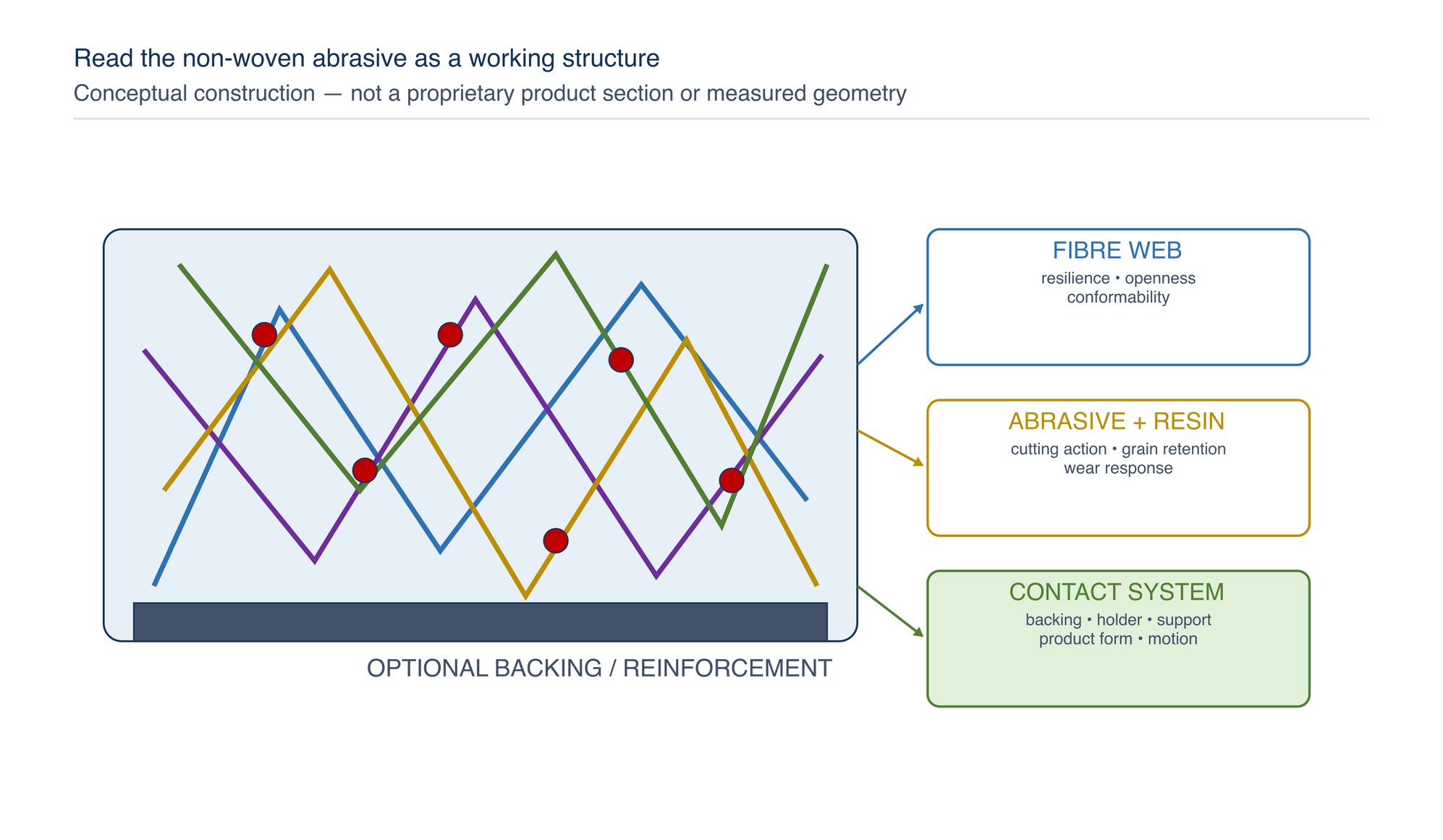
Non-woven abrasive products commonly use a three-dimensional network of synthetic fibres carrying abrasive mineral in a resin system. The spaces in the web allow removed material to escape, while the resilient fibres follow surface features and expose new abrasive as the product wears. The result can be a controlled combination of cut, blending and surface conformity. [S060; S129–S132]
The construction varies widely. A flexible hand pad, a scrim-backed surface-conditioning disc, a flap wheel, a dense unitized wheel and a coarse clean-and-strip product may all be described as non-woven, yet they differ greatly in aggressiveness, support, edge behaviour and intended machine.
Read the complete construction
Treat the product marking and technical information as a system:
| Construction element | What it influences | Practical selection question |
|---|---|---|
| Fibre and web structure | Openness, resilience, conformability, debris clearance and wear behaviour | Must the product follow a contour, reach a recess or hold a defined face? |
| Abrasive mineral | Cutting character, fracture behaviour and finish response | Is the mineral suitable for the substrate and required finish? |
| Abrasive grade | Relative cutting and finishing level within that product family | Is the task cleaning, blending, refinement or final satin finishing? |
| Density or compression | Support, durability, edge retention, cut and conformity | Does the job need a soft following action or a firmer, more defined contact? |
| Resin and treatment | Grain retention, resilience and wet/dry suitability | Is the product intended for the chosen coolant, cleaner or dry process? |
| Backing or reinforcement | Strength, stretch, attachment and contact control | Does the backing match the machine, holder and geometry? |
| Product form | Access, contact footprint, edge action and permissible mounting | Is a pad, roll, disc, belt, flap wheel, unitized wheel or stripping product appropriate? |
A familiar colour is not a reliable universal specification. Colours, grade names, density numbers and shorthand codes can differ between manufacturers and product families. Likewise, a non-woven grade should not be assumed to equal a coated-abrasive P-grade or a bonded-wheel grit. Use the actual product designation and its technical information when matching a process.
Grade and density are separate controls
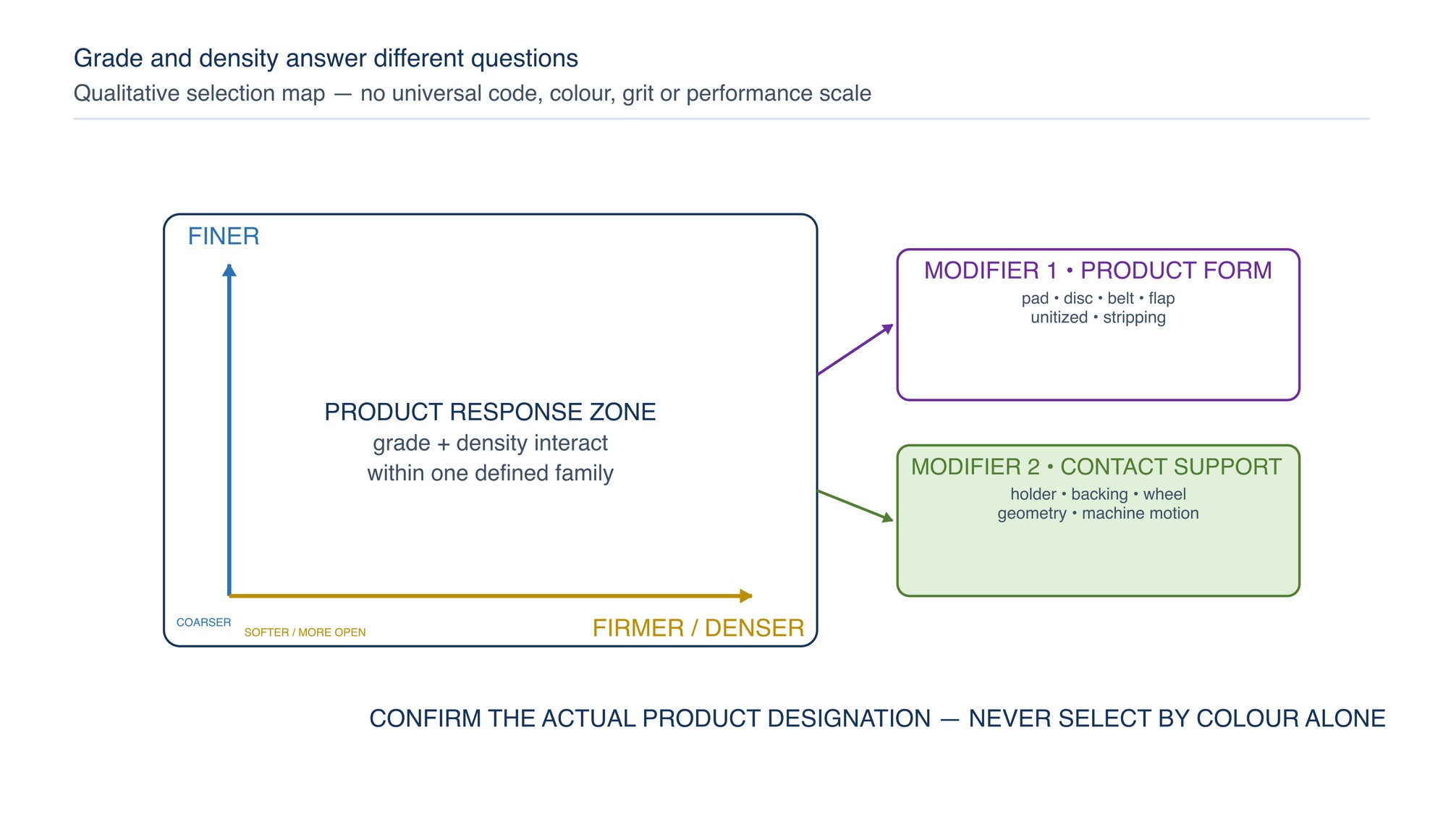
Abrasive grade describes the relative cutting or finishing level within a defined product range. Density describes how compact, supported or firm the non-woven structure is. They interact, but they are not interchangeable.
As a general selection tendency:
- a more open or softer construction usually follows contours more readily and produces a broader, more forgiving contact;
- a firmer or denser construction usually holds shape and edges more strongly and can deliver a more defined action;
- a coarser grade generally cuts or blends more aggressively within the same family; and
- a finer grade generally refines the scratch and appearance within the same family.
These are tendencies, not cross-brand conversions. Mineral, fibre size, resin, compression, backing, speed, pressure and wear state can change the result. [S129–S132]
| Need | Starting selection tendency | Check on the workpiece | Typical error to avoid |
|---|---|---|---|
| Follow a radius or irregular profile | More conformable construction with suitable support | Contact reaches the intended zone without thinning edges | Choosing a firm product that bridges low areas |
| Hold a straight edge or narrow face | Firmer, shape-holding construction | Edge remains controlled without digging or rounding over a critical edge | Using an unsupported soft web |
| Remove light oxidation or blend a transition | Grade and family with sufficient cut but controlled base-metal action | Contaminant is removed without deep isolated scratches | Increasing pressure on a product that is too fine or loaded |
| Produce a uniform satin appearance | Finishing grade and motion matched to the required lay | Direction, sheen and line character match the reference | Selecting by colour alone |
| Prepare for a subsequent coating or bonding step | Product specifically suitable for the substrate and preparation objective or condition | Surface is clean, dry and meets the separately specified profile or condition | Treating visual dullness as proof of readiness |
Select the correct non-woven product family
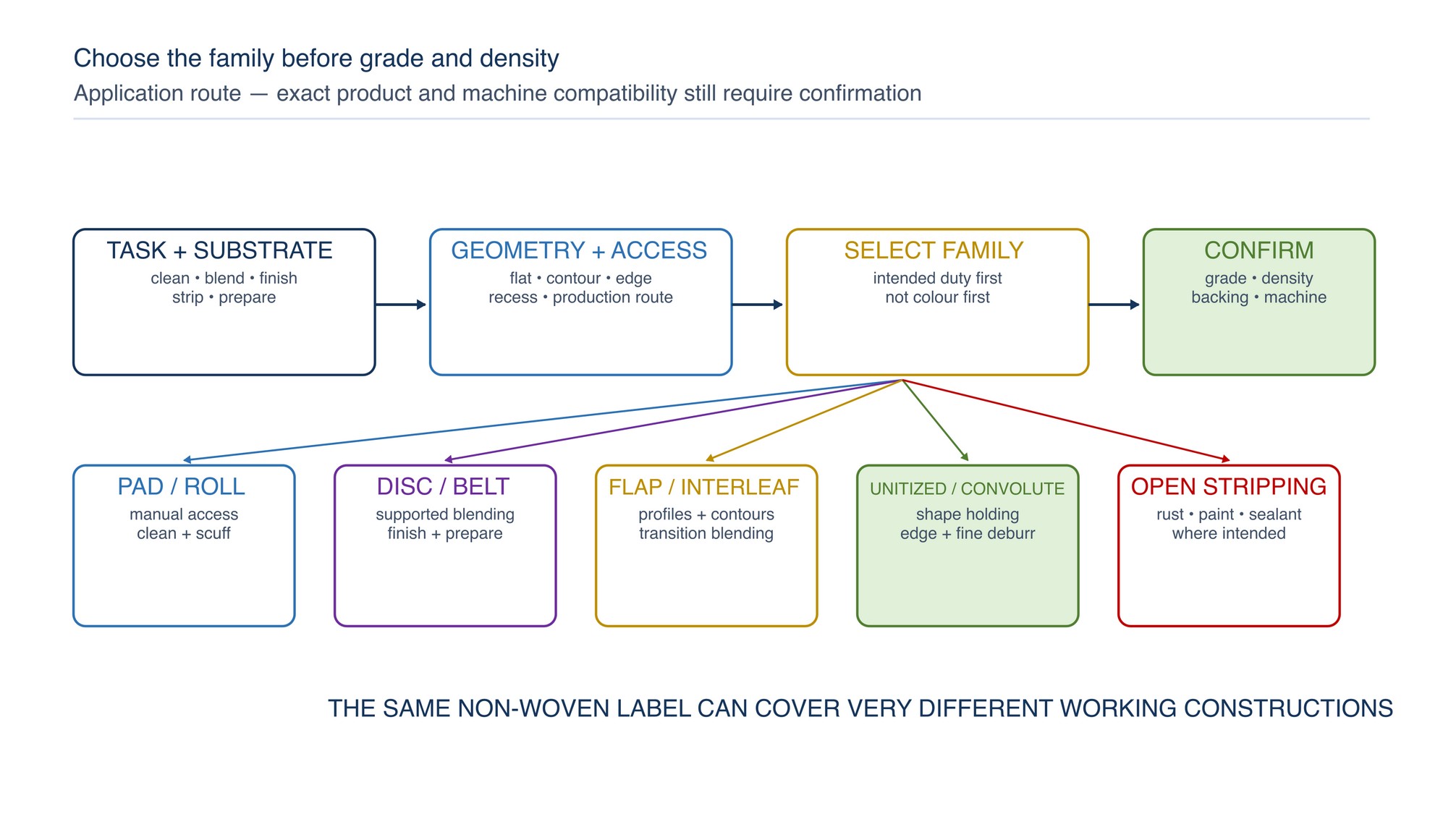
Non-woven families are not interchangeable merely because they share a fibre-web construction.
| Product family | Typical strengths | Main controls | Do not assume |
|---|---|---|---|
| Hand pad or roll | Manual cleaning, scuffing, light blending and access to complex forms | Hand support, stroke direction, cleanliness and even coverage | The colour defines one universal grade |
| Surface-conditioning disc or belt | Controlled blending, deburring, finishing and surface preparation | Backing, attachment, contact support, machine motion and wear duty | Every disc or belt has the same reinforcement or permissible use |
| Flap or interleaf wheel | Contour following, tube/profile finishing and blending | Flap construction, exposure, rotation direction and access | It behaves like either all-coated or all-non-woven material |
| Unitized or convolute wheel | Shape-holding finishing, light deburring, edge work and controlled contact | Density, wheel construction, dressing, guarding and machine compatibility | It is a flexible hand pad in wheel form |
| Open stripping or clean-and-strip product | Removal of rust, paint, sealant or adherent contamination where the product is intended for it | Substrate protection, debris, heat, edge action and dust control | A general finishing web can perform heavy stripping, or that all stripping products preserve every substrate |
Non-woven abrasive families include open stripping products, surface-preparation products and denser wheel constructions. Surface-conditioning products may also be supplied as pads, discs, belts and other forms with different support and use cases. Select the intended product family first, then the required grade and density within that family. [S060; S129–S132]
Conformability must preserve geometry
Conformability helps the abrasive follow radii, moulded features, weld transitions and irregular surfaces. It can also widen the contact footprint, wrap over an edge or reach an adjacent face. A highly conformable product is therefore not automatically safest for every geometry.
Use a contact method that supports the intended surface:
- use a suitable holder or backing pad where the product requires one;
- keep the contact footprint on the controlled zone;
- approach edges and corners deliberately rather than allowing the web to wrap uncontrolled;
- use lighter, progressive contact around thin sheet and heat-sensitive areas;
- inspect dimensional and edge-critical features separately from visual finish; and
- stop when the product no longer holds the required shape or contact pattern.
Cleaning is not the same as abrasive finishing
Non-woven products can remove loose contamination, light deposits and surface films when the selected family is intended for that task. Abrasive action does not replace appropriate degreasing or chemical cleaning. Oils, salts, polishing compounds, adhesive residue and process chemicals may be spread, embedded or concealed if the surface is simply abraded.
Use a controlled sequence:
- identify the contaminant and substrate;
- remove gross soil using a compatible cleaning method;
- use a clean, dedicated abrasive where contamination transfer matters;
- abrade in the required direction with even coverage;
- remove residue using the specified cleaning method; and
- inspect the clean, dry surface before the next operation.
For stainless steel, avoid tools that have been used on carbon steel and work with the existing grain where appearance matters. BSSA guidance supports dedicated cleaning tools and alignment with the surface grain. [S125–S126]
Blending welds, scratches and surface transitions
Surface conditioning is effective when the heavy defect or weld profile has already been reduced to a level the selected web can refine. A finishing web should not be forced to perform stock removal beyond its intended duty.
For a controlled blend:
- define the remaining defect, required geometry and final lay;
- remove deep damage through an appropriate preceding abrasive stage;
- select a non-woven family with enough cut to remove the previous scratch pattern;
- blend over a planned transition rather than polishing one small spot;
- keep direction, overlap, pressure and abrasive wear consistent;
- clean and inspect under broad and low-angle light; and
- finish to the accepted visual reference or specified functional condition.
If the previous scratch remains visible, adding pressure or dwell can burnish the surrounding peaks without removing the deeper line. Return to the last stage capable of removing the defect efficiently.
Oxide, rust and scale removal
Match the product family to the oxide and substrate. Light surface oxidation may respond to a surface-conditioning product; heavier rust, scale, heat oxide, paint or sealant may require a purpose-designed open stripping product or another approved method. Do not confuse an open finishing web with an aggressive stripping construction.
Control oxide removal by:
- identifying whether the layer is loose, adherent, local or widespread;
- checking the base metal, coating, plating, edge and dimensional sensitivity;
- using the least aggressive effective route;
- keeping the tool moving to limit local heat and grooving;
- inspecting for residual oxide in pits, corners and weld features;
- removing abrasive and contaminant residue; and
- completing any required stainless-steel cleaning, pickling, passivation or coating-preparation step separately.
Mechanical removal can change appearance without proving that a corrosion-sensitive surface is chemically clean or fully restored. The subsequent specification controls any chemical treatment and acceptance requirement. [S001; S125]
Producing a satin finish
A satin finish depends on the combined scratch character, lay, sheen and uniformity. It cannot be specified reliably by pad colour or non-woven grade alone.
Establish:
- the intended direction of lay;
- an approved reference or clearly stated appearance;
- the starting surface and preceding scratch stage;
- the product family, grade, density, backing and wear condition;
- the machine or hand motion and contact support;
- the pass sequence and transition boundary; and
- the inspection lighting and viewing conditions.
Complete the visible face in one planned progression. Avoid isolated reworking, repeated dwell or mixing new and heavily worn products across one panel. Where adjacent parts must match, prepare them with the same controlled process and compare them in their assembled orientation. Chapter 025 gives detailed guidance on directional and brushed finishes.
Surface preparation for painting, coating or bonding
Non-woven abrasion can help clean, scuff or refine a surface, but visual dullness alone does not prove coating readiness. Coating and bonding systems may separately require removal of oil, salts, corrosion products, weak existing coatings, dust and moisture, together with a specified surface profile or chemical treatment.
Before releasing a prepared surface, confirm:
- substrate and existing coating compatibility;
- the preparation method required by the coating or adhesive supplier;
- cleanliness after abrasive work;
- complete removal of loose or weakly bonded material;
- profile or texture where it is specified;
- absence of embedded residue or cross-contamination;
- permitted time between preparation and application; and
- environmental conditions required by the next process.
Chapter 027 addresses coating-preparation requirements in detail. The non-woven selection must remain subordinate to the coating, adhesive or customer specification.
Loading resistance is a process advantage, not immunity
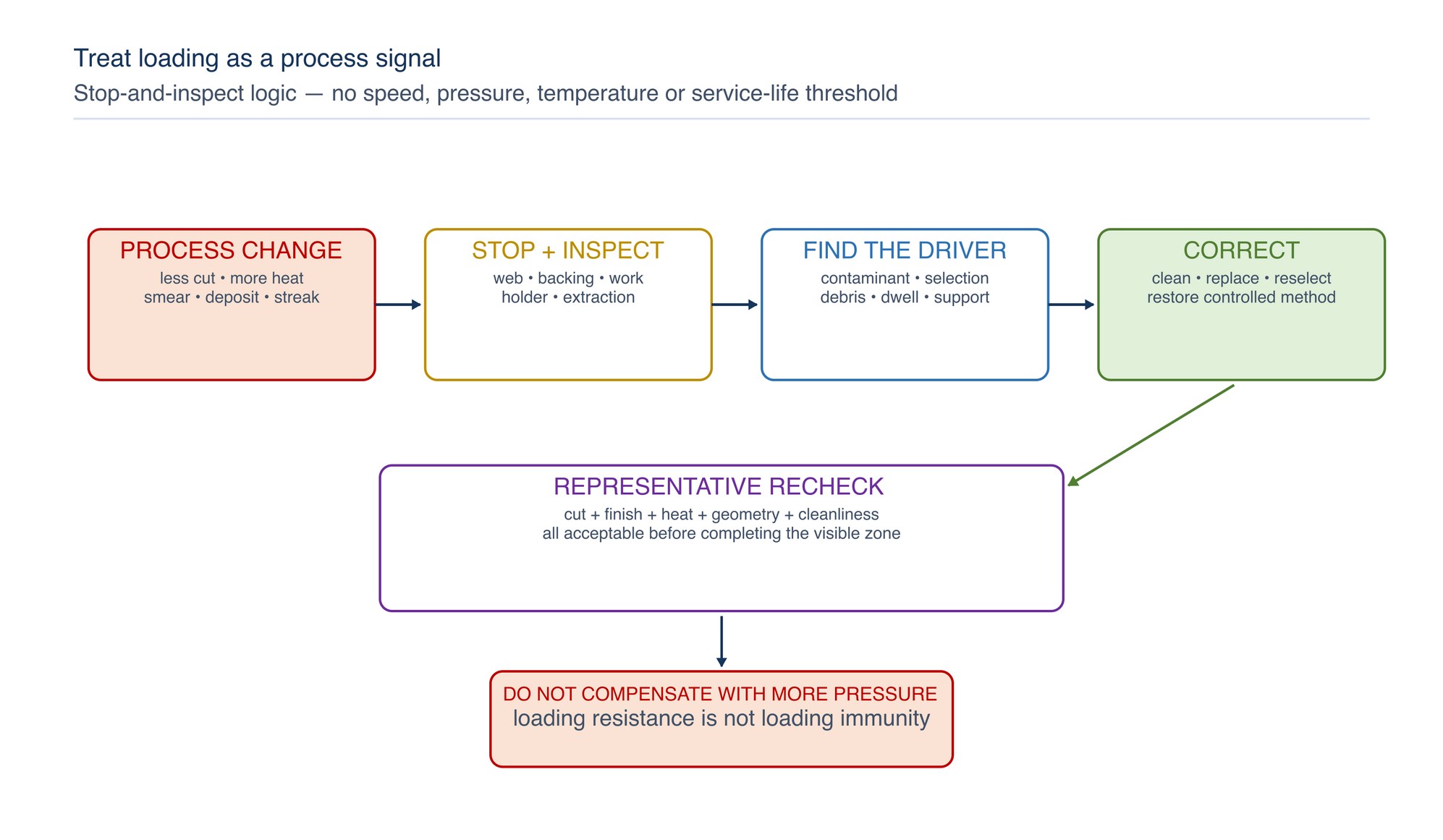
The open web provides spaces through which swarf and debris can escape, so many non-woven products resist loading better than a closed abrasive surface in comparable finishing work. Loading can still occur when the contaminant is soft or adhesive, the product is too fine or too dense for the task, pressure and heat are excessive, extraction is poor, or the web becomes packed with residue. [S060; S129–S132]
Signs include streaking, smearing, increasing heat, reduced cut, a changed contact sound, deposits on the workpiece and a glazed or packed web. Stop and inspect rather than compensating with more pressure.
Hand, machine, wet and dry use
Use each product only in the form and mode for which it is designed. A hand pad is not automatically suitable for mounting on a power tool. A machine disc or wheel requires the specified attachment, support, guarding and compatible machine. Products described as washable or wet-capable must still be compatible with the chosen liquid, substrate, machine and workplace controls.
For machine use:
- confirm product dimensions, attachment and direction of rotation;
- use the required backing pad, arbor, flange or holder;
- keep the machine and product within all marked limits;
- inspect the web, backing and attachment before use;
- secure the work and control the line of fire;
- provide extraction or wet collection appropriate to the generated residue; and
- isolate the machine before changing, cleaning or adjusting the abrasive.
Refer to the product label, Technical Data Sheet, or MKTECH representative.
Troubleshooting non-woven surface conditioning
| Symptom | Likely process cause | Practical correction |
|---|---|---|
| Product loads or smears | Oil, adhesive or soft coating remains; web is too fine or closed; pressure or heat is excessive | Clean appropriately, review the product family and grade, restore debris clearance and reduce dwell |
| Cut falls rapidly | Web is loaded, glazed, damaged or unsuitable; contact is too light or poorly supported | Inspect the interface, replace the product if required and confirm grade, density and support |
| Surface becomes too bright or polished | Grade is too fine, dwell is excessive or repeated overlap burnishes the same zone | Return to the required finishing stage and use a planned full-surface sequence |
| Finish is too coarse | Product family or grade is too aggressive; previous scratches remain; contamination creates random lines | Verify the construction, refine progressively and clean the work and abrasive interface |
| Patchy satin appearance | Uneven pressure, overlap, direction, backing support or wear state | Standardise the pass sequence, contact footprint and product-change point |
| Edges round or dimensions change | Product wraps over an edge, contact is too concentrated or finishing continues too long | Protect critical edges, change support or density and inspect geometry during the process |
| Oxide remains in pits or corners | Contact cannot reach the feature or the selected family lacks effective action | Change access, form or preceding removal method without overworking adjacent metal |
| Deep isolated scratches appear | Trapped swarf, contamination, damaged web, exposed backing or debris on the surface | Stop, clean and inspect the product, holder and work area before reworking |
| Surface heats or discolours | Dwell, pressure, loading, poor cutting or unsuitable operating conditions | Stop, inspect the complete setup, restore effective cutting and reduce local heat input |
| Coating adhesion concern remains | Surface looks uniform but cleanliness, profile, residue or environmental condition is uncontrolled | Re-clean, measure or verify against the coating or bonding specification before application |
Concise safety reminders
- Use only products intended for the material, application, machine and mounting system.
- Inspect the web, backing, attachment, wheel or belt before use; discard damaged products.
- Keep guards, handles, extraction, interlocks and required machine controls in place.
- Secure the workpiece and maintain stable support, stance and line of fire.
- Control sparks, hot particles, combustible dust, metal dust and contaminated residue through the workplace risk assessment.
- Wear eye and face, hearing, respiratory, hand, body and foot protection selected for the task.
- Keep hands, clothing, hair, cables and hoses clear of abrasive contact and in-running nip points.
- Stop for abnormal vibration, tearing, tracking error, tool stall, heavy loading, smearing, heat or unstable contact.
- Isolate energy before changing, cleaning, dressing, adjusting or inspecting machine-mounted products.
- Consult the label and applicable product information, including VPI or SDS where supplied, and follow Malaysian workplace requirements. [S032; S133]
Application sequence
- Define the substrate, contaminant or defect, geometry and required final condition.
- Select the intended non-woven product family before choosing grade or density.
- Confirm mineral, grade, density, backing, attachment and wet/dry suitability from the product information.
- Clean gross oil, dirt or incompatible residue using an appropriate method.
- Protect critical edges, dimensions, adjacent faces and completed finishes.
- Confirm machine compatibility, guarding, work support, extraction and PPE.
- Establish the required direction, contact footprint and pass sequence.
- Make a representative pass and inspect cut, finish, heat, loading and geometry.
- Complete the work with consistent motion, coverage, pressure and abrasive condition.
- Stop and correct any loading, smearing, streaking, deep line, heat or edge change.
- Remove residue and inspect the clean, dry surface under suitable lighting.
- Confirm the appearance and any separately specified cleanliness, profile, dimensional or coating-readiness requirement.
Surface Preparation for Painting and Coating
This heading appears at the end of Chapter 026 in the printed handbook as the title of the next chapter; its content is covered in Chapter 027, outside this chapter extract.