
Fabricators, maintenance teams, production supervisors, coating personnel, inspectors, safety and environmental personnel and technical sales personnel
Practical selection and control of mechanical, abrasive-blast, water-jet and chemical methods for removing rust, oxide and scale from industrial metal surfaces.
Remove the unwanted layer without creating a new surface problem. The correct result is not simply “bright metal”; it is a clean, compatible and suitably profiled surface ready for its next operation.
Rust, mill scale, weld oxide, heat tint and flash rust differ in composition, adhesion and effect on the substrate. A method that quickly removes loose rust may leave adherent scale, soluble contamination or an unsuitable profile. A chemical that dissolves oxide may attack the base metal, trapped joints, coatings or dissimilar materials. Selection therefore begins with the actual layer and downstream requirement, not with the most aggressive available tool or chemical. [S202; S205; S212]
Surface preparation can combine high-energy equipment with dust, sharp debris, noise, vibration, corrosive chemicals, pressurised water and hazardous old coatings. Establish the controls before work starts. Water jets can penetrate skin and cause severe injury; leaks and damaged hoses require immediate isolation under the equipment procedure. Pickling products can contain highly corrosive acids, including formulations that require urgent specialist first aid after contact.
Chapter objectives
After this chapter, the reader should be able to:
- distinguish common rust, oxide and scale conditions;
- define the required end condition before selecting a method;
- compare hand-tool, power-tool, blast, water-jet and chemical removal routes;
- recognise when surface appearance, dust, salts and profile need separate checks;
- avoid cross-contamination and unnecessary base-metal removal;
- manage rinsing, drying, flash rust and temporary protection;
- recognise dust, noise, impact, toxic-coating and corrosive-chemical hazards;
- route blasting residue, spent chemical, sludge and rinsate appropriately; and
- troubleshoot incomplete removal, rapid re-rusting, staining, smearing and coating-readiness defects.
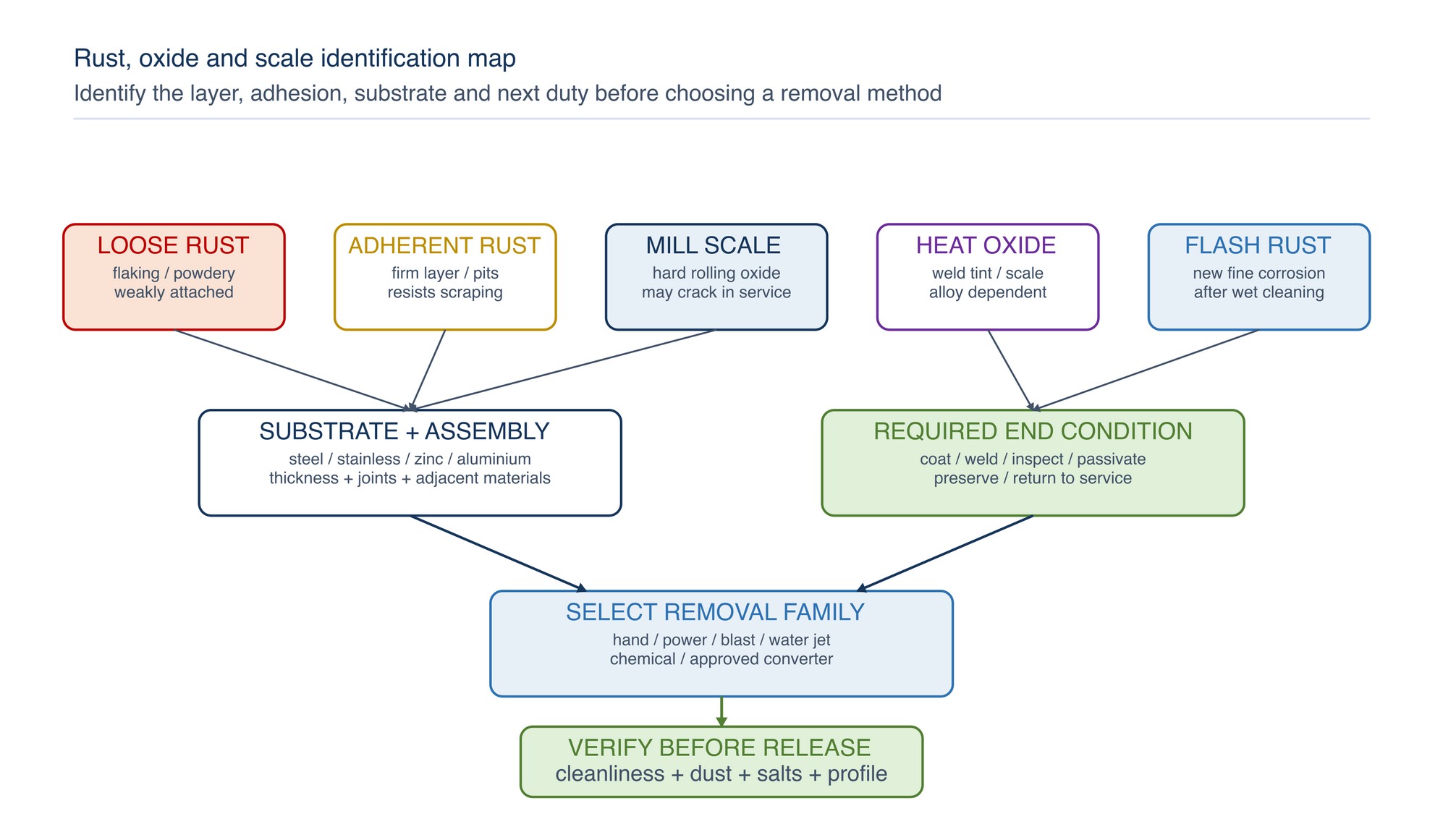
Identify the unwanted layer
Do not treat every brown, black, blue or grey surface as the same “rust.” Identify what is present, how strongly it adheres and what may lie beneath it.
| Typical appearance and location | Surface condition | Removal implication | Important check |
|---|---|---|---|
| Loose atmospheric rust | Flaking, powdery or weakly attached corrosion product | Hand or power tools may remove loose material; pits and salts can remain | Inspect recesses and the pit base after cleaning |
| Adherent rust | Firm corrosion layer that resists scraping | May require a more capable mechanical, blast, water-jet or chemical route | Confirm required preparation grade and remaining section |
| Mill scale | Dark, hard oxide formed during hot rolling | Can be strongly adherent but may crack or detach in service | Do not assume smooth dark scale is a sound coating substrate |
| Weld oxide and heat tint | Coloured oxide around welds and heat-affected zones | Mechanical or chemical treatment depends on alloy and service duty | Preserve geometry and prevent embedded contamination |
| Flash rust | Fine new rust after wet preparation or humid exposure | Control water quality, drying, environment and time to the next step | Use the defined flash-rust acceptance for the coating system |
| Non-ferrous corrosion product | White zinc salts, aluminium oxide, copper compounds or mixed deposits | Ferrous-steel methods can damage the substrate or protective coating | Identify the alloy or coating before removal |
The first inspection should include the visible condition, process history, previous coating, possible chemical exposure and any evidence of section loss. Thick corrosion can conceal pits, laminations, cracks, perforation or sharp remaining edges.
Removal does not restore lost metal; structural or pressure-containing items require the appropriate engineering assessment.
Define the required end condition
State what the surface must be ready for: painting, thermal spraying, welding, inspection, assembly, passivation, preservation or return to service. These outcomes can require different levels of oxide removal, roughness and chemical cleanliness.
For coating work, the governing specification can separately define:
- the visual preparation grade;
- permitted remaining coating or staining;
- dust condition;
- soluble-contaminant limit and test method;
- surface-profile range and measurement method;
- treatment of welds, edges and imperfections;
- environmental condition and flash-rust limit; and
- maximum time before coating.
ISO 8501-1 provides visual rust and preparation grades for steel, while ISO 8501-3 addresses welds, edges and visible imperfections. ISO 8501-4 covers visual conditions and flash-rust grades associated with water jetting. These visual references do not by themselves establish soluble-salt content or surface profile. [S202-S204]
Where the exact preparation grade, profile, salt limit, flash-rust grade or time-to-coat is product or specification dependent, Refer to the product label, Technical Data Sheet, or MKTECH representative.
Remove oil, grease and interfering contamination first
Oil and grease can shield oxide from chemical action, contaminate abrasive media and smear across mechanically cleaned steel. Remove them using the suitable cleaning process before oxide removal where they would interfere with the selected method. Chapter 037 explains industrial cleaning and degreasing in detail.
Also identify old coatings and deposits that may contain hazardous metals or other toxic constituents. Surface preparation can convert an intact material into airborne dust, spent abrasive, sludge or contaminated wash water. The hazard assessment must consider both the removal medium and the material being removed. [S198; S215]
Use clean, dedicated tools where material transfer matters. Carbon-steel brushes, grinding debris or contaminated blasting media can deposit iron on stainless steel. Abrasive previously used on another surface can also transfer coating residue, salts or metals.
Select the removal family
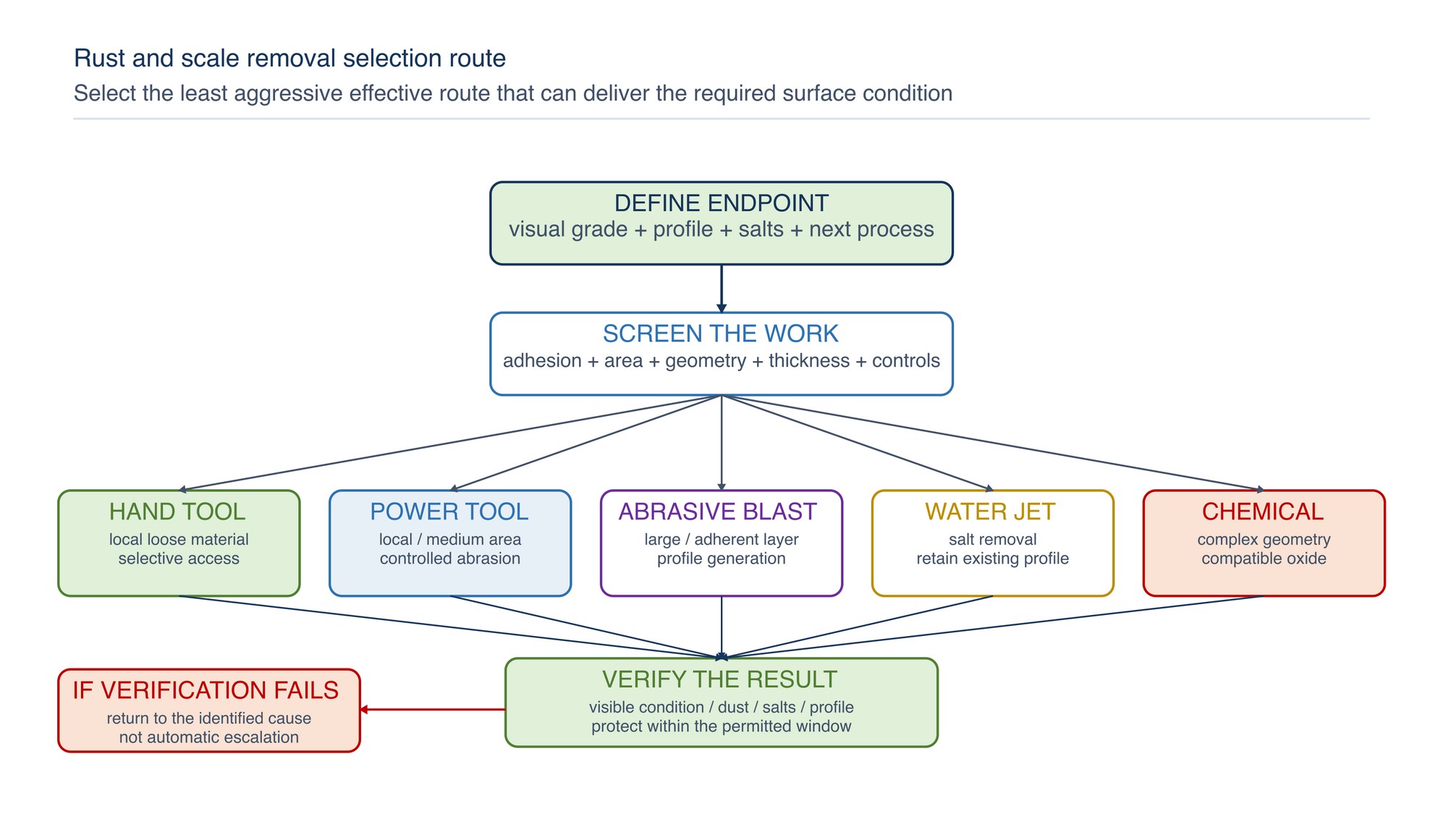
Choose the least aggressive effective route that can reach the surface and deliver the required condition.
| Method family | Suitable starting applications | Main strengths | Main limitations and controls |
|---|---|---|---|
| Hand-tool cleaning | Local loose rust, light scale, edges, small repairs and access-limited work | Portable, selective and easy to observe | Slow; may leave adherent material; wire brushing can polish or smear |
| Power-tool cleaning | Local-to-medium areas, maintenance repairs, welds and controlled mechanical removal | Higher productivity and range of abrasive actions | Heat, dust, noise, vibration, geometry loss and polished surfaces require control |
| Abrasive blast-cleaning | Large areas, strongly adherent scale, coating removal and profile generation | Efficient cleaning and deliberate surface profiling | Containment, dust, media condition, rebound, profile and substrate thickness are critical |
| High-pressure water jetting | Removal of rust, weak coating and water-soluble contamination where the system is suitable | Can remove salts and avoid adding dry abrasive matter | Does not normally create a new profile; flash rust, water collection and injection hazards |
| Chemical descaling or pickling | Complex geometry, internal surfaces or oxide that responds to compatible chemistry | Can reach detailed surfaces and dissolve oxide rather than mechanically cut it | Alloy attack, hydrogen effects, fumes, trapped acid, rinsing and waste require engineered control |
| Rust converter (specifically approved system) | Compatible residual rust in a specifically approved coating condition where full removal is impractical | May stabilise a defined residual rust condition | Not a substitute for removing loose scale, oil, salt or failed coating; system compatibility is essential |
Hand-tool removal
Scrapers, chipping tools, hand wire brushes and abrasive sheets can remove loose rust, scale and coating from small or irregular areas. ISO 8504-3 describes hand- and power-tool cleaning as recognised preparation methods for new and maintenance-coated steelwork. [S207]
Use hand tools when access, selectivity or local control is more important than production rate. Work from sound boundaries into the affected area and pay particular attention to edges, pits, weld toes, fasteners and corners. Keep scraping edges in usable condition and choose brush material compatible with the substrate.
Hand-tool cleaning has a defined limit: it can leave tightly adherent rust, scale and coating. Repeated wire brushing may burnish the surface, spread contamination or produce a polished appearance without achieving the required cleanliness or profile. If the selected endpoint cannot be reached, change the method rather than increasing effort indefinitely.
Power-tool removal
Power wire brushes, abrasive discs, non-woven stripping products, flap products, needle scalers and specialised impact or rotary tools provide different contact actions. Select the product form for the layer, geometry and required finish rather than treating all power-tool cleaning as equivalent.
Control the process by:
- securing the work and controlling the line of fire;
- selecting the correct accessory, attachment and guard;
- keeping the tool within all marked limits;
- using controlled passes instead of prolonged local dwell;
- preventing edge rounding, gouging, thinning and heat tint;
- removing dust and checking the surface under good lighting; and
- replacing damaged, loaded or ineffective consumables.
A shiny surface can be a warning sign when brushing or fine abrasion has polished rust or scale rather than removed it. Deep pits may remain contaminated even when the surrounding peaks are bright. Inspect both the overall appearance and the lowest accessible features.
Refer to the product label, Technical Data Sheet, or MKTECH representative.
Abrasive blast-cleaning
Abrasive blasting combines media, velocity, angle, distance, dwell, equipment condition and operator technique. It can remove strongly adherent oxide and create a surface profile suitable for many coating systems. ISO 8504-2 describes blast-cleaning methods and their fields of application. [S206]
Before blasting, confirm:
- the substrate is thick and stable enough for the process;
- oil, grease and incompatible contamination have been removed;
- the old coating and corrosion residue have been assessed for hazardous constituents;
- the abrasive type, cleanliness and size distribution suit the required surface;
- air supply, hoses, nozzle, recovery, ventilation and containment are in suitable condition;
- adjacent equipment, threads, bearings, seals and openings are protected; and
- the coating specification defines the required cleanliness and profile.
Do not use abrasive appearance as the only acceptance check. Worn or contaminated media can change the profile and leave embedded residue. Excessive blasting can distort thin sheet, round edges, enlarge pits or remove sound metal.
Incomplete coverage often remains around welds, corners, stiffeners and shadowed geometry.
Blasting creates dust from both the abrasive and the surface material. Enclosure, local extraction, exclusion zones, respiratory protection, hearing protection, protective clothing and cleanup methods must follow the assessed hazards. Dry sweeping and compressed-air dispersal can re-suspend fine contamination and should not replace controlled collection. [S198; S215]
High-pressure water jetting
Water jetting can remove loose rust, coating and water-soluble contamination without introducing dry abrasive. It is especially useful where salt removal and dust reduction are important. The existing steel profile normally remains rather than a new abrasive profile being created, so the exposed condition must suit the coating system. [S204]
Control water quality, pressure-rated equipment, nozzle condition, hose restraint, drainage, collection and the exclusion zone. Water jets can penetrate skin and cause severe injury; leaks and damaged hoses require immediate isolation under the equipment procedure.
After cleaning, inspect for retained coating, oxide, salts and flash rust. Drying begins with geometry: drain pockets, tubes, laps and blind holes before treating the visible face as dry. ISO 8501-4 distinguishes visual preparation and flash-rust grades, while ISO 8502 methods address invisible contamination separately. [S204; S209; S210]
Chemical scale removers, descaling and pickling
Chemical oxide removal uses a formulation that reacts with or dissolves the unwanted layer. The correct chemistry depends on the oxide, alloy, temperature, geometry and downstream requirement. Degreasing normally precedes chemical descaling because oil can prevent uniform contact. [S212]
Do not formulate or mix an improvised pickling solution. Use the supplied product in the specified equipment with the required ventilation, handling, first-aid and emergency controls. Acids can attack the base metal, release hazardous fumes, react with incompatible products and remain trapped in joints or cavities. Contact with some metals can generate hydrogen, with implications for fire, pressure and material integrity.
Stainless-steel pickling removes scale and a thin affected surface layer; passivation is a distinct treatment applied to a chemically clean surface. They are not interchangeable terms. Chapter 039 covers stainless-steel cleaning and passivation in depth. [S212; S213; S217]
Where exact chemistry, dilution, temperature, contact time, neutralisation sequence or compatibility is required, Refer to the product label, Technical Data Sheet, or MKTECH representative.
Rust converters and conversion treatments
A rust converter is used only where the selected coating system permits a defined residual rust condition. It does not make loose scale, grease, salt, dust or weak coating acceptable. Remove non-adherent material, clean the surface and achieve the preparation condition required by the converter and coating manufacturer.
Check compatibility across the complete system:
- base metal and remaining rust;
- previous coating and repair boundary;
- converter chemistry and film thickness;
- primer or topcoat family;
- cure condition and recoat window;
- service temperature and exposure; and
- inspection and acceptance method.
Do not use a converter to conceal uncertain corrosion depth, active contamination or an inaccessible structural defect. A dark colour change is not by itself proof of complete reaction, adhesion or coating readiness.
Protect the substrate and adjacent materials
The removal method must be compatible with the full assembly, not only the principal metal.
| Material or feature | Main risk during oxide removal | Practical control |
|---|---|---|
| Thin carbon-steel sheet | Distortion, thinning, gouging and excessive profile | Use controlled energy and inspect geometry and remaining thickness |
| Stainless steel | Embedded carbon steel, smearing, heat tint and incompatible chemistry | Use dedicated compatible tools and follow the specified cleaning or passivation route |
| Galvanized or zinc-coated steel | Removal of protective zinc and attack by unsuitable chemistry | Confirm whether the objective is cleaning the zinc or exposing the steel beneath |
| Aluminium and soft alloys | Rapid abrasion, chemical attack, staining and dimensional loss | Use alloy-compatible media, chemistry and representative-area checks |
| Plated, painted or conversion-coated surfaces | Unplanned stripping, undercutting or loss of repair boundary | Define what must remain and protect sound adjacent areas |
| Seals, bearings, threads and electrical parts | Grit, water or chemical entry and loss of function | Mask, isolate, dismantle or select a process that prevents ingress |
Heat-sensitive, hardened, high-strength or fatigue-critical components may have restrictions on aggressive grinding, blasting, acid treatment or hydrogen-producing processes. The drawing, repair specification or responsible engineer controls the permitted route.
Rinse, neutralise where specified and dry completely
Rinsing removes reacted oxide, dissolved metal, cleaner and process chemistry. Inadequate rinsing can leave corrosive residue or interfere with coating, welding, bonding and passivation. Use a sequence that reaches the same crevices and internal surfaces as the chemical treatment.
Neutralisation is product and process specific. It should not be improvised by adding an opposite chemical to the workpiece, bath or spill. Uncontrolled neutralisation can generate heat, gas and splashing, and can precipitate material that remains on the surface. Follow the defined treatment sequence and verify the rinse result.
Drain and dry the entire geometry promptly. Use clean handling and protected transfer after preparation; bare steel can re-rust rapidly and stainless steel can be recontaminated by dirty tools, racks or contact surfaces.
Control flash rust and the time to the next process
Flash rust is new corrosion that forms after wet preparation as water evaporates or the surface remains exposed. Its development depends on steel condition, soluble contamination, water quality, humidity, temperature, air movement and elapsed time. [S204]
Reduce the risk by:
- removing soluble contamination as required;
- using suitable process and rinse water;
- draining pockets and hidden geometry;
- drying with clean controlled air or another compatible method;
- preventing condensation and dirty handling;
- monitoring the environment required by the coating system; and
- applying the next treatment within its defined window.
Do not automatically coat over flash rust or repeat aggressive preparation without diagnosis. Determine whether the observed grade is acceptable to the coating system and whether salts, retained moisture or environmental conditions caused the recurrence.
Verify four separate surface dimensions
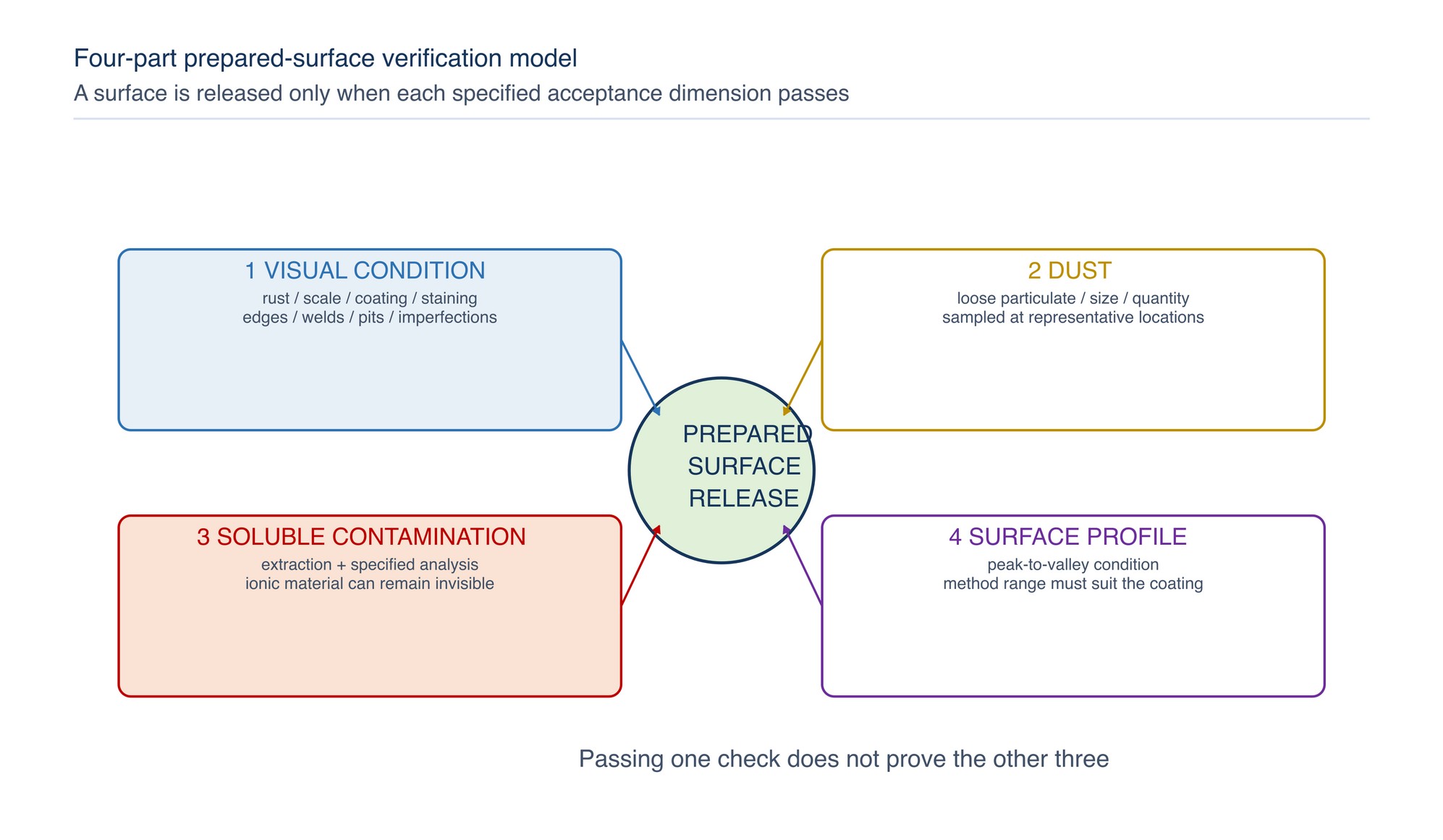
A reliable release decision separates visual cleanliness, dust, soluble contamination and profile. Passing one does not prove the others.
| Verification dimension | What it addresses | Example approach | Limitation |
|---|---|---|---|
| Visual condition | Remaining rust, scale, coating and visible defects | Comparison with the specified visual grade and inspection of edges, welds and pits | Does not quantify invisible salts or profile |
| Dust | Loose particulate remaining after preparation | Pressure-sensitive tape or another specified dust method | Sampling location and roughness affect interpretation |
| Water-soluble contamination | Ionic material that can promote coating failure or corrosion | Specified extraction and analysis method | Conductometry does not identify each ion and extraction may not reach concealed material |
| Surface profile | Peak-to-valley texture created or retained by preparation | Comparator, replica tape, stylus or specified instrument | Method range and coating requirement must be compatible |
ISO 8502-3 addresses qualitative dust assessment. ISO 8502-6 describes extraction of water-soluble contamination, including limitations where material is hidden under films or in crevices. ISO 8502-9 uses conductometry to assess ionic contamination but does not identify the individual salt species. [S208-S210]
Record the method, location, condition and result needed by the job specification. Refer to the product label, Technical Data Sheet, or MKTECH representative.
Safety and waste controls
Surface preparation can combine high-energy equipment with dust, sharp debris, noise, vibration, corrosive chemicals, pressurised water and hazardous old coatings. Establish the controls before work starts.
Key safety checks include:
- isolate and secure equipment and workpieces;
- identify hazardous coating, scale and process residues;
- use enclosure, extraction, wet control or containment appropriate to the method;
- control flying particles, rebound and the line of fire;
- protect hearing, eyes, face, skin, body and respiratory system as required by the assessment;
- keep incompatible chemicals segregated and in labelled compatible containers;
- provide the specified spill, eyewash, shower and first-aid arrangements;
- treat confined-space work as a separate controlled activity; and
- stop for damaged hoses, guards, ventilation, respiratory equipment or containment.
Pickling products can contain highly corrosive acids, including formulations that require urgent specialist first aid after contact. HSE guidance emphasises substitution where practicable, effective ventilation, contamination control, suitable PPE and immediate first-aid readiness. [S214]
The removal process transfers material into dust, spent abrasive, filters, sludge, pickling solution, rinsate, wipes and protective sheeting. Characterise and segregate these streams by their actual composition and generating process.
Malaysian DOE guidance governs scheduled-waste classification, compatible packaging, labelling, storage and authorised routing; industrial effluent requires the applicable treatment and discharge controls. [S199; S216]
Troubleshooting and release checklist
| Symptom | Likely causes | Practical correction |
|---|---|---|
| Rust or scale remains | Method lacks effective action; coverage is incomplete; layer is shielded by oil; pits or shadow zones were missed | Re-identify the layer, clean interfering soil, improve access or select a suitable removal family |
| Surface is bright but coating preparation fails | Burnishing or smearing; salts, dust or oil remain; profile is unsuitable | Separate visual, dust, salt and profile checks; repeat only the deficient stage |
| Rapid flash rust | Soluble contamination, poor water quality, retained moisture, high humidity or delay | Correct rinse, drainage, drying, environment and time-to-coat controls |
| Deep random scratches or gouges | Tool or media too aggressive; debris trapped at the interface; local dwell or poor support | Clean the interface, change product or support, and use controlled progressive passes |
| Uneven blast profile | Media mix or flow varies; angle, distance, dwell or access is inconsistent | Restore equipment and media control, standardise technique and remeasure representative areas |
| Dark staining after chemical treatment | Incomplete oxide removal, base-metal attack, retained chemistry or poor rinsing | Stop, identify the stain mechanism and correct the specified clean-rinse-dry sequence |
| Rust returns beneath coating | Residual salts, dust, moisture, weak material or delay before coating | Review preparation records and coating conditions; correct the verified cause before repair |
| Stainless surface develops rust spots | Embedded iron, carbon-steel tool transfer or recontamination after cleaning | Isolate the source, use dedicated tools and complete the specified stainless-cleaning route |
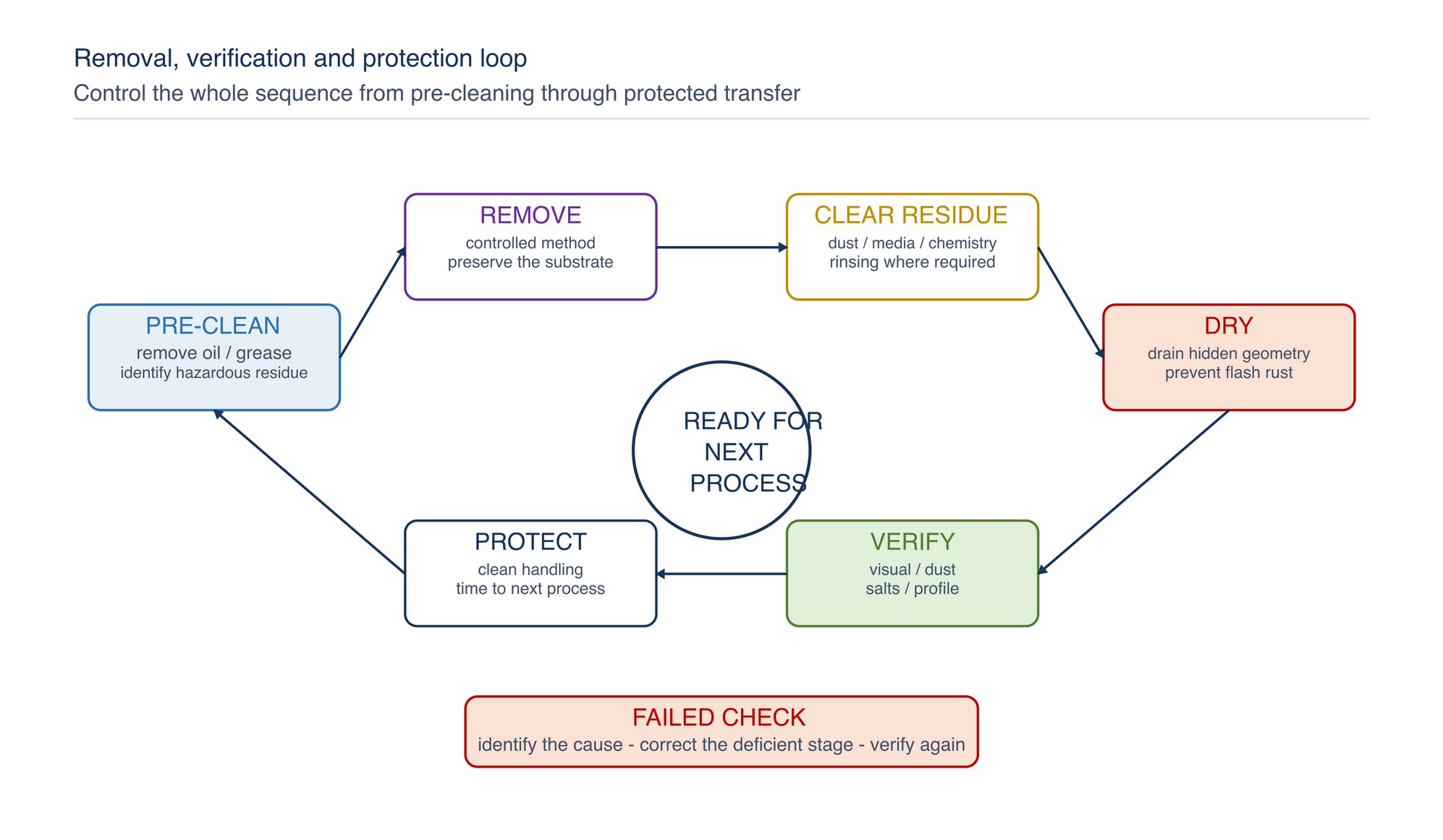
Before release, confirm:
- the substrate, unwanted layer and required end condition were identified;
- oil, grease and hazardous previous material were addressed;
- the selected method preserved required dimensions, edges, coatings and adjacent components;
- remaining rust, scale and coating meet the specified visual condition;
- dust, soluble contamination and profile were checked where required;
- chemical residue and rinse water were removed from hidden geometry;
- the surface is dry, protected and within the permitted time window;
- waste and effluent streams are contained and routed correctly; and
- the next coating, joining, passivation, inspection or service step accepts the prepared surface.
Stainless-Steel Cleaning and Passivation
The Stainless-Steel Cleaning and Passivation chapter appears on the following page of the printed handbook (page 326), outside this chapter extract.