
Production supervisors, maintenance teams, fabricators, finishing operators, coating and bonding personnel, QA/QC teams, safety and environmental personnel and technical sales personnel
Practical selection and control of water-based, solvent, alkaline, acidic and neutral cleaning systems for industrial metalwork, equipment and fabricated components.
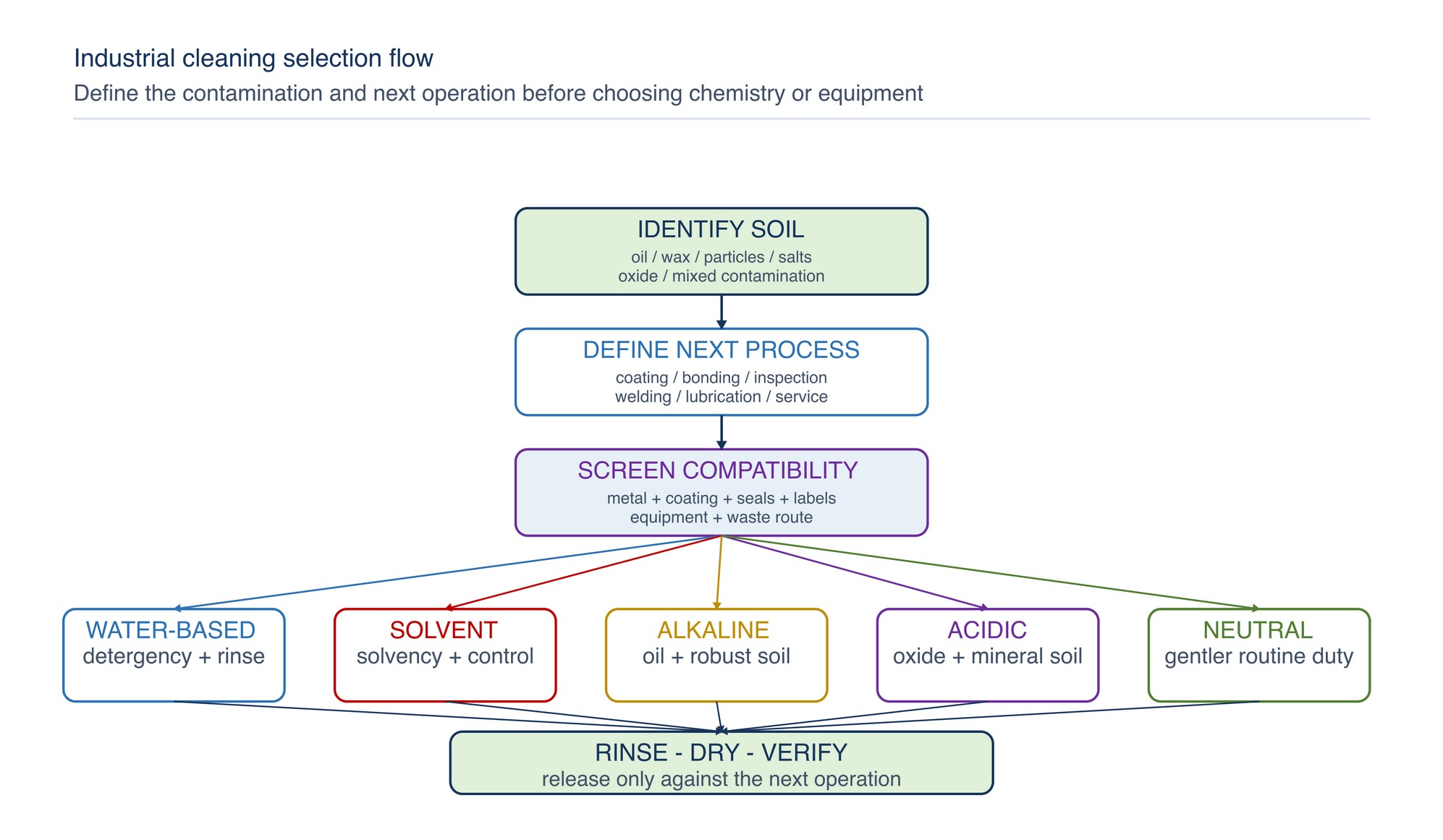
Cleaning is a complete process: identify the soil, select compatible chemistry and action, remove the released contamination, rinse where required, dry promptly and verify the surface against its next operation.
Concentrated alkalis can cause serious skin and eye injury. Avoid splashing during mixing and part handling, and never improvise a neutralisation step on the workpiece or on a spill. [S198] Keep acid cleaners separate from alkaline products, hypochlorite-containing materials and other incompatible chemicals. Never mix cleaners unless the manufacturer explicitly specifies the combination. Acid with hypochlorite can release toxic gas; acid with alkali can generate violent heat and splashing; incompatible solvents can attack equipment or create unexpected fire and exposure hazards. Stop and apply the site emergency response if there is uncontrolled reaction, strong unexpected odour, heat, gas, pressure, fire, significant spill or acute worker symptoms.
Chapter objectives
After this chapter, the reader should be able to:
- classify common industrial soils before selecting a cleaner;
- distinguish water-based, solvent, alkaline, acidic and neutral cleaner families;
- match chemistry, delivery method and mechanical action to the work;
- screen the complete assembly for material compatibility;
- control concentration, temperature, contact, agitation and bath loading without guessing product values;
- prevent cleaner residue, rinse carry-over, water spotting and flash rust;
- select practical cleanliness checks for coating, bonding, inspection or service;
- recognise inhalation, skin, eye, fire and reaction hazards;
- manage spent solution, rinsate, sludge and contaminated wipes according to their actual composition; and
- troubleshoot common cleaning defects through a disciplined cause-and-correction method.
A surface can look clean yet retain oil film, surfactant, dissolved salt, polishing compound or moisture that later causes coating failure, corrosion, staining, poor bonding or unreliable inspection. Conversely, aggressive cleaning can attack the base metal, existing coating, seal, adhesive or precision feature. Effective degreasing therefore starts with the contaminant and downstream requirement, not with the strongest available chemical. [S198; S200]
Identify the soil before choosing the chemistry
“Dirt” is not one material. A cleaner that dissolves lubricating oil may leave polishing compound, metal fines or salt behind. An acid that removes oxide may spread oil across the surface and prevent uniform contact with the metal. Begin by identifying the dominant soil and any hidden second layer.
| Soil family | Typical examples | Useful first observations | Cleaning implication |
|---|---|---|---|
| Oils and greases | Machining oil, hydraulic oil, rust preventive, bearing grease | Smear, gloss, water beading, oily transfer to a clean wipe | Needs solvency, emulsification or alkaline detergency plus removal of released oil |
| Waxes and compounds | Buffing bar residue, lapping compound, protective wax | Firm or sticky film, often concentrated at seams and cool zones | May need heat, compatible solvent action and brushing or spray force |
| Particulate soils | Abrasive dust, metal fines, carbon, shop dust | Loose deposit, dark wipe, particles in corners and threads | Needs displacement, suspension, filtration and effective rinse or vacuum removal |
| Water-soluble soils | Salts, coolant residue, fingerprints, some process chemicals | May be invisible; can leave crystals, stains or conductive residue | Needs suitable water quality, access to crevices and complete rinse and drying |
| Oxides and scale | Light rust, heat tint, mill scale, corrosion products | Coloured or rough adherent layer; may remain after degreasing | Degrease first, then use a compatible oxide-removal process where appropriate |
| Mixed soils | Oily metal fines, burnt lubricant, compound plus oxide | Layered, tenacious or variable across the part | Usually requires staged cleaning rather than one increasingly aggressive bath |
Use process history as evidence. Ask what machining fluid, polishing compound, handling material, protective coating or previous cleaner contacted the part. A clean white wipe, magnified examination and water-break observation can help locate contamination, but each test has limits and should be related to the next process.
Choose a cleaner family by mechanism and duty
Cleaner names alone do not define performance. Water-based products may contain alkalis, acids, surfactants, corrosion inhibitors, chelants or solvent components. Solvent products vary widely in toxicity, evaporation, flammability and compatibility. Selection must use the current product information and the actual process.
| Cleaner family | Best suited to | Principal strengths | Main cautions |
|---|---|---|---|
| Water-based detergent | General oils, shop soil, particulate contamination and many production parts | Combines wetting, emulsification, dispersion and rinsing; compatible with spray, immersion and ultrasonic systems | Bath loading, foam, residue, water quality, drying and corrosion control need attention |
| Solvent cleaner | Localised oil, grease, wax or adhesive residue where the solvent is compatible and water is unsuitable | Rapid solvency; useful for precision or spot cleaning when | Vapour exposure, skin contact, fire, static, confined-space accumulation, material attack and contaminated-wipe handling |
| Alkaline cleaner | Oils, greases, carbonaceous soil and robust ferrous components, depending on formulation | Strong detergency; can combine wetting, emulsification and chemical action | May attack aluminium, zinc, coatings, skin and eyes; inadequate rinsing can leave alkaline residue |
| Acidic cleaner | Oxides, rust, mineral deposit or scale after oil has been removed | Chemical removal of inorganic contamination and surface conditioning | Can attack metal, generate fumes or hydrogen, damage coatings and accelerate corrosion if poorly rinsed or overexposed |
| Neutral or near-neutral cleaner | Routine cleaning, mixed-material assemblies and applications needing gentler chemistry | Often easier compatibility and handling profile; useful for light- to-moderate soils | “Neutral” does not mean harmless or universally residue-free; cleaning power and corrosion protection remain formulation specific |
Select the least hazardous effective option that can reach the soil and deliver the required surface. Where the product concentration, temperature, immersion time, spray pressure, compatibility or rinse method is exact and product dependent, Refer to the product label, Technical Data Sheet, or MKTECH representative.
Water-based cleaning systems
Water-based cleaning uses water as the main carrier and relies on a combination of wetting, detergency, emulsification, dispersion, chemical reaction and mechanical or thermal energy. Spray cabinets, agitated tanks, ultrasonic systems, flow-through washers and manual stations apply these mechanisms differently. [S200]
Water-based systems are often effective when the complete process is designed around them:
- expose the soil to fresh solution;
- provide appropriate temperature, contact and movement;
- separate displaced oil and solids from the active bath where the equipment permits;
- prevent dirty solution from redepositing on the part;
- rinse to remove cleaner and carried soil; and
- dry the complete geometry before corrosion or water spotting develops.
The bath changes in service. Oil can consume or overload its cleaning capacity; fines can lodge in recesses; evaporation can concentrate dissolved material; incoming water can affect foam, spotting and rinse behaviour. A bath that remains visually clear is not necessarily effective, and a dark bath is not automatically exhausted. Monitor the condition indicators appropriate to the selected chemistry and equipment. Refer to the product label, Technical Data Sheet, or MKTECH representative.
Avoid adding concentrate merely because cleaning has slowed. First check soil loading, bath circulation, heater or ultrasonic condition, nozzle alignment, filtration, foam, part orientation, contact time and rinse quality. Uncontrolled additions can increase residue, chemical exposure, cost and effluent load without correcting the true cause.
Solvent cleaning
Solvent cleaning removes compatible organic soils by dissolution and displacement. It may be useful for local repair, precision items, water-sensitive assemblies or tenacious wax and grease. It is not automatically the correct choice simply because it dries quickly.
Use a closed or otherwise controlled delivery method where practicable. Minimise exposed liquid area, avoid open soaking containers and keep lids closed when the equipment is idle. Provide the ventilation and other exposure controls established for the chemical and task. OSHA guidance on toxic cleaning solvents illustrates the enduring principles of enclosure, source ventilation, skin and eye protection and additional precautions for flammable solvents; Malaysian workplace controls follow the applicable DOSH chemical-risk framework. [S198; S201]
Never assume that evaporation removes the soil. A dirty wipe or bath can spread dissolved oil into a thin film that becomes difficult to see. Use clean-to-dirty wipe sequencing, turn or replace wipes before they are saturated, and verify the final surface. Do not use compressed air to accelerate evaporation where it could disperse vapour, spray liquid, drive contamination into openings or create an ignition hazard.
Before using solvent on an assembly, screen plastics, elastomers, painted surfaces, labels, sealants, electrical insulation and adhesives. Swelling, softening, crazing, colour transfer or loss of bond may appear after contact rather than immediately. “Non-flammable”, “low odour” and “fast drying” are not sufficient selection criteria; the Safety Data Sheet and the product’s declared application govern.
Alkaline cleaning
Alkaline cleaners range from mild detergent systems to strongly caustic formulations. Depending on composition, they can wet the surface, emulsify or displace oil, disperse particulate, react with fatty soil and support high-throughput spray or immersion cleaning.
Use alkaline cleaning when the formulation is compatible with every exposed material. Aluminium, zinc, galvanised surfaces, some coatings, glass, certain seal materials and sensitive alloys can be attacked or stained by unsuitable alkalinity, temperature or contact. Hidden pockets may retain concentrate and continue reacting after the visible surface is rinsed.
A successful alkaline process needs:
- correct solution make-up using the specified order of addition;
- controlled contact and mechanical action rather than excessive dwell;
- bath maintenance that removes oil and solids where possible;
- thorough rinsing, especially at folds, threads, tubes and blind holes;
- prompt inspection for etching, darkening or residue; and
- drying or subsequent treatment before corrosion develops.
Concentrated alkalis can cause serious skin and eye injury. Avoid splashing during mixing and part handling, and never improvise a neutralisation step on the workpiece or on a spill. Chemical addition, spill response and personal protective equipment follow the current Safety Data Sheet and site procedure. [S198]
Acidic cleaning and oxide removal
Acidic cleaners are principally selected for inorganic contamination such as rust, oxide, mineral scale or some heat-formed surface products. Oil and grease inhibit uniform acid contact, so effective degreasing normally precedes oxide removal. [S200]
Acid strength alone does not determine cleaning quality. Formulation, inhibitor system, alloy, temperature, contact, agitation, soil thickness and geometry all influence the result. Excessive exposure can etch the base metal, enlarge pits, change appearance, damage dimensions or leave a reactive surface. Contact with some metals can generate hydrogen; incompatible chemical mixing can produce heat, splashing or hazardous gas.
Keep acid cleaners separate from alkaline products, hypochlorite-containing materials and other incompatible chemicals. Use dedicated labelled tools and containers where cross-contamination could occur. Rinse the part thoroughly, remove trapped solution and proceed promptly to the specified drying, neutralisation or downstream treatment. Do not prescribe an improvised neutraliser: the correct sequence depends on the cleaner, substrate and process. Refer to the product label, Technical Data Sheet, or MKTECH representative.
Neutral and speciality cleaners
Neutral or near-neutral cleaners are useful for routine maintenance, light-to-moderate oils, mixed-material assemblies and situations where aggressive chemistry is unnecessary. Speciality products may be formulated for electronics, food-contact equipment, precision components, aluminium, stainless steel or low-residue duties.
The pH description does not prove low toxicity, non-flammability, corrosion protection, rinse-free use or universal material compatibility. Surfactants, builders, solvents, chelants and inhibitors still influence performance and hazard. Treat every formulation according to its label and Safety Data Sheet.
Neutral chemistry may need greater reliance on temperature, spray force, agitation, ultrasonics, brushing or longer contact. That is often preferable to stronger chemistry, provided the equipment and workpiece tolerate the added mechanical or thermal input. Compare the complete cleaning result, not only the wash step.
Screen the whole assembly for compatibility
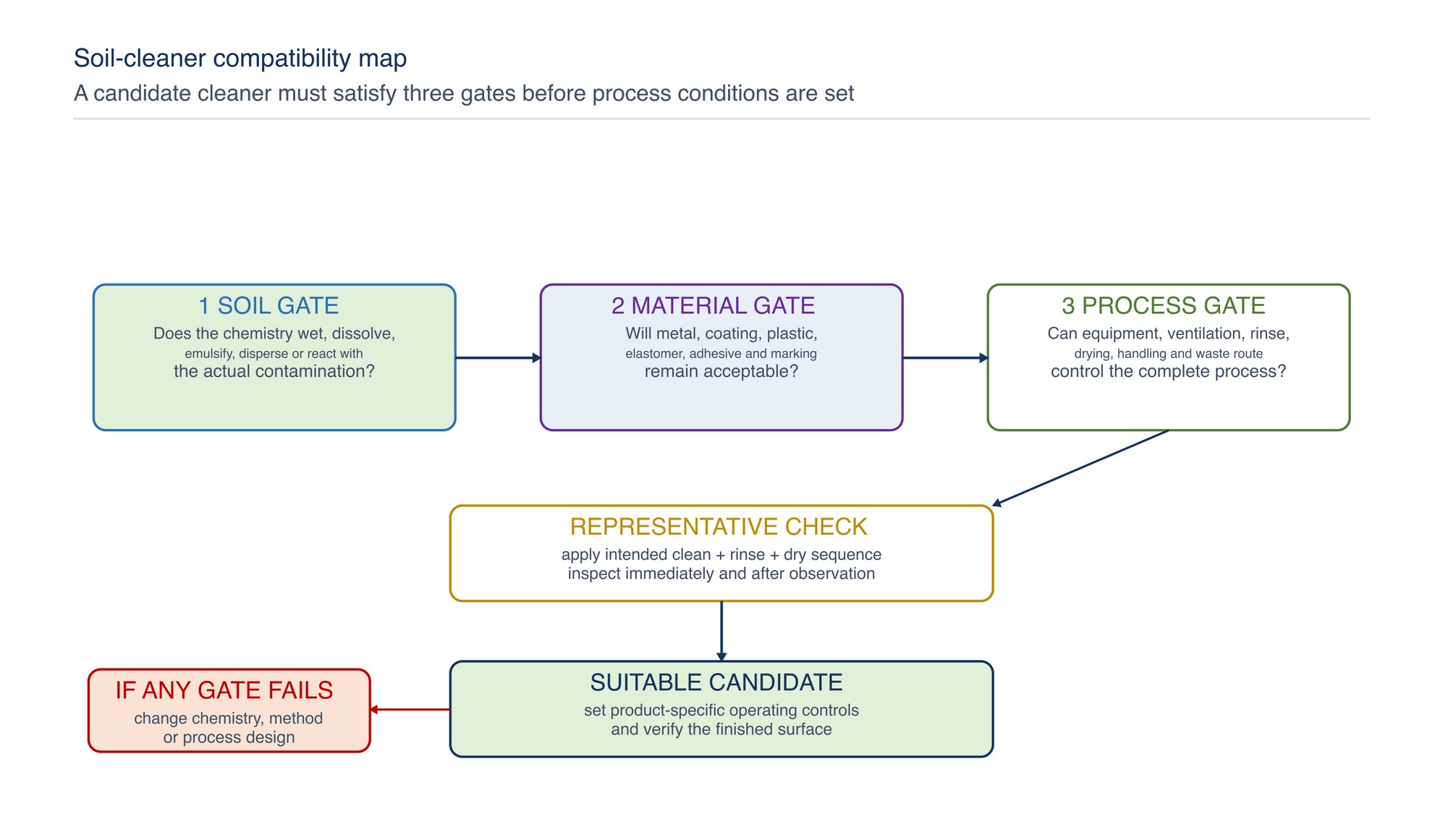
Compatibility checks must include more than the principal metal. A steel housing may contain aluminium nameplates, copper conductors, polymer bearings, elastomer seals, adhesive labels and trapped lubricant. A cleaner acceptable for one material can damage another or carry contamination into a joint.
| Compatibility area | What to examine | Unacceptable signs |
|---|---|---|
| Base metal | Colour, gloss, roughness, mass-sensitive or dimensional features | Etching, darkening, pitting, staining or measurable change |
| Coating and plating | Paint, powder coat, conversion layer, anodising, zinc or decorative finish | Softening, lifting, blistering, chalking, colour transfer or loss of adhesion |
| Elastomers and plastics | Seals, hoses, grommets, glazing, housings and liners | Swelling, shrinkage, tackiness, cracking, crazing or hardness change |
| Adhesives and markings | Bonded joints, threadlock, tapes, labels, inks and identification marks | Edge lift, weakened bond, bleeding, loss of print or traceability |
| Equipment materials | Tank, pump, heater, nozzle, filter, basket and drain system | Corrosion, embrittlement, seal failure, blocked filters or incompatible waste route |
| Downstream process | Coating, welding, bonding, metrology, electrical service or lubrication | Residue, moisture, altered surface, poor wetting or contamination transfer |
When compatibility is not established, use a representative test piece or a non-critical area and reproduce the intended exposure, rinse and drying sequence. Examine immediately and again after a suitable observation period. A small-area check reduces risk but does not prove long-term service compatibility.
Control the five process variables
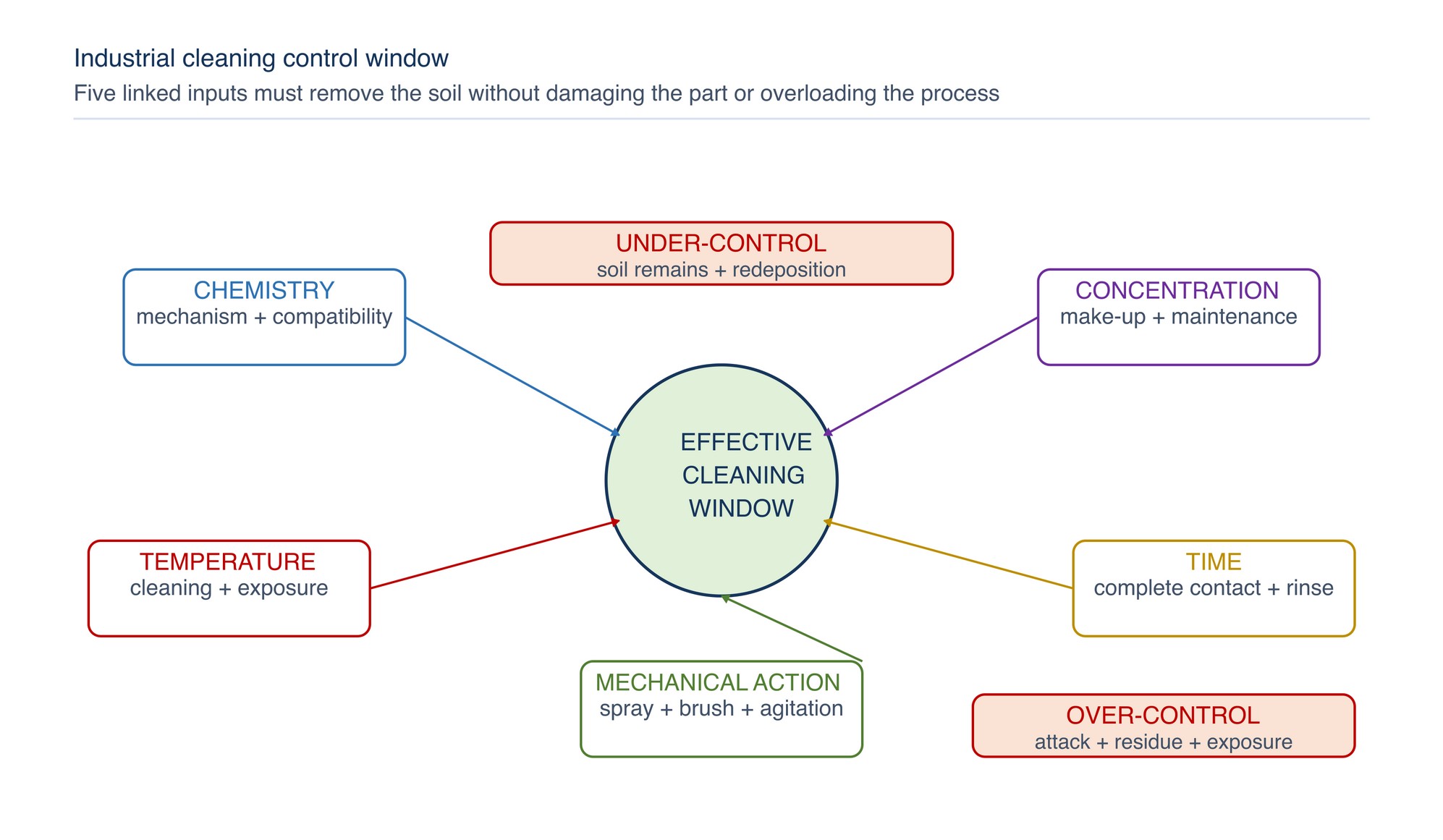
Cleaning performance depends on five linked inputs: chemistry, concentration, temperature, time and mechanical action. Increasing one may allow another to decrease, but only within the product and material limits.
| Variable | Too low or insufficient | Too high or excessive | Control approach |
|---|---|---|---|
| Chemistry or concentration | Incomplete wetting, slow oil removal, redeposition | Residue, attack, foam, exposure and waste load | Make up and maintain by the specified method |
| Temperature | Poor solvency or detergency, slow drying | Evaporation, attack, vapour, exposure | Verify heater and solution energy use and worker condition; do not exceed declared limit |
| Contact time | Soil remains in recesses or heavy deposits | Base-metal or coating attack, drying-on, swelling or staining | Time the actual wet contact, including delays before rinse |
| Mechanical action | Boundary layers and trapped soil remain | Damage to precision features, coatings or soft materials | Select spray, brushing, agitation or ultrasonics to suit geometry |
| Bath loading | Fresh solution cleans effectively | Oil, fines and dissolved material cause slow cleaning or redeposition | Monitor, separate contaminants and replace by condition |
Load parts so solution reaches all surfaces and drains freely. Avoid nesting, air locks and large horizontal pockets. Point blind openings to fill and drain where practical. In spray systems, check nozzle pattern and obstruction; in immersion systems, prevent baskets from shielding parts; in ultrasonic systems, confirm that the item and attachments are suitable for cavitation.
Rinsing is part of cleaning
Rinsing removes cleaner, released soil and dissolved contaminants. It is not simply dilution at the end of the process. Poor rinsing can turn a successful wash into a coating or corrosion failure.
Use enough rinse stages and movement to prevent carry-over from returning to the part. Arrange cleanest water at the final stage where the process permits, and control overflow or counterflow through the designed treatment system rather than discharging uncontrolled rinsate. Inspect spray nozzles, tank agitation, part orientation and drainage. Replace or treat rinse water by its relevant condition indicators.
Rinse-water quality matters when spots, conductivity, ionic residue or high-value finishes are important. Hardness minerals can remain after evaporation; contaminated water can reintroduce oil, salt or metal. Exact water-quality and cleanliness limits are application specific. Refer to the product label, Technical Data Sheet, or MKTECH representative.
Avoid allowing concentrated cleaner to dry on the part before rinsing. On large fabrications, work in manageable zones and maintain a wet edge only where the product instructions allow. Do not use a high-pressure jet where it can aerosolise corrosive liquid, force water into sealed equipment or damage a prepared surface.
Dry promptly and prevent flash rust
After aqueous cleaning, water can remain in seams, threads, lap joints, tubes, porous deposits and under fasteners. Evaporation from the visible face does not prove the assembly is dry.
Drying methods include clean heated air, controlled oven drying, vacuum, centrifugal action, compatible water-displacing treatment or immediate transfer to the next controlled stage. The method must suit part mass, geometry, cleanliness requirement, coating schedule and heat-sensitive components.
Flash rust is favoured by a reactive steel surface, retained water, dissolved salts, slow drying and humid exposure. Reduce the wet hold time, improve final-rinse quality, expose pockets to drainage and keep cleaned parts away from grinding dust, fingerprints, rain and condensation. If an inhibitor or temporary protection is used, confirm that it is compatible with coating, bonding, welding or service.
Do not wipe a clean surface with a contaminated cloth to make it “look dry”. Use clean, low-lint materials only where wiping is part of the specified process. Compressed air must be suitable for the cleanliness duty; oil, water or particles from the air system can undo the entire wash.
Verify cleanliness for the next operation
There is no single universal cleanliness test. Select checks that can detect the contamination most likely to harm the next operation.
| Verification method | Useful for | Limitation |
|---|---|---|
| Visual and magnified inspection | Gross soil, stains, corrosion, particles and damage | Thin oil, surfactant or soluble salt may remain invisible |
| Clean-wipe check | Loose particulate, oil transfer and inaccessible edges | Wipe material and pressure affect result; can miss uniform films |
| Water-break observation | Discontinuous wetting associated with some hydrophobic contamination | Surface texture, chemistry and water quality affect interpretation; not a universal pass test |
| Rinse-water or extract check | Ionic or soluble residue when a defined method exists | Requires controlled water, area, time and acceptance basis |
| Surface-energy or dyne method | Comparative wetting for selected coating or bonding processes | Material, roughness and method affect reading; not interchangeable across processes |
| Coating or bond process check | Direct confirmation through a representative downstream result | Slower and may combine several variables; use a defined acceptance plan |
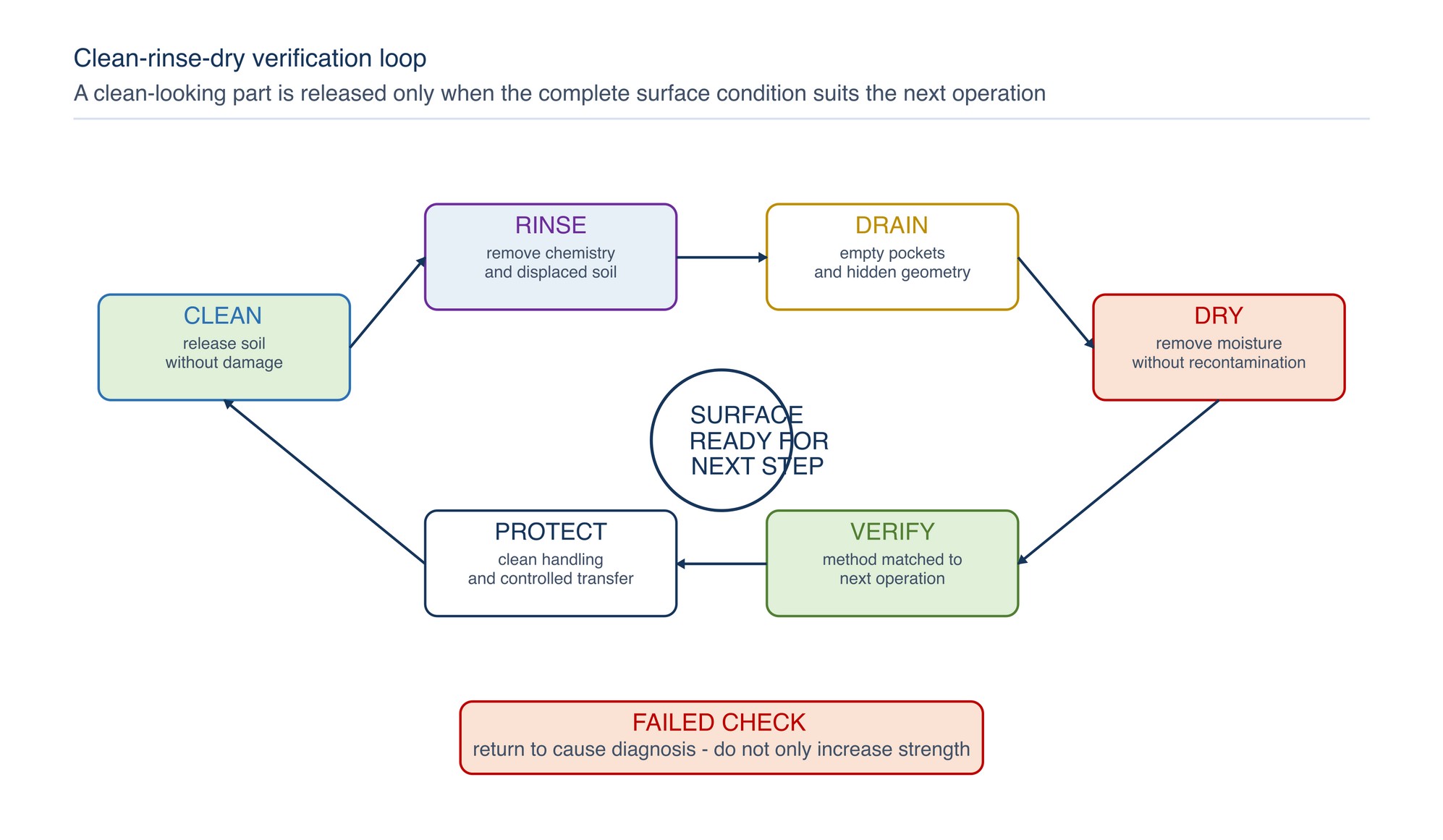
Inspect for chemical attack as well as soil removal. Record the part family, soil, cleaner identity, equipment, significant process controls, rinse and drying route, check method and result. For exact product or acceptance values, Refer to the product label, Technical Data Sheet, or MKTECH representative.
Protect workers and control chemical reactions
The chemical risk depends on the ingredients, quantity, physical form, temperature, delivery method, frequency, duration and route of exposure. Heated tanks, spraying, brushing, compressed-air agitation and confined geometries can increase inhalation or contact risk. DOSH chemical-risk guidance uses hazard and exposure information to determine suitable controls within a hierarchy. [S160; S198]
Apply these practical principles:
- substitute a less hazardous effective chemistry or delivery method where practicable;
- enclose or automate the process where this materially reduces exposure;
- capture mist or vapour at source and maintain the ventilation system;
- prevent skin and eye contact through equipment design, tools, splash control and suitable PPE;
- keep containers labelled and closed, and make Safety Data Sheets accessible;
- segregate incompatible chemicals and use dedicated transfer equipment;
- provide suitable eyewash, spill response and emergency arrangements; and
- train operators in mixing, loading, draining, waste handling and abnormal-condition response.
Never mix cleaners unless the manufacturer explicitly specifies the combination. Acid with hypochlorite can release toxic gas; acid with alkali can generate violent heat and splashing; incompatible solvents can attack equipment or create unexpected fire and exposure hazards. Stop and apply the site emergency response if there is uncontrolled reaction, strong unexpected odour, heat, gas, pressure, fire, significant spill or acute worker symptoms.
Manage effluent, spent baths and contaminated materials
Cleaning moves contamination; it does not make it disappear. Oil, metal fines, dissolved metals, acid, alkali, surfactant, solvent and coating residue can transfer into the bath, rinsate, sludge, filters, absorbents and wipes.
Keep waste streams segregated where this supports safe treatment and accurate classification. Do not discharge concentrated cleaner, solvent, oily water, sludge or uncontrolled rinsate to a drain. Characterise the actual stream and route it through the site’s authorised environmental system. Malaysia’s industrial-effluent framework governs treatment, discharge, monitoring and related controls; spent chemical and contaminated material may also require classification under the applicable scheduled-waste framework. [S188; S189; S199]
Practical controls include:
- minimise drag-out by allowing parts to drain back into the process where suitable;
- remove free oil and solids to extend bath usefulness where the equipment and chemistry permit;
- prevent leaks, evaporation and cross-contamination through closed, labelled storage;
- keep incompatible waste streams separate;
- retain the information needed to identify the generating process and contaminants; and
- send waste only through the site’s authorised route.
Waste classification follows the actual composition and process. It should not be inferred from the cleaner’s unused form or from the carrier material alone.
Troubleshooting cleaning defects
| Symptom | Likely contributors | Verification | Corrective direction |
|---|---|---|---|
| Oily film remains | Wrong cleaner family, low mechanical action, overloaded bath, poor access or dirty wipe | Compare soil type, fresh-solution response, bath condition and recesses | Restore effective bath chemistry/action and prevent redeposition |
| White haze or powder | Cleaner dried on part, hard-water deposit, inadequate rinse or excessive concentration | Inspect rinse coverage, water quality, drainage and solution control | Correct wash control and improve final rinse and drainage |
| Water spots | Mineral-laden rinse, slow drying, droplets trapped on horizontal faces | Compare spot pattern with drainage and water condition | Improve final-rinse quality and dry promptly |
| Flash rust | Retained water, salt residue, reactive surface, long wet hold or contaminated air | Inspect pockets, drying route, rinse condition and exposure delay | Improve rinse, drainage, drying and clean storage |
| Darkening or etching | Chemistry, temperature or contact incompatible with substrate | Compare exposed and shielded areas; check representative sample | Stop use, confirm compatibility and select gentler conditions or chemistry |
| Paint fisheyes or poor wetting | Oil, silicone, surfactant, compressed-air contamination or handling | Trace materials and perform process-relevant wetting checks | Remove the verified source and repeat complete clean-rinse-dry cycle |
| Adhesive bond inconsistency | Residue, moisture, surface ageing, roughness variation or handling | Compare preparation-to-bond time and representative bond process | Stabilise surface preparation, protection and transfer |
| Foaming or overflow | Wrong product, contamination, excess concentration, air entrainment or spray return | Observe foam timing and check solution make-up and circulation | Correct source; do not add an incompatible defoamer |
| Short bath life | Excess soil input, poor oil/solid separation, evaporation or cross-contamination | Trend load, bath condition, incoming parts and make-up condition | Reduce soil load, improve separation and maintain by condition |
| Staining in seams | Trapped cleaner or rinse, mixed metals, slow drainage or continued reaction | Open or orient representative geometry and inspect retained liquid | Improve access, rinse, drainage and drying; reassess chemistry |
Correct one verified cause at a time where safe and practical. Retest using comparable parts, soil load and downstream checks. A cleaner change that removes visible oil but introduces residue, corrosion or worker exposure is not an improvement.
Practical selection and release checklist
Before cleaning:
- identify the soil and next process;
- confirm cleaner compatibility with the complete assembly and equipment;
- review the label, Technical Data Sheet and Safety Data Sheet;
- prepare ventilation, PPE, spill control and segregated waste route; and
- set up clean handling, rinse and drying capacity before the first part enters the wash.
During cleaning:
- maintain solution and equipment by the specified method;
- expose every surface without trapping air or shielding the spray;
- control contact, agitation and drainage;
- watch for attack, unusual heat, gas, odour, excessive foam or redeposition; and
- keep clean and dirty tools, baskets and areas separated.
Before release:
- confirm soil removal using a method suited to the next operation;
- confirm cleaner and rinse residue have been removed;
- verify the part is dry, including concealed geometry;
- inspect for staining, etching, swelling, corrosion or lost identification;
- protect the cleaned surface from handling and shop contamination; and
- record the process and result at the level needed for repeatability.
Industrial cleaning succeeds when the soil is removed without damaging the part, exposing the worker or transferring an uncontrolled burden to the next process or the environment. The best system is not the most aggressive one; it is the compatible, controllable and verifiable system that consistently produces the required surface.
Rust, Oxide and Scale Removal
The chapter “Rust, Oxide and Scale Removal” begins on the following page of the printed handbook (page 318), outside this chapter extract.