

Production managers, workshop supervisors, safety and health personnel, operators, maintenance teams, technical buyers and application personnel involved in grinding, cutting, sanding, polishing and industrial surface finishing
Occupational noise; hand-arm vibration; task assessment; engineering and administrative controls; tool, abrasive and workstation selection; hearing protection; symptom reporting; inspection, maintenance and troubleshooting.
Never continue operating merely to see whether severe vibration will settle. Stop, isolate as required and inspect the complete system. Do not dress, reshape, modify or remount an abrasive product except by an approved method for that product type. Never lift a protector for conversation while remaining in the noise. Move to a controlled quiet location or use an approved communication method that preserves protection.
Noise and vibration are process outputs. Control them by selecting an efficient method, keeping the machine–abrasive–workpiece system stable and reducing transmission to people before relying on exposure time limits or personal protection.
Grinding and surface finishing combine high-speed motion, abrasive contact, airflow, impacts and vibrating structures. The same task may expose the operator to airborne sound and hand-transmitted vibration while also affecting nearby workers. A smooth-sounding tool is not automatically low-risk, and a short task is not automatically acceptable. Actual exposure depends on the source, operating condition, task duration, work pattern and position of each person. Malaysia's Noise Exposure Regulations 2019 and the supporting DOSH industry code provide the national framework for identification, assessment, control, hearing conservation and audiometric management. [S290; S312]
Chapter objectives
After this chapter, the reader should be able to:
- distinguish noise level, daily noise exposure and impulsive noise;
- recognise how hand-arm vibration enters the operator through a tool or workpiece;
- map noisy and vibrating stages across the complete work cycle;
- apply elimination, substitution and engineering controls before personal protection;
- select suitable, efficient equipment using comparable application information;
- recognise abrasive, mounting, machine and work-support conditions that increase vibration;
- control airborne, structure-borne and reflected sound;
- distinguish equipment emission information from worker exposure;
- organise representative noise and vibration assessment;
- select, fit and verify hearing protection for residual noise;
- recognise early hearing and hand-arm symptoms;
- identify conditions requiring a controlled stop; and
- troubleshoot abnormal noise and vibration systematically.
Understand the two exposure pathways
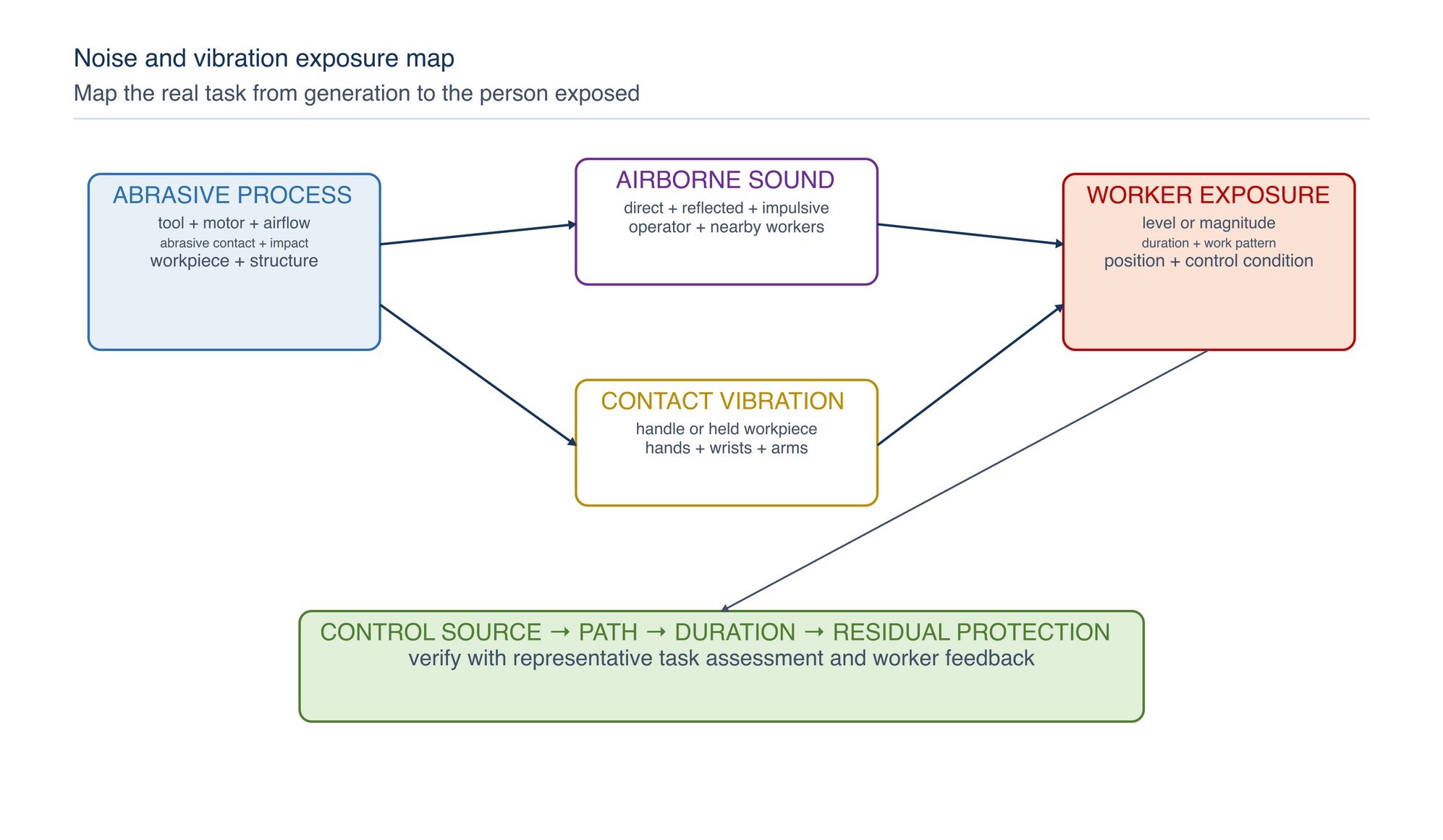
Noise reaches the ear through the air and, in some circumstances, through structures that radiate sound. Hand-arm vibration enters through contact with a powered tool, a hand-guided machine or a workpiece held against a powered machine. Grinding, sanding, cutting and polishing can create both at the same time.
| Hazard | Main pathway | Typical abrasive-work source | Principal health concern |
|---|---|---|---|
| Continuous or varying noise | Airborne sound to the ear | Motor, abrasive contact, extraction, compressed air, rattling guards | Permanent hearing damage, tinnitus, fatigue and reduced warning-signal awareness |
| Impulsive or impact noise | Short-duration pressure peaks | Workpiece impact, hammering, dropped stock, explosive release | High short-term hearing risk and startle response |
| Hand-arm vibration | Tool handle or vibrating workpiece into hands and arms | Portable grinder, sander, cut-off tool, polisher or hand-fed pedestal machine | Vascular, neurological and musculoskeletal injury, including hand-arm vibration syndrome |
| Whole-body vibration | Seat, feet or supporting surface into the body | Mobile plant, vibrating platform or vehicle | Discomfort and musculoskeletal risk, commonly involving the lower back |
This chapter concentrates on occupational noise and hand-arm vibration because these are directly associated with handheld and hand-fed abrasive work. Where vehicles, mobile plant or vibrating platforms are involved, assess whole-body vibration separately.
Identify noise before it becomes routine
Noise often becomes accepted because it is familiar. Treat the following as prompts for formal evaluation:
- conversation at normal voice becomes difficult at close working distance;
- workers raise their voices or remove hearing protection to communicate;
- ringing, buzzing or dulled hearing follows a shift or task;
- powered tools, compressed air, impact work or multiple machines operate together;
- alarms or verbal warnings are difficult to recognise;
- sound changes sharply with contact force, workpiece position or abrasive condition;
- a quiet task is performed beside a louder uncontrolled process; or
- maintenance work exposes a person closer to a source than normal production.
The DOSH excessive-noise identification checklist uses practical observations such as raised-voice communication, powered machinery and impact sources to decide whether a noise-risk assessment is needed. These observations are screening prompts. They do not quantify exposure. [S312]
Map the complete work cycle
Observe the entire shift, not only the moment when abrasive contact looks most intense. Include:
- tool startup and free running;
- first contact, steady cutting and exit;
- repositioning and repeated short contacts;
- abrasive dressing, cleaning or changing;
- compressed-air use and dust extraction;
- workpiece loading, unloading and impact;
- maintenance, fault finding and test running;
- nearby machines and simultaneous tasks;
- travel between noisy zones; and
- actual trigger or contact time for each vibrating tool.
Group workers only where their tasks, sources, durations and positions are genuinely similar. A supervisor who enters several noisy areas, a maintenance technician working close to an open machine and an operator stationed at one guarded process may have different exposure patterns even in the same workshop.
Apply the control hierarchy
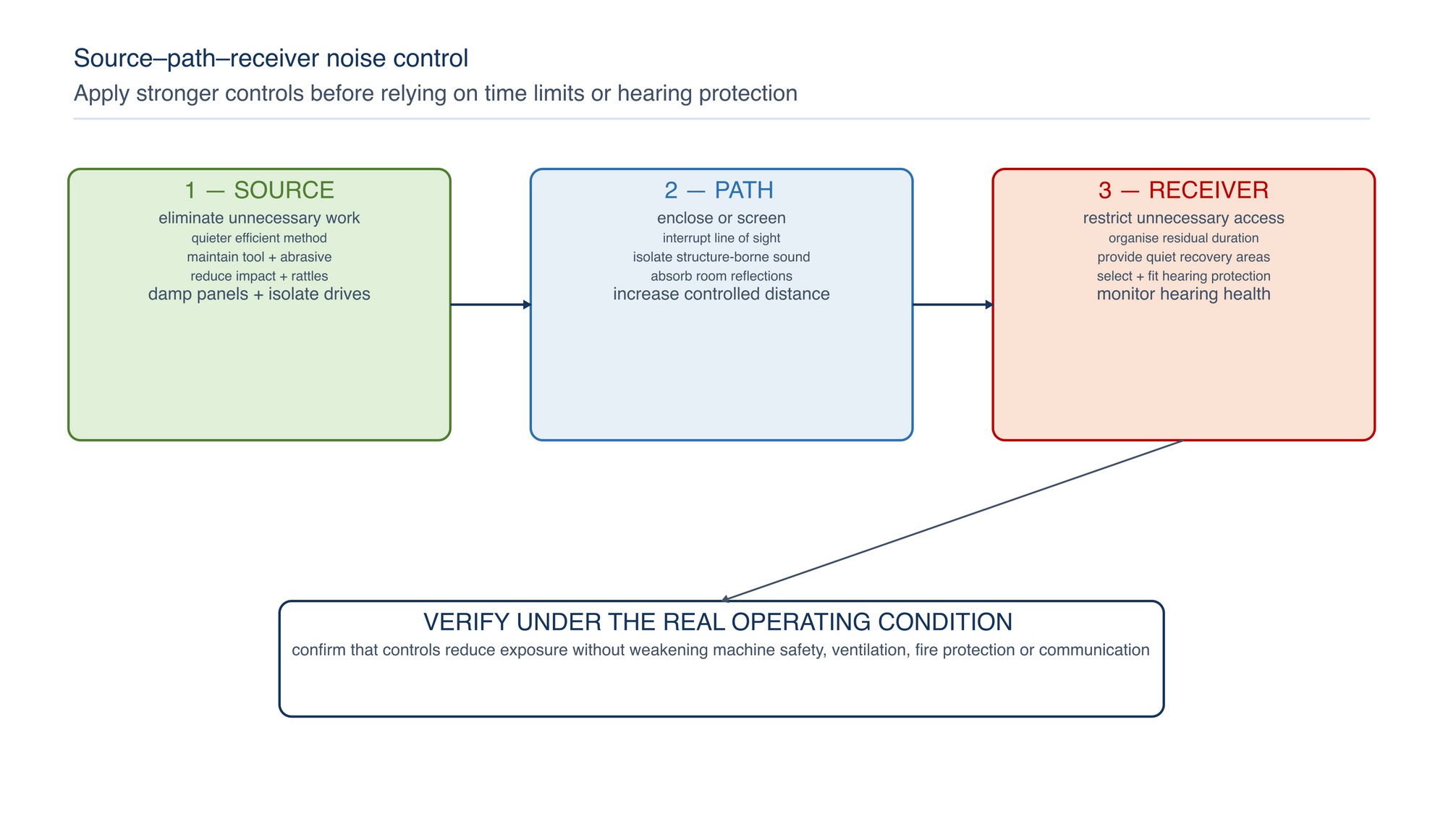
Use the strongest practicable control first:
- remove unnecessary grinding, cutting, impact or compressed-air work;
- change the design, preparation or production sequence so less finishing is required;
- mechanise, automate or isolate repetitive high-exposure work;
- substitute a quieter or lower-vibration method that still performs the task safely and efficiently;
- reduce noise and vibration at the machine, abrasive contact and work support;
- interrupt the transmission path with isolation, damping, enclosures, barriers or distance;
- organise access and duration around the residual exposure;
- use correctly selected and fitted hearing protection for residual noise; and
- verify performance through assessment, inspection and worker feedback.
Do not extend a slow, unsuitable process merely because its declared emission appears lower. If it takes much longer, creates poor control or requires greater force, total exposure and other risks may increase. Select the method for safe, efficient removal and finish quality as well as noise and vibration.
Select suitable and efficient equipment
Compare tools that are capable of completing the same application. Consider:
| Selection factor | Why it matters | Verification question |
|---|---|---|
| Task capacity | An underpowered or unsuitable tool may prolong exposure and encourage force | Can it complete the work efficiently within its intended use? |
| Declared noise information | Supports like-for-like procurement screening | Were values measured and reported using a comparable method? |
| Declared vibration information | Helps identify unusually high-emission options | Does the information represent the intended accessory and application? |
| Control features | Isolation, balancing, speed control or damping may reduce transmission | How must the feature be used and maintained to remain effective? |
| Ergonomics | Weight, handle position and trigger design affect grip and fatigue | Can the operator maintain a neutral posture without excessive grip? |
| Accessory system | Abrasive, backing, flange, guard and attachment affect stability | Is the complete combination approved and compatible? |
| Service support | Wear and faults can increase exposure | Are inspection criteria, spares and competent repair available? |
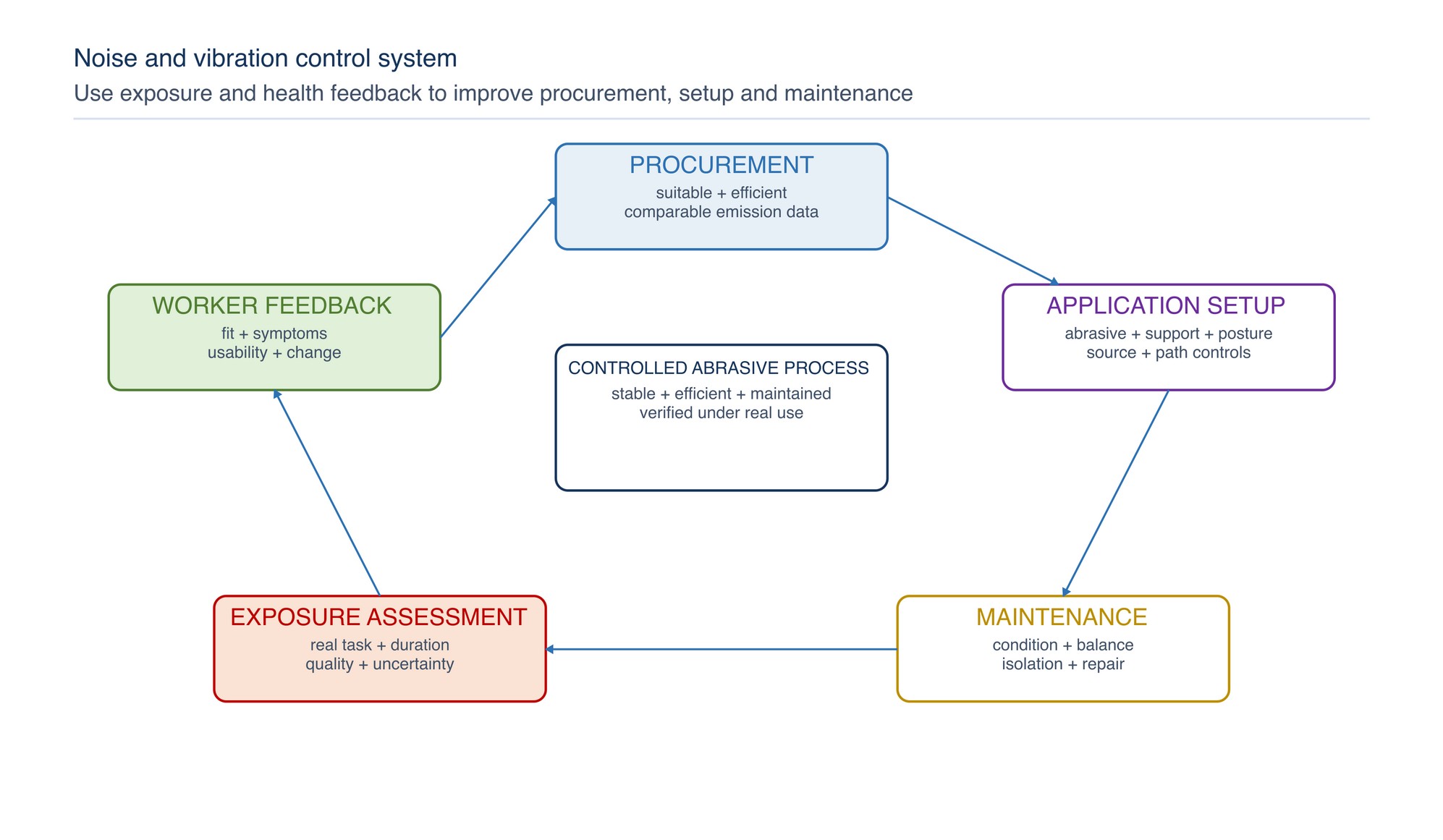
Battery power does not by itself establish lower noise or vibration. HSE comparative research found that battery-powered tools can perform higher or lower than traditional equivalents depending on tool and task. Compare suitable models using application-relevant information and, where needed, representative in-use evaluation. [S318]
When an exact tool, abrasive or accessory value is required, Refer to the product label, Technical Data Sheet, or MKTECH representative.
Keep the machine–abrasive system stable
Abnormal vibration often indicates energy being wasted in movement that does not contribute to the cut or finish. Common contributors include:
- damaged, distorted, unsuitable or incorrectly stored abrasive products;
- incorrect mounting, flange condition or tightening method;
- contamination between mounting surfaces;
- imbalance, excessive runout or eccentric tracking;
- loaded, glazed or unevenly worn abrasive surfaces;
- damaged backing pads, belts, contact wheels or interface layers;
- worn bearings, loose fasteners, damaged guards or flexible couplings;
- unsuitable speed selection where speed adjustment is permitted;
- excessive force, unstable entry or interrupted contact;
- unsupported, resonant or thin workpieces; and
- poor workstation stiffness or machine anchorage.
Never continue operating merely to see whether severe vibration will settle. Stop, isolate as required and inspect the complete system. Do not dress, reshape, modify or remount an abrasive product except by an approved method for that product type.
Match the control to the abrasive process
| Application | Main contributors | Practical control direction |
|---|---|---|
| Portable angle grinding | Abrasive contact, motor, cooling air, imbalance, force and workpiece resonance | Use a suitable efficient abrasive; support the work; maintain the tool; avoid side loading and excessive force |
| Abrasive cutting | High contact energy, binding, unstable work and thin resonant sections | Secure the work, keep the cut aligned, avoid twisting and use the correct guarded cutting arrangement |
| Random-orbital or disc sanding | Airflow, backing-pad condition, abrasive loading, surface discontinuity and hose drag | Match abrasive and backing; keep extraction paths clear; support hoses; replace damaged or loaded components |
| Belt grinding | Belt joint, tracking, platen/contact wheel, work support and enclosure radiation | Maintain tracking and tension by the machine procedure; inspect contact surfaces and isolate radiating panels |
| Pedestal grinding | Wheel condition, mounting, guard, work rest, motor and workpiece contact | Maintain wheel and machine; set work support correctly; isolate hand-fed support from avoidable machine vibration |
| Buffing and polishing | Flexible wheel condition, compound loading, spindle balance and grip | Maintain wheel build and balance; use suitable support; avoid catching edges and excessive pressure |
Changing only the abrasive grit may not solve a noise or vibration problem. Confirm material, removal objective, contact area, tool power, speed range, backing, guard, support and technique as one application system.
Reduce noise at the source
Source control is normally more reliable than trying to protect every exposed person. Practical measures include:
- maintain bearings, drives, fasteners, guards and panels;
- eliminate rattles, looseness and unnecessary impacts;
- use low-noise compressed-air nozzles where air use is necessary and suitable;
- reduce material drop height and cushion impact surfaces where compatible;
- separate vibrating panels from the machine or add engineered damping;
- smooth turbulent airflow paths in ducts and pneumatic systems;
- reduce unnecessary free-running time;
- isolate or relocate secondary sources such as extraction fans; and
- procure quieter equipment before an old machine becomes locked into production.
Maintenance is a noise control, not only a reliability activity. A new rattle, tonal sound, bearing whine or contact squeal should trigger inspection because it may signal a developing fault, poor setup or unstable process.
Control the transmission path
When source control cannot complete the job, interrupt the path between source and people.
| Path control | Suitable use | Important limitation |
|---|---|---|
| Full or partial enclosure | Stationary source that can operate behind closed panels | Openings, gaps and unsealed penetrations can dominate leakage; ventilation and fire hazards must remain controlled |
| Acoustic barrier or screen | Direct line-of-sight sound, especially at higher frequencies | Sound can pass around edges and reflect from ceilings or walls |
| Absorptive treatment | Reverberant rooms with hard reflective surfaces | It reduces reflections but does not replace source control or block direct sound |
| Vibration isolation | Structure-borne transmission from machine, duct or pipe | Incorrect isolator selection can increase movement or compromise stability |
| Damping | Thin panels, guards or chutes that radiate sound | Material and placement must suit temperature, cleaning, fire and process conditions |
| Distance or remote operation | Tasks not requiring continuous close attendance | Moving one person must not expose another or weaken supervision |
An acoustic enclosure must preserve cooling, dust extraction, spark control, visibility, access, interlocking and emergency arrangements. A barrier should be close enough and large enough to interrupt the direct path without introducing collision, handling or line-of-sight hazards. [S317]
Understand what measurements mean
A sound-level reading describes a location and time under stated conditions. A personal dosimeter follows a worker and integrates changing exposure. Frequency information supports control design and hearing-protector selection. Peak measurements address short impulsive events.
ISO 9612:2025 specifies methods for measuring workers' occupational noise exposure, calculating exposure level, observing work conditions and estimating uncertainty. It does not calculate the sound at the ear beneath a hearing protector. [S313]
Representative assessment should document:
- worker and task or similar exposure group;
- measurement strategy and instrument configuration;
- calibration and field checks;
- operating condition, material, tool and abrasive;
- duration, cycles, breaks and unusual events;
- nearby sources and room conditions;
- uncertainty and limitations; and
- priorities for control and follow-up.
A smartphone reading can be useful for awareness or finding a louder condition, but it should not be used as the sole basis for statutory exposure decisions, hearing-protector attenuation calculations or declaring a task safe.
Distinguish emission from exposure
Manufacturer emission data describe a defined test condition. Worker exposure describes the person's actual work pattern and environment. They are related but not interchangeable.
For hand-arm vibration, representative workplace evaluation considers frequency-weighted vibration in three axes together with the duration of exposure. ISO 5349-1 establishes the general evaluation framework, while ISO 5349-2 provides practical workplace measurement guidance, including the need to represent tool condition, task, grip, workpiece and operating mode. [S314; S315]
For procurement, declared data help compare candidate equipment when methods and tasks are comparable. For exposure control, use representative workplace information. Do not convert a catalogue value into a universal daily “safe time” without a competent assessment of the real task and all contributing exposures.
Reduce hand-arm vibration at the task
Use a combined technical and organisational approach:
- eliminate or automate high-vibration work where practicable;
- use a suitable lower-vibration method that completes the task efficiently;
- support heavy tools with balancers, jigs or suspension systems;
- fixture the workpiece to reduce gripping and unstable contact;
- maintain neutral wrist and arm posture;
- use only the grip force needed to control the tool safely;
- keep hands warm and dry where cold conditions aggravate symptoms;
- maintain tools, bearings, handles and vibration-reduction features;
- replace damaged, worn, unbalanced or inefficient abrasives promptly;
- organise work to avoid long uninterrupted periods of vibration; and
- account for all vibrating tools used during the day.
Anti-vibration gloves may help with warmth and some contact conditions, but they are not a substitute for reducing vibration at the source. Do not assume a glove produces a defined exposure reduction unless the complete assessment supports that conclusion.
Design the workstation for control
The workstation influences grip force, posture, contact stability and exposure time. Arrange work so that:
- the task is between comfortable elbow and shoulder levels where practicable;
- heavy workpieces are supported rather than held against the abrasive;
- jigs resist movement without forcing the hands close to the hazard;
- a suspended or balanced tool remains controllable through its full path;
- hoses and cables do not pull the tool off line;
- lighting reveals the contact point without requiring the operator to lean closer;
- work rests are stable and maintained to the machine procedure;
- the operator is not positioned between a noise source and a reflecting corner; and
- controls can be reached without releasing a secure working posture.
For repetitive fixed work, HSE guidance specifically supports jigs and suspension systems that reduce arm loading and tight grip, including counterbalancing a heavy grinder at a permanent workstation. [S316]
Organise residual exposure responsibly
Administrative controls support engineering controls but depend on consistent supervision. Use them to:
- restrict unnecessary entry to noisy work areas;
- schedule noisy work when fewer people are present;
- separate noisy and quiet tasks spatially;
- provide genuinely quiet recovery areas;
- limit individual trigger time and total time in noisy zones;
- rotate tasks only where this reduces individual exposure without spreading risk;
- coordinate contractors and neighbouring processes;
- keep doors to acoustic enclosures closed during operation; and
- record task changes that can invalidate an assessment.
Do not use job rotation as the only response where a practical source control is available. Do not transfer a noisy or vibrating task to another worker without accounting for that person's existing exposures and competence.
Select hearing protection for the residual noise
Hearing protection must suit the measured or competently assessed exposure, frequency content, work, wearer and other PPE. Selection should achieve sufficient protection while preserving necessary communication and alarm awareness.
| Selection question | Practical consideration |
|---|---|
| Is attenuation sufficient? | Use valid exposure and protector data through the applicable method; do not assume the package number equals protection achieved by every wearer |
| Will it fit this worker? | Ear canal shape, head size, hair, jewellery and technique affect fit |
| Is it compatible? | Eyewear temples, respirator straps, helmets and face shields can disturb earmuff seals or placement |
| Can it be worn for the full exposure? | Heat, pressure, hygiene and communication affect consistent use |
| Are signals still usable? | Verify alarms, vehicles, radio and speech under actual conditions |
| Is double protection indicated? | Base the decision on the noise assessment and programme method, not assumption |
| Can fit be checked? | Individual fit testing provides a personal attenuation result and targeted coaching |
ISO 4869-2 provides recognised methods using octave-band, HML or SNR information to estimate protected A-weighted level. Individual fit can differ materially from laboratory-labelled performance; NIOSH recommends fit testing where available. [S294; S301]
Fit, inspect and care for protectors
For earplugs:
- use clean hands and the taught insertion method;
- select the correct model and size;
- seat the plug consistently in both ears;
- replace disposable plugs after their intended use;
- clean reusable plugs by the documented method; and
- discard hardened, torn, contaminated or misshapen items.
For earmuffs:
- inspect cushions, cups, headband and attachment points;
- keep the seal free from hair, eyewear temples, clothing and respirator straps;
- replace worn cushions and hygiene components as specified;
- store them clean, dry and protected from deformation; and
- confirm helmet-mounted cups engage fully in the use position.
Never lift a protector for conversation while remaining in the noise. Move to a controlled quiet location or use an approved communication method that preserves protection.
Recognise and report early symptoms
Noise-related warning signs include ringing or buzzing in the ears, temporary dullness, difficulty understanding speech and a need to increase audio volume after work. Hearing damage can develop without pain and may become permanent.
Hand-arm warning signs include:
- tingling or numbness in fingers;
- reduced touch or temperature sensitivity;
- loss of grip strength or dexterity;
- fingers becoming pale in cold or wet conditions;
- pain or delayed recovery after tool use; and
- difficulty with fine tasks such as fastening buttons or handling small components.
Report symptoms promptly through the workplace health system. Early reporting supports exposure review, control improvement and appropriate occupational-health assessment. Do not wait until symptoms interfere with normal work.
Diagnose abnormal noise and vibration
| Symptom | Likely contributors | Corrective direction |
|---|---|---|
| Tool vibrates before contact | Abrasive damage, mounting error, imbalance, worn bearing or loose component | Stop; isolate as required; inspect the abrasive, mounting and tool before release |
| Vibration rises only during contact | Excessive force, unstable work, wrong abrasive, loading, glazing or interrupted contact | Stabilise the work and verify application selection and technique |
| Thin workpiece “drums” loudly | Resonance, insufficient support or broad unsupported area | Add safe support or damping and review contact method |
| Sharp squeal during grinding | Glazing, rubbing, unstable contact, unsuitable specification or machine resonance | Stop and review abrasive condition, pressure, support and machine state |
| New rattle from guard or enclosure | Loose fastener, cracked panel, contact with rotating parts or worn mounting | Stop and correct before further operation |
| Noise increases after enclosure work | Open gap, failed seal, bypass path, removed absorption or restricted cooling | Restore enclosure integrity and verify temperature and control performance |
| Operator grips harder over time | Tool weight, poor balance, hose drag, awkward posture, blunt abrasive or fatigue | Improve support, workstation, abrasive efficiency and work organisation |
| Hearing protector repeatedly removed | Poor fit, discomfort, communication need, heat or incompatible PPE | Reassess selection and fit; provide suitable alternatives and communication control |
| Exposure assessed one task at a time only | Several tools contribute across shift | Combine all work-cycle contributions in the competent assessment |
Troubleshoot from the source outward: tool and abrasive, mounting and bearings, workpiece and fixture, workstation and structure, enclosure and room, then duration and personal protection. Verify the correction under the real task.
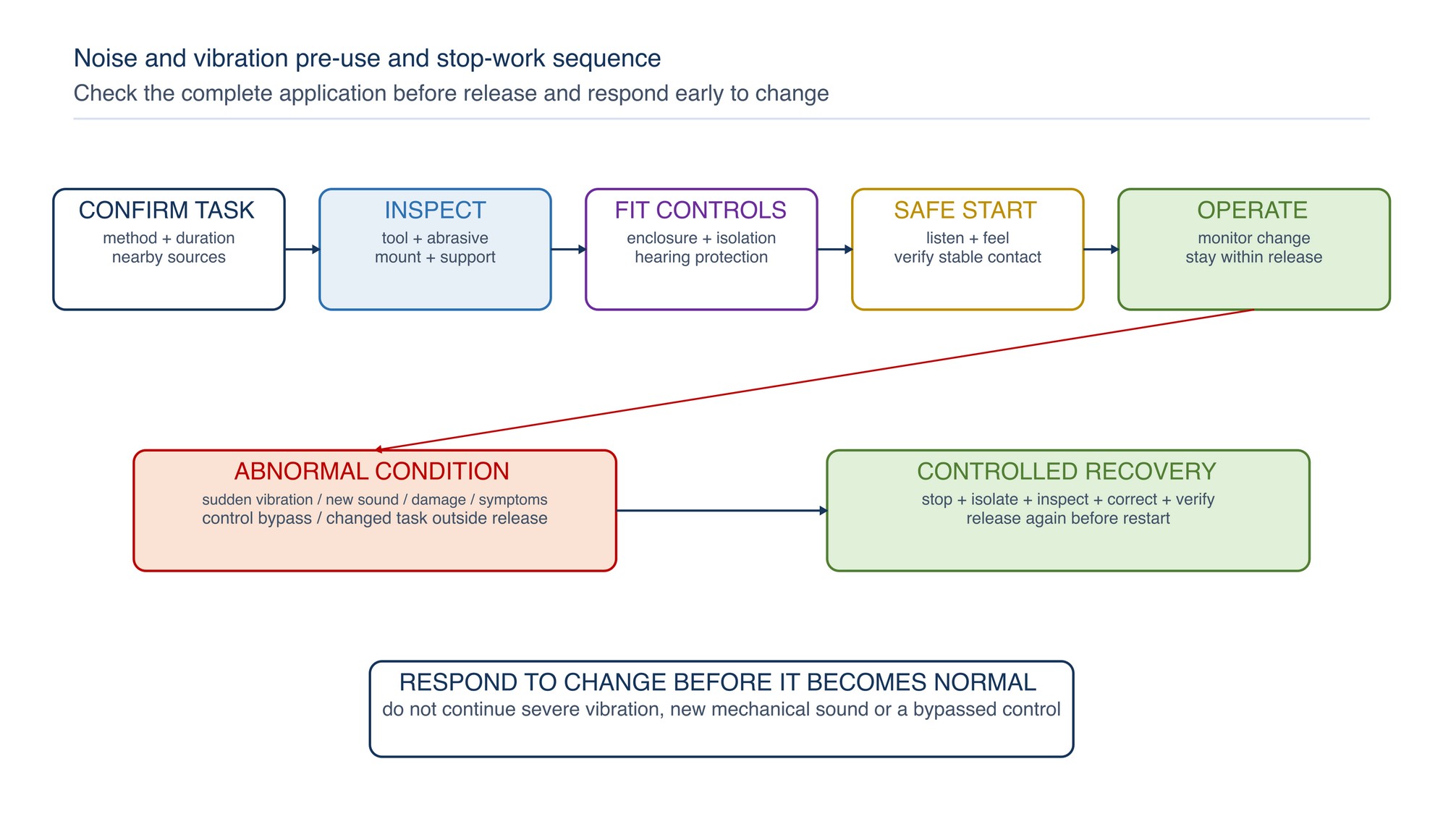
Know when to stop work
Stop the task when:
- a tool or hand-fed workpiece shows sudden, severe or increasing vibration;
- the abrasive product is damaged, loose, incorrectly mounted or unstable;
- a new rattle, knock, squeal, bearing sound or structural movement appears;
- the workpiece, fixture, rest or support is unstable;
- a guard, enclosure, isolator, damper or acoustic control is damaged;
- required hearing protection is unavailable, damaged or cannot be fitted correctly;
- an alarm or warning signal cannot be detected by the approved method;
- a changed tool, abrasive, material, duration or layout is outside the assessed arrangement;
- the operator experiences ringing ears, sudden hearing change, tingling, numbness, loss of grip or finger colour change; or
- noise or vibration control has been bypassed.
Move to a controlled area, isolate equipment as required and report the condition. Restart only after the cause has been corrected, the equipment and application have passed their release checks, and any required health or exposure follow-up has been arranged.
Noise and vibration release checklist
Before work begins, confirm:
- [ ] the complete work cycle and all nearby sources have been considered;
- [ ] the tool and abrasive are suitable and efficient for the application;
- [ ] declared noise and vibration information has been used only within its stated conditions;
- [ ] the abrasive, backing, flanges, guard, bearings and machine are serviceable;
- [ ] the workpiece, fixture, rest and workstation are stable;
- [ ] hoses, cables and extraction do not increase grip force or instability;
- [ ] source controls, isolation, damping, enclosure and absorption are intact;
- [ ] noisy areas and access controls are clearly managed;
- [ ] actual exposure duration includes every noisy and vibrating task;
- [ ] hearing protection is selected from the assessment and fits the individual;
- [ ] eyewear, respirator, helmet and hearing protection remain compatible;
- [ ] alarms, communication and emergency arrangements remain effective;
- [ ] operators recognise early hearing and hand-arm symptoms;
- [ ] abnormal sound or vibration has a clear reporting and isolation route; and
- [ ] restart follows correction and a complete release check.
Spark, Fire and Explosion Control
The next chapter, Spark, Fire and Explosion Control, begins on the following page of the printed handbook (page 440), outside this chapter extract.