
Production managers, workshop supervisors, safety and health personnel, operators, maintenance teams, technical buyers, trainers and application personnel involved in grinding, cutting, sanding, polishing, weld preparation or chemical surface finishing
Risk-based selection, fitting, compatibility, inspection, use, care and replacement of eye, face, hearing, respiratory, hand, body and foot protection for industrial abrasive and surface-finishing work.
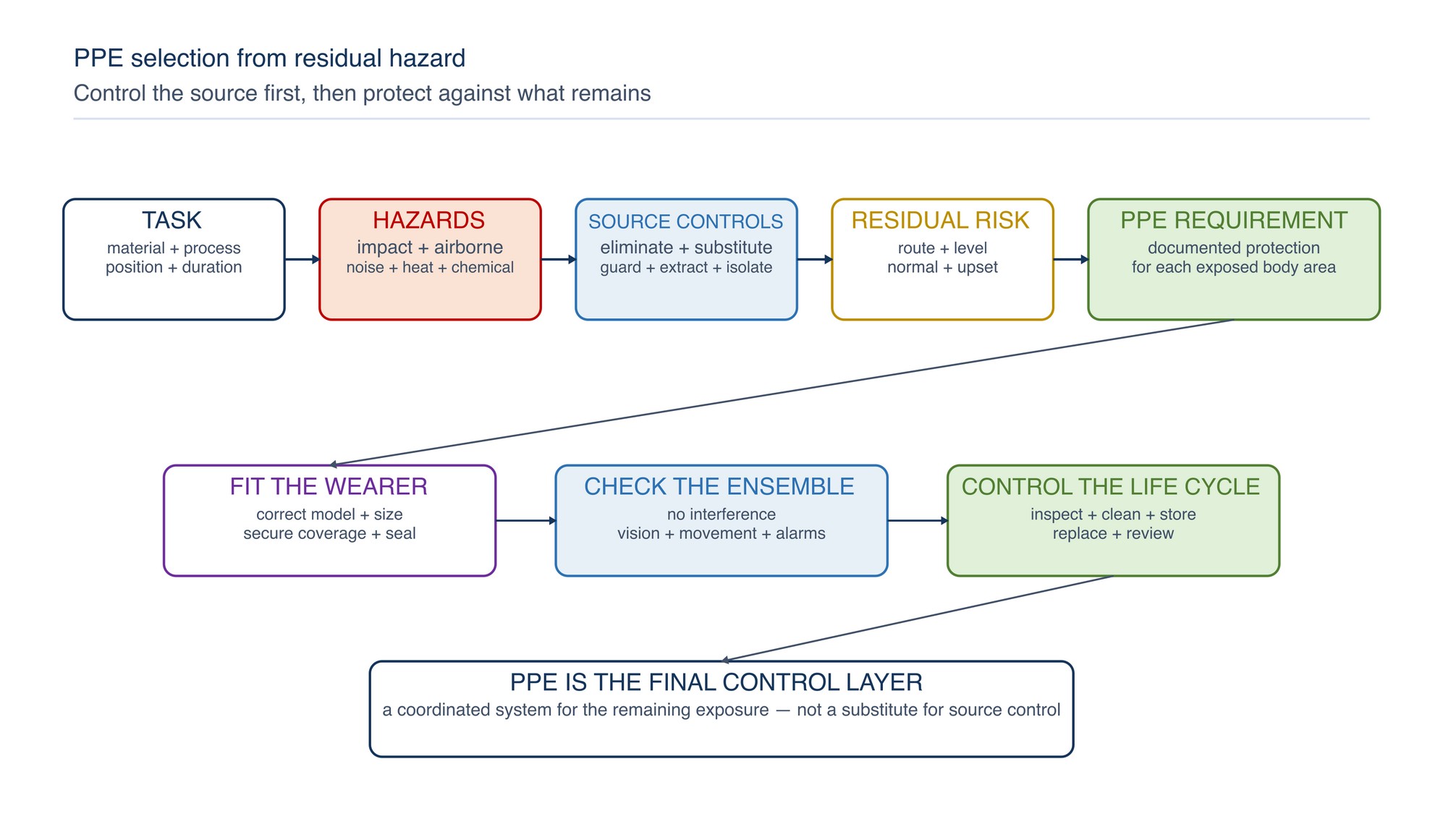
Personal protective equipment reduces the worker's exposure when hazards cannot be eliminated or adequately controlled by engineering and work-practice measures. It does not make an uncontrolled process acceptable. The correct sequence is to understand the task, control the source, define the remaining exposure, select documented protection, verify fit and compatibility, and supervise correct use. [S275; S288] Never reach toward a moving abrasive product, rotating workpiece or drive system with a gloved or bare hand. Do not enter such an environment on the basis of this chapter alone.
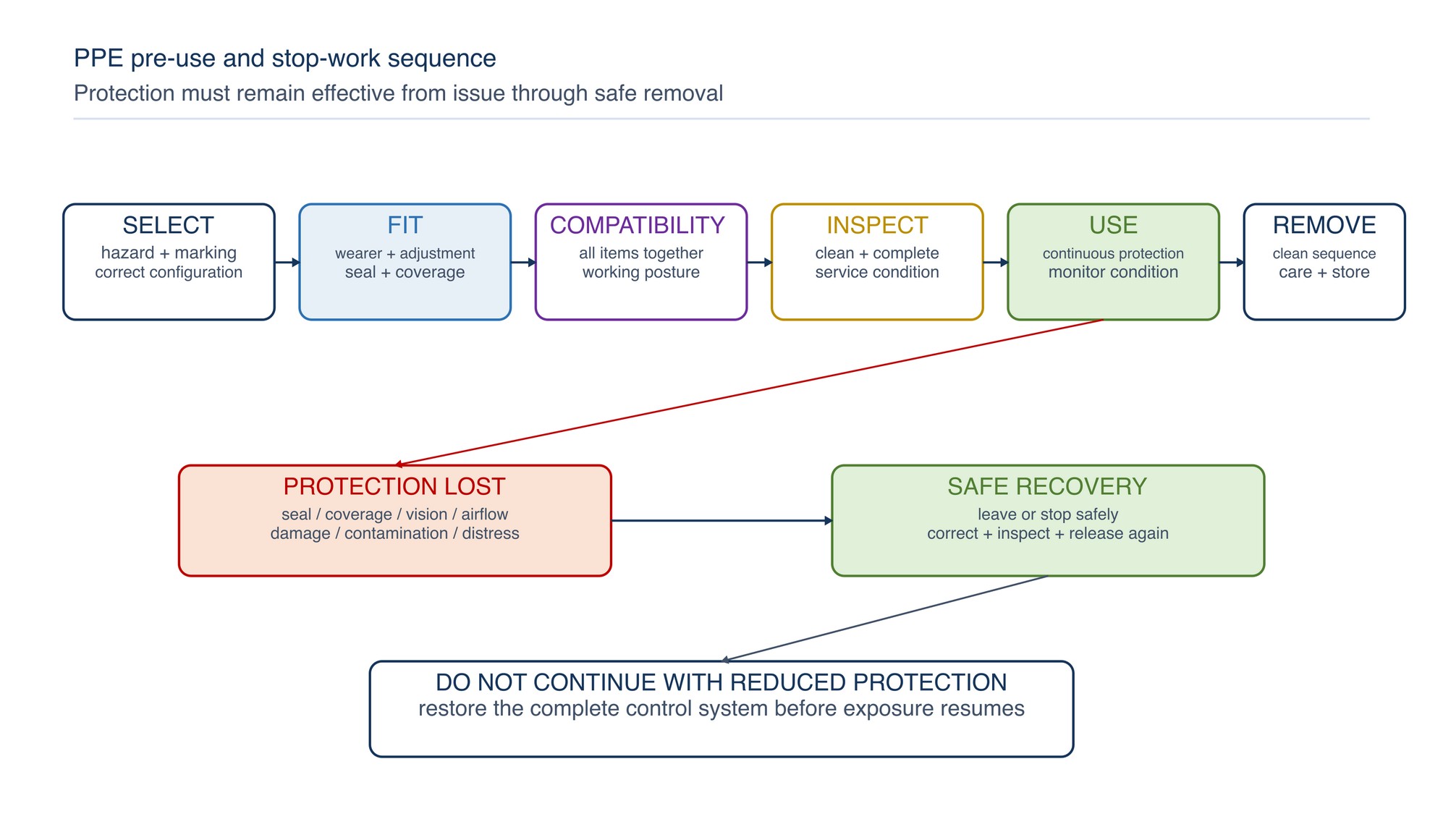
PPE is a coordinated protection system for the residual hazard. Each item must suit the task, fit the wearer, remain compatible with the other items and retain its protective function throughout the work.
Chapter objectives
After this chapter, the reader should be able to:
- position PPE correctly within the hierarchy of control;
- translate abrasive-process hazards into protection requirements by body area;
- distinguish primary eye protection from supplementary face protection;
- select hearing protection using valid noise and attenuation information;
- recognise when a respiratory-protection programme is required;
- distinguish particulate filters from gas and vapour cartridges;
- select gloves for mechanical, chemical and thermal hazards without creating an entanglement risk;
- choose clothing and footwear for the actual spark, heat, chemical, impact and slip hazards;
- check that all items remain compatible when worn together;
- inspect, clean, store and replace PPE using controlled criteria; and
- troubleshoot common PPE failures before exposure occurs.
Begin with the residual hazard
PPE selection starts after the task and its controls have been reviewed. Identify the workpiece, coating, abrasive, process fluid, tool, work position, duration, nearby work and foreseeable upset conditions. Determine how harm could reach the worker: impact, inhalation, skin contact, eye splash, noise, heat, sharp edges or falling material.
Then apply the hierarchy:
- eliminate unnecessary grinding, cutting or chemical handling;
- substitute a lower-hazard material or process where practicable;
- use guards, enclosure, local extraction, wet methods, screens, fixtures and noise control;
- control access, competence, work sequence, exposure time and housekeeping; and
- select PPE for the exposure that remains.
Malaysian USECHH requirements place chemical PPE after preferred control measures, or as an interim or supplementary measure where those controls do not adequately control exposure. Where chemical PPE is used, selection, issue, maintenance, inspection, training, suitability and fit must be managed as a system. [S288]
Build the ensemble by hazard and body area
Avoid issuing one standard kit for every task. A worker may need several items, but each must answer a defined hazard.
| Hazard from the task | Body area at risk | Typical protection decision |
|---|---|---|
| High-speed particles, fragments and swarf | Eyes and face | Suitable impact-rated primary eye protection; add appropriate face protection for broader exposure |
| Fine dust, fume, mist, gas or vapour | Respiratory tract | Source control first; suitable respiratory protection selected through the respiratory-protection programme |
| Grinding, cutting and compressed-air noise | Hearing | Suitable earplugs, earmuffs or a compatible combination selected from assessed exposure and attenuation data |
| Sharp edges, burrs and abrasive handling | Hands and forearms | Close-fitting mechanical-protection gloves or sleeves suited to cut, abrasion, puncture and grip needs |
| Chemicals and contaminated parts | Eyes, skin and respiratory tract | Chemical goggles or face protection, compatible gloves, clothing and respiratory protection as the assessment requires |
| Sparks, hot particles and hot surfaces | Face, torso, arms, legs and feet | Suitable face protection, clothing, gloves and footwear that resist the identified heat and particle exposure |
| Falling workpieces and sharp offcuts | Feet | Safety footwear with documented properties appropriate to impact, penetration, slip and other site hazards |
The ensemble must protect during setup, operation, cleaning and waste handling. A worker who is protected during grinding may still be exposed while emptying a dust collector, changing a contaminated filter or handling a hot component.
Select eye protection for the exposure
Occupational eye protectors include spectacles, goggles and other designs with different coverage and performance. ISO 16321-1 addresses common hazards including impact, dust, splash, heat and optical radiation, together with product marking and information. [S291]
Select from the hazard outward:
- Flying particles: use primary eye protection with documented impact performance suitable for the task.
- Fine airborne dust: use a design that limits entry around the eyes; ordinary open-sided spectacles may not control dust from all directions.
- Liquid splash: use chemical-splash protection compatible with the liquid and exposure direction.
- Hot particles or radiant heat: select protection documented for the relevant thermal hazard.
- Optical radiation: use the correct filter and coverage for the source; clear impact lenses do not provide welding protection.
- Prescription needs: use compatible prescription safety eyewear or a protector designed to fit over prescription lenses without disturbing coverage.
Inspect lenses for cracks, deep scratches, chemical attack, heat damage, loose components and impaired vision. Clean them using a method that will not damage coatings or transfer abrasive grit across the lens.
Understand the face-shield relationship
A face shield provides broader face coverage, but it should not be treated as automatic primary eye protection. For grinding and cutting, use suitable primary eye protection beneath the selected face protection unless the documented protector system and workplace assessment specify otherwise.
Check that the shield:
- covers the foreseeable fragment and spark directions;
- is marked and documented for the hazard;
- remains down in the operating position;
- is not cracked, deeply scratched, warped or heat damaged;
- does not contact the respirator, eyewear or hearing protection;
- allows adequate peripheral vision and head movement; and
- stays secure when the operator bends or changes posture.
For welding and related processes, ISO 16321-2 adds requirements for optical radiation, impact, fragments and hot solids. Select the welding protector and filter for the actual process and exposure; do not infer suitability from lens colour alone. [S292]
Match the eye-and-face combination to the task
| Task condition | Primary concern | Practical selection direction |
|---|---|---|
| Bench or angle grinding | High-speed particles, sparks and side exposure | Impact-rated primary eyewear plus suitable face protection and correctly positioned machine guard |
| Cutting-off | Wheel or workpiece fragments, sparks and hot offcut | Primary eyewear plus broad face coverage; maintain the controlled fragment plane and spark path |
| Power sanding | Dust and ejected debris | Eye protection with coverage suited to dust direction; coordinate with extraction and respirator |
| Wire-brush or non-woven finishing | Wire or fibre release and debris | Primary impact protection plus face coverage selected for the ejection hazard |
| Chemical cleaning or pickling | Splash, mist and contaminated droplets | Chemical-splash eye protection with compatible support face and skin protection as required |
| Weld preparation near active welding | Impact plus optical radiation | Separate the tasks or select documented combined protection for both hazards |
Fogging is a control problem, not a reason to remove protection. Review ventilation, lens treatment, fit, work-rest cycles and compatibility with the respirator. Replace a protector that cannot provide clear vision without compromising coverage.
Select hearing protection from assessed noise
Grinding, cutting and finishing noise varies with the tool, abrasive, workpiece, enclosure, contact condition and neighbouring processes. Selection therefore requires workplace noise information rather than a generic protector rating. Malaysian Noise Exposure Regulations 2019 provide the current national framework for assessment, control, hearing protection, training and health surveillance. [S290]
ISO 4869-2 provides octave-band, HML and SNR methods for estimating protected A-weighted sound levels. The calculation method and input data must match the workplace assessment. [S294]
Consider:
- noise level, frequency character, duration and impulsive content;
- protector attenuation data and the method used to apply it;
- fit variation between workers;
- compatibility with eyewear, helmets, respirators and face shields;
- communication, alarms and situational awareness;
- heat, humidity, hygiene and the need for repeated fitting; and
- whether dual protection is required by the assessed exposure.
Avoid unnecessary over-protection that prevents communication or warning detection. Provide a suitable choice of protectors where several models meet the protection requirement; comfort and usability influence consistent wear. NIOSH also emphasises attenuation, fit, comfort, compatibility and communication rather than rating alone. [S301]
Fit and inspect hearing protectors
Earplugs must be inserted according to their design and training. Earmuff cushions must seal around the ear without gaps from eyewear temples, hair, headwear or respirator straps. Helmet-mounted muffs must be compatible with the helmet and attachment system.
Before use, check:
- plugs are clean, undamaged and within their intended service condition;
- reusable plugs retain their shape and flanges;
- earmuff cushions are soft, complete and sealing;
- cups, headband and attachment arms are not cracked or distorted;
- tension is adequate without unsafe modification; and
- the selected configuration matches the assessed work area.
Replace disposable products after their intended use. Replace reusable components when damaged, hardened, contaminated or no longer sealing. Store clean protectors away from dust, chemicals, heat and crushing.
Treat respiratory protection as a programme
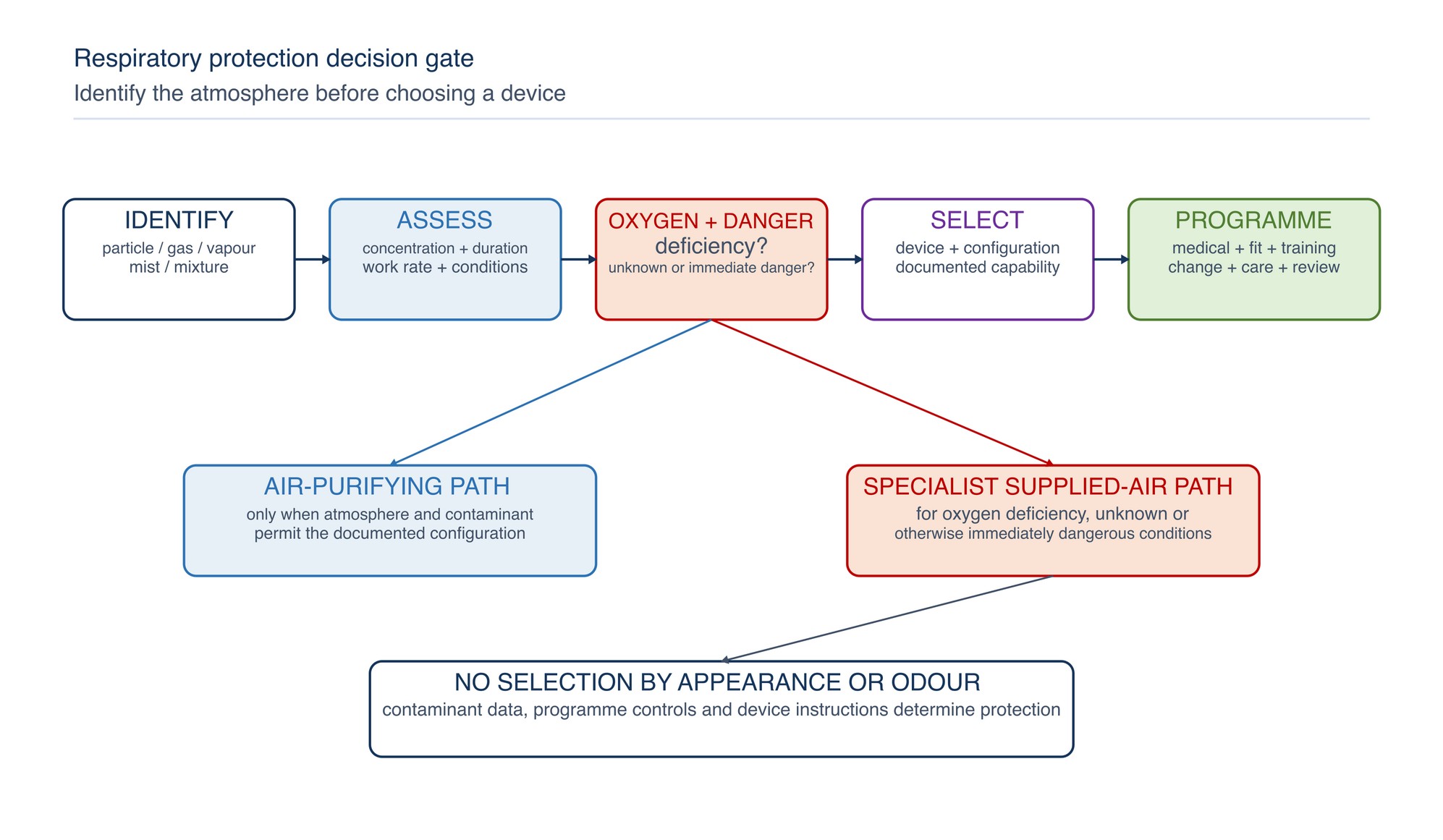
A respirator is not selected by dust visibility or mask appearance. A complete programme identifies the contaminant, exposure level, physical form, oxygen condition, work rate, duration and other hazards; selects a suitable device; confirms medical suitability and fit; and controls training, inspection, cleaning, storage, filter or cartridge change, and programme review. ISO/TS 16975-1 establishes this programme approach. [S293]
The responsible person should determine:
- what contaminants are present or can be generated;
- whether they are particles, gases, vapours, mists or a mixture;
- the concentration and exposure pattern;
- whether oxygen deficiency or an immediately dangerous condition is possible;
- the required level and duration of protection;
- eye, skin, heat and impact hazards that affect device choice;
- wearer medical and ergonomic factors; and
- cleaning, storage, filter and cartridge controls.
Atmosphere-supplying equipment requires specialist selection where an air-purifying respirator is unsuitable, including oxygen-deficient or otherwise immediately dangerous environments. Do not enter such an environment on the basis of this chapter alone.
Distinguish particles from gases and vapours
Grinding and sanding commonly generate particles, but coatings, solvents, cleaning chemicals, heated contamination and some metals can create gases, vapours or complex fumes. A particulate filter does not protect against gases or vapours. A gas or vapour cartridge does not automatically protect against particles unless the documented configuration includes suitable particulate protection.
| Airborne hazard | Selection question | Common error to prevent |
|---|---|---|
| Dust from metal, coating, abrasive or filler | What material is airborne, at what concentration and particle form? | Choosing a disposable mask from appearance alone |
| Welding or thermal fume near finishing work | What metals, coatings and process conditions contribute? | Treating all fume as ordinary nuisance dust |
| Solvent or coating vapour | Which chemical and concentration must the cartridge address? | Assuming a particulate filter removes vapour |
| Acid or alkaline mist | Is the hazard liquid aerosol, vapour or both? | Selecting only for splash and ignoring inhalation |
| Mixed contaminant | Which combined device and change control are documented? | Combining unapproved components or relying on odour |
| Unknown or oxygen-deficient atmosphere | Is air-purifying protection prohibited? | Entering before competent atmospheric assessment |
Use the safety data sheet, workplace assessment and respirator manufacturer's selection information together. Refer to the product label, Technical Data Sheet, or MKTECH representative.
Control respirator fit and facial seal
Tight-fitting respirators depend on a continuous face seal. Fit testing must be specific to the make, model, style and size used. A user seal check is performed each time the respirator is donned, following the manufacturer's method; it does not replace fit testing. [S300]
Hair, stubble, jewellery, eyewear parts, headwear or facial features must not cross or disturb the sealing surface. Reassess fit after a model or size change and when facial, dental or body changes could affect the seal. Respirator straps should not be moved merely to accommodate other PPE if that changes the approved wearing position.
Stop and leave the exposure area safely if breathing resistance rises unexpectedly, the seal fails, contamination is tasted or smelled, the device is damaged, airflow alarms activate, or physical distress occurs. Investigate the cause before reuse.
Manage filters, cartridges, cleaning and storage
Filter and cartridge service life depends on the device, contaminant, concentration, humidity, temperature, breathing rate and use pattern. Establish the change method from the workplace programme and manufacturer information. Odour, taste or irritation is not an acceptable primary change schedule.
After use:
- remove PPE without transferring contamination to the face or clean clothing;
- dispose of single-use components through the applicable waste route;
- clean reusable parts with the specified method;
- inspect facepiece, valves, seals, straps, threads and connectors;
- dry fully without damaging heat or sunlight;
- record controlled maintenance where required; and
- store in a clean, sealed or protected container without deforming the facepiece.
Never wash a disposable filter, use compressed air to clean it, mix components from incompatible systems or repair a respirator with improvised parts.
Select gloves by hazard—not material name
ISO 21420 covers general glove design, construction, comfort, marking and information, but it does not establish hazard-specific protection by itself. Use it with the relevant mechanical, chemical or thermal standard. [S295]
Mechanical-risk selection should consider abrasion, blade cut, tear, puncture, impact, grip and dexterity. ISO 23388 addresses these mechanical properties, but a single performance level does not describe every sharp-edge or puncture hazard. [S296]
Chemical-glove selection requires the actual chemical, mixture, concentration, temperature, contact type and expected duration. ISO 374-1 addresses chemical-risk terminology and performance requirements. Breakthrough, permeation and degradation information for one chemical must not be transferred automatically to another. [S297]
| Glove duty | Key selection factors | Stop-use signs |
|---|---|---|
| Handling unused abrasive products | Grip, cleanliness, dexterity and avoidance of product contamination | Torn, oily or grit-embedded surface |
| Handling burrs and sharp sheet | Cut, puncture and abrasion needs balanced with secure grip | Cuts, holes, worn coating or exposed liner |
| Handling hot finished work | Documented contact-heat protection, cuff and dexterity glove | Charring, stiffening, shrinkage or heat felt through |
| Chemical preparation or cleanup | Chemical-specific compatibility, cuff length, splash direction and change time | Swelling, softening, cracking, colour change or contamination inside |
| Precision measurement after finishing | Cleanliness, tactile control and part protection | Glove interferes with safe instrument control or contaminates surface |
Prevent glove-related entanglement
Gloves can protect against sharp edges and heat, yet they can also be caught by rotating spindles, chucks, drills, shafts or exposed moving parts. The machine and task assessment must decide whether gloves may be worn during operation.
Never reach toward a moving abrasive product, rotating workpiece or drive system with a gloved or bare hand.
Use guards, fixtures, brushes, hooks or handling tools to keep hands out of danger. Isolate and verify complete stop before measuring, clearing swarf, adjusting, cleaning or changing the setup. Choose close-fitting gloves where gloves are permitted; loose cuffs, damaged fingers and excess material reduce control and increase snagging risk.
Choose clothing for sparks, heat and contamination
Work clothing should fit closely enough to avoid entanglement while covering exposed skin against the assessed sparks, hot particles, sharp edges and contamination. Secure sleeves and collars. Remove jewellery, secure long hair and avoid open pockets, cuffs or trouser turn-ups that can collect hot particles.
For welding and allied-process hazards, ISO 11611:2024 covers clothing such as hoods, aprons, sleeves and gaiters for specified spatter, flame, radiant-heat and optical-radiation risks. It does not replace eye, face, hand or foot protection. [S299]
Do not assume ordinary cotton, synthetic workwear or a leather apron has a defined protective performance. Select documented properties for the exposure. Keep clothing clean; oil, solvent, metal dust and other contamination can change fire behaviour or skin exposure. Remove contaminated clothing by a method that prevents transfer to the wearer, other workers, vehicles or homes.
Select footwear for the workplace and task
ISO 20345:2021 with Amendment 1:2024 specifies general-purpose safety-footwear requirements and optional properties, including mechanical, slip, thermal and ergonomic aspects. Special chemical, electrical, molten-metal and other risks require relevant additional protection. [S298]
Assess:
- falling workpieces, tools and abrasive products;
- sharp offcuts and floor debris;
- wet, oily, dusty or uneven walking surfaces;
- sparks, hot particles and hot metal;
- chemicals and contaminated liquids;
- electrical or electrostatic conditions;
- ladder, platform and driving duties; and
- fit, support and heat comfort during the full shift.
Keep trouser legs arranged so sparks and debris cannot enter the footwear. Inspect uppers, seams, fastenings, soles and protective components. Remove footwear from service when damage, contamination or excessive wear compromises the required property.
Verify ensemble compatibility
PPE items that pass individual inspection can fail when combined. Spectacle arms may break an earmuff seal; a face shield may push a respirator; helmet fittings may prevent muffs from closing; straps may cross and move each other; goggles may redirect exhaled air and fog.
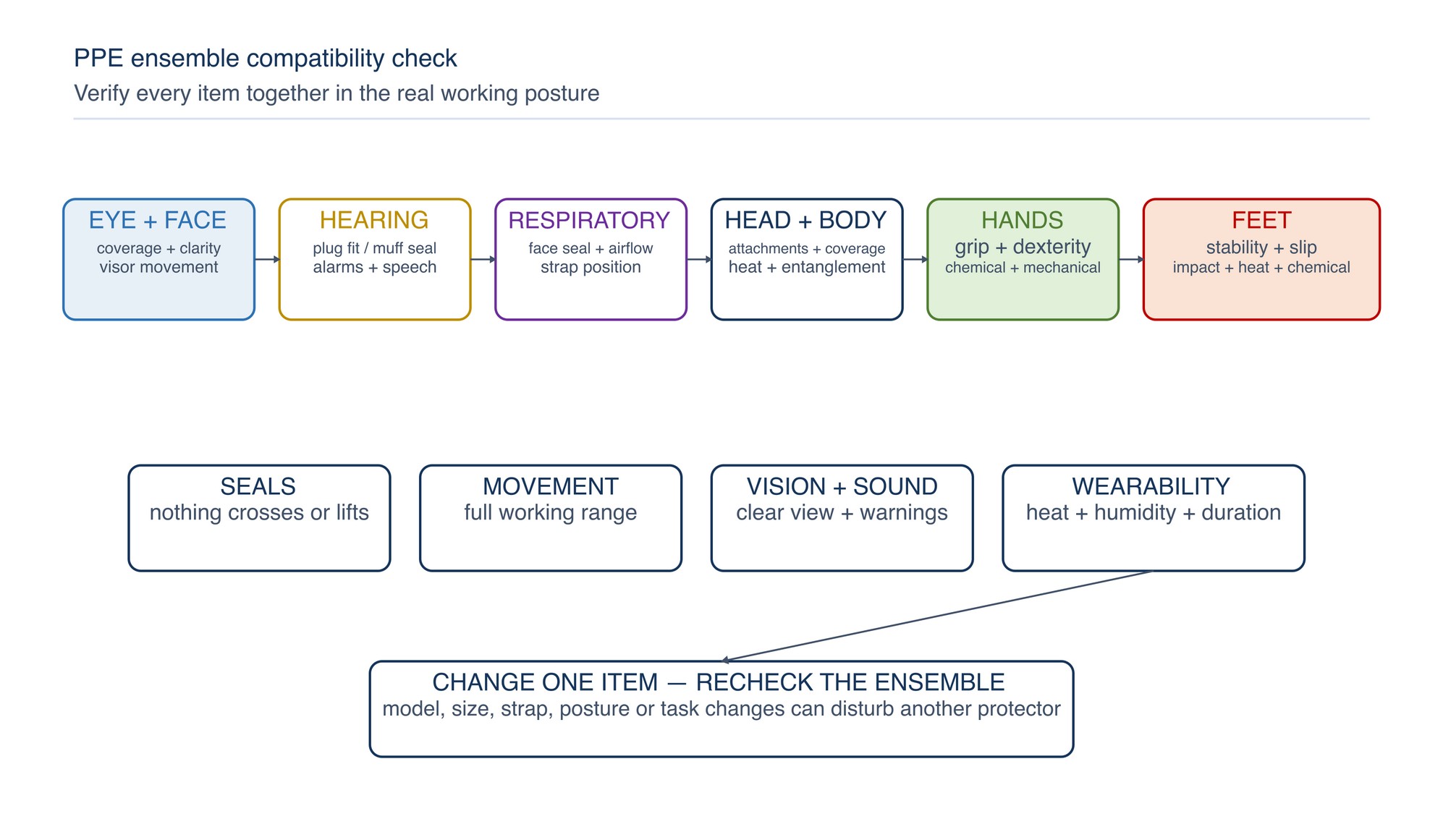
Conduct the compatibility check with the complete ensemble:
- don each item in the trained sequence;
- check eye, face, skin and respiratory coverage;
- verify respirator and earmuff seals;
- move the head, shoulders and arms through the working range;
- adopt the actual bending, kneeling or overhead posture;
- verify vision, communication and alarm recognition;
- confirm that sweat and heat will not predictably defeat fit; and
- repeat after any item, model, size or task changes.
Malaysian heat and humidity make comfort and moisture management operational issues. Provide clean replacement items, suitable rest and hygiene arrangements, and a selection that workers can wear correctly for the required period.
Inspect, clean, store and replace systematically
| PPE category | Pre-use check | Care and replacement trigger |
|---|---|---|
| Eye and face | Lens or visor clarity, cracks, marking, frame, side coverage and adjustment | Clean without scratching; replace for damage, severe abrasion, chemical attack or insecure fit |
| Hearing | Plug condition, cushion seal, cup, band and attachment | Replace soiled disposables and hardened, cracked or non-sealing reusable parts |
| Respiratory | Correct identity, facepiece, valves, straps, filters, cartridges, battery and alarms | Follow programme cleaning and change control; replace damaged or contaminated parts |
| Gloves and sleeves | Correct type, holes, coating, seams, contamination and fit | Replace for wear, penetration, degradation, internal contamination or loss of grip |
| Clothing | Correct garment, closures, holes, burns, contamination and coverage | Repair only by an approved method; replace when protective integrity is uncertain |
| Footwear | Upper, toe area, sole, tread, penetration layer, seams and contamination | Replace when worn, cut, separated, contaminated or no longer stable and protective |
Separate clean PPE from used or contaminated items. Store products away from sunlight, heat, moisture, chemicals, dust, crushing and distortion as applicable. Do not mark, drill, paint or modify PPE unless the manufacturer permits the method.
Troubleshoot PPE problems
| Symptom | Likely contributors | Corrective action |
|---|---|---|
| Eyewear repeatedly fogs | Poor compatibility, high humidity, blocked airflow, worn treatment or incorrect fit | Stop safely; review fit, ventilation, lens condition and a documented anti-fog solution |
| Face shield rises or contacts tool | Loose adjustment, incompatible headgear or wrong working posture | Replace or adjust the compatible system; do not continue with reduced coverage |
| Earmuff seal gaps at spectacles | Thick temple arms, poor cup position or incompatible combination | Select compatible eyewear or hearing protection and verify fit on the wearer |
| Earplugs loosen during shift | Incorrect size, insertion, contamination or jaw movement | Retrain fitting and provide another suitable size or model |
| Respirator leaks at nose or cheeks | Incorrect size or model, facial hair, strap interference, damage or poor donning | Leave exposure safely; correct the cause and repeat the required checks before entry |
| Breathing resistance increases | Loaded filter, wet media, blocked component or high work rate | Leave exposure safely and follow the programme's inspection and change procedure |
| Chemical glove swells or softens | Incompatible material, concentration, temperature or excessive contact time | Stop contact, remove safely, decontaminate as directed and select documented compatibility |
| Glove reduces tool control | Excess bulk, poor fit, contamination or unsuitable grip | Stop and reassess glove and handling method; never trade control for nominal protection |
| Sparks enter clothing or footwear | Open cuff, pocket, damaged closure or wrong garment arrangement | Stop, extinguish and cool safely; correct coverage before restarting |
| PPE is removed in the work zone | Heat, discomfort, communication, fogging or poor supervision | Stop the task and redesign selection, compatibility, work–rest and control arrangements |
Repeated discomfort is useful safety information. Investigate it; do not normalise partial wear, loosened straps or lifted visors.
PPE release checklist
Before exposure begins, confirm:
- [ ] the task, materials, airborne contaminants, noise, sparks, heat and chemicals are understood;
- [ ] source and engineering controls are operating;
- [ ] residual hazards have been mapped to each exposed body area;
- [ ] every PPE item has documented suitability for its assigned hazard;
- [ ] the correct make, model, size and configuration have been issued;
- [ ] primary eye protection and supplementary face protection are correctly combined;
- [ ] hearing protection is based on assessed noise and valid attenuation information;
- [ ] respiratory protection is controlled under the workplace programme;
- [ ] tight-fitting respirator fit and seal conditions are satisfied;
- [ ] filters and cartridges are correct, in service condition and within change control;
- [ ] gloves suit the mechanical, chemical or thermal hazard without unsafe entanglement;
- [ ] clothing covers exposed skin and cannot trap sparks or enter moving parts;
- [ ] footwear suits impact, penetration, slip, heat, chemical and site conditions;
- [ ] all items remain compatible through the full working posture;
- [ ] vision, communication, alarms and movement remain adequate;
- [ ] inspection, cleaning, storage and replacement arrangements are ready; and
- [ ] the wearer knows when to stop, leave the exposure area and report a problem.
Dust, Fume and Ventilation
The next chapter, “Dust, Fume and Ventilation”, begins on the following page of the printed handbook (page 418), outside this chapter extract.