
Production engineers, process engineers, supervisors, technical buyers, QA/QC personnel, maintenance teams, storekeepers, contractors and abrasive users
RFQ ownership; application definition; workpiece and outcome requirements; machine and interface information; abrasive form and dimensions; safety and environmental conditions; quantity, packaging and delivery; samples and inspection; supplier responses; deviations; commercial comparison; revision control and troubleshooting.
This chapter converts established abrasive-specification principles into a practical RFQ workflow. It supports product selection and purchasing decisions without assigning unverified product properties or replacing the product label, Technical Data Sheet, machine instructions, drawing, process controls or workplace risk assessment. Confirm product, machine, mounting, guard and intended-use compatibility before purchase and use.
Give every supplier the same clear description of the job, result and operating conditions. Compare technical compliance first; compare commercial value only after the offers are technically understood.
A request for quotation is a technical communication as well as a purchasing document. “Abrasive disc, fine grade” may be quick to type, but it does not tell a supplier which material is being processed, which machine will be used, what result is acceptable or whether a proposed alternative will fit the mounting system. A structured RFQ reduces clarification cycles, incomparable offers, unsuitable samples, receiving disputes and uncontrolled substitutions.
This chapter converts established abrasive-specification principles into a practical RFQ workflow. It supports product selection and purchasing decisions without assigning unverified product properties or replacing the product label, Technical Data Sheet, machine instructions, drawing, process controls or workplace risk assessment.
Chapter objectives
After this chapter, the reader should be able to:
- assign clear ownership for preparing and approving a technical RFQ;
- describe the application, workpiece and required result in supplier-ready language;
- record machine, interface, guarding and wet/dry conditions accurately;
- identify abrasive form, dimensions and grading system without false equivalence;
- distinguish mandatory requirements, preferences and supplier proposals;
- request useful documentation, marking, samples and traceability;
- obtain declared deviations and structured alternative offers;
- compare technical compliance separately from commercial value; and
- control RFQ revisions and post-award changes.
Treat the RFQ as a controlled technical brief
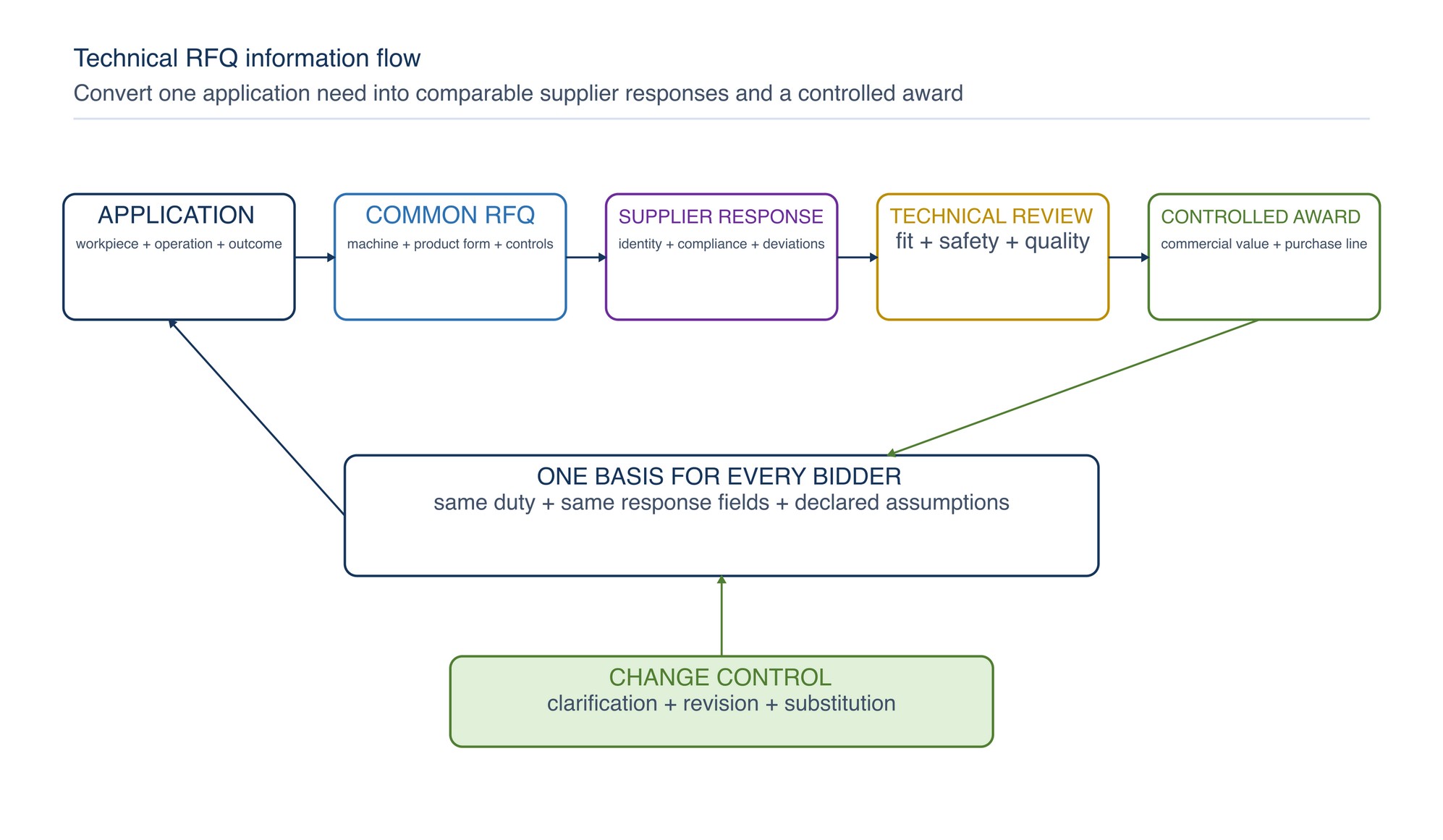
The RFQ should establish one common basis for every bidder. It needs enough information for a competent supplier to understand the application, identify a suitable product family, state assumptions and declare deviations. It should also give the buyer a consistent basis for technical review, quotation comparison and purchase-description preparation.
An effective RFQ answers five questions:
- What material and feature will be processed?
- What operation and result are required?
- Which machine, interface and conditions apply?
- How will the offer, sample and delivered goods be checked?
- How must alternatives, deviations and changes be declared?
Do not use the RFQ to copy an operating speed, pressure, life claim or result from an unrelated product. Describe the application and let the verified product information and technical review establish the applicable limits.
Assign ownership before issue
RFQ quality improves when responsibilities are explicit. One person may perform several roles in a small company, but each decision should still have an owner.
| Role | Main responsibility before issue | Main responsibility after response |
|---|---|---|
| Requester or production owner | Define the work, access, starting condition and operational need | Confirm that the proposed approach addresses the real task |
| Engineering or technical owner | Define machine, interface, process envelope and technical constraints | Review compatibility, deviations and alternatives |
| QA/QC | Define drawing, finish, inspection and acceptance references | Review sample, measurement and conformity information |
| Safety or EHS | Identify dust, spark, noise, chemical, contamination and workplace controls | Review safety information and use restrictions |
| Purchasing | Issue one controlled RFQ, manage clarifications and preserve bid comparability | Compare commercial terms after technical classification |
| Stores or logistics | Define packaging, identification, storage and receiving needs | Confirm delivery, marking, shelf-life and handling arrangements |
| Authorised approver | Confirm that the RFQ is complete and properly classified | Authorise the selected description and any accepted deviation |
Purchasing should not be expected to infer missing process details, and production should not accept a technically different alternative solely because its unit price is lower. Cross-functional review is especially valuable for new applications, high-volume use, safety-critical fit or expensive rework risk.
Use an RFQ issue-readiness gate
Before the RFQ is released, confirm that the application, outcome, machine, product form and response format are sufficiently clear. A short clarification before issue is normally less costly than comparing quotations based on different assumptions.
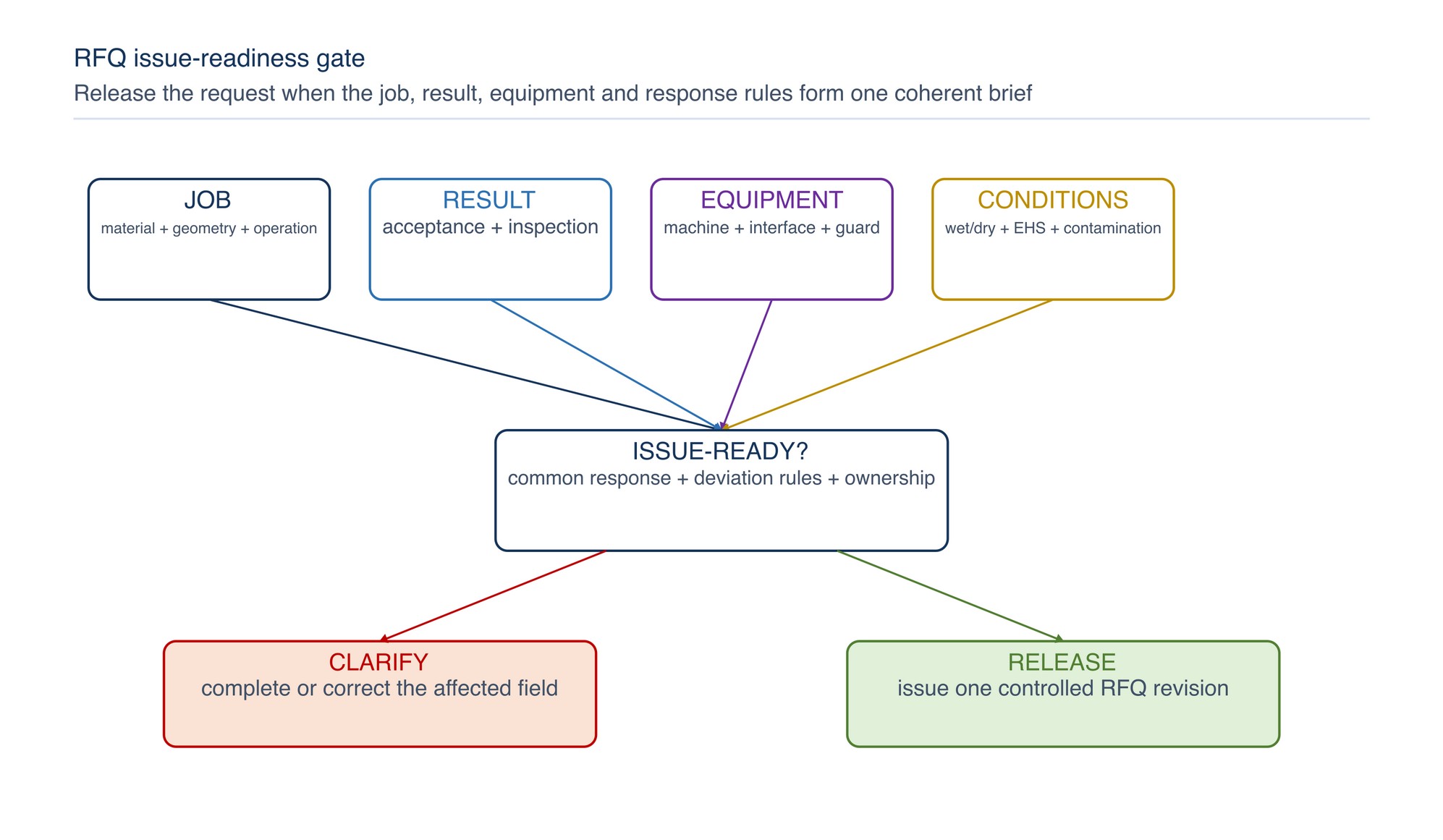
| Readiness question | Ready when |
|---|---|
| Is the duty clear? | Operation, workpiece and processing area are described |
| Is the result clear? | Acceptance criteria and inspection approach are stated |
| Is the equipment clear? | Machine, interface, guard and use condition are identified |
| Is the product request clear? | Form, dimensions and grading context are stated or left deliberately open for proposal |
| Are special controls clear? | Contamination, extraction, coolant, storage and site restrictions are stated |
| Is comparison possible? | Every supplier must use the same response and deviation fields |
Start with a one-page application summary
Place the essential decision information at the front of the RFQ. Attach drawings, photographs, process sheets or detailed tables after the summary.
| RFQ application summary | Customer entry |
|---|---|
| RFQ title, number and revision | Unique controlled identity |
| Requester and technical contact | Name, role and contact route |
| Application statement | Operation + workpiece + purpose |
| Required result | Drawing, measured criterion, visual reference or defect limit |
| Machine and interface | Tool/machine, model, mounting and accessory arrangement |
| Product form | Wheel, disc, belt, sheet, roll, non-woven, mounted or supplier-proposed form |
| Quantity and usage pattern | Initial quantity, expected consumption pattern and delivery need |
| Sample requirement | Sample quantity or demonstration arrangement, if applicable |
| Response deadline and format | Date, currency, delivery basis and required response table |
| Alternative-offer rule | Separate, clearly identified alternative with declared differences |
Write the application statement as a complete sentence. For example: “Remove weld spatter and blend local transitions on carbon-steel fabrications before coating while maintaining the drawing-defined edges and surface-preparation requirement.”
Describe the workpiece precisely
Product suitability and process behaviour depend on the material, condition and geometry. Include the fields that materially affect the application.
| Workpiece field | Useful RFQ description |
|---|---|
| Material | Controlled grade or material family; coating or cladding where relevant |
| Condition | Cast, forged, rolled, welded, heat treated, hardened, coated or previously finished |
| Geometry | Flat, edge, radius, tube, bore, profile, casting, fabrication or complex access |
| Size and thickness | Section range, wall thickness and stability of the processed feature |
| Starting surface | Scale, weld reinforcement, burr, corrosion, paint, scratches or prior finish |
| Removal allowance | Stock available for removal or dimensions that must be preserved |
| Sensitive features | Datum, thread, seal face, edge, coating boundary, cosmetic face or thin section |
| Cleanliness restriction | Dedicated stainless/non-ferrous use, coating preparation or other contamination control |
Use separate RFQ lines where workpiece conditions create materially different duties. A heavy gate-removal operation and a light cosmetic blend should not be combined under one vague description merely because the material is the same.
Define the operation and required outcome
Name the operation by its function: cutting-off, stock removal, weld grinding, deburring, blending, surface preparation, finishing or polishing. Then state what constitutes an acceptable result.
| Result category | RFQ field | Practical verification basis |
|---|---|---|
| Dimensions | Drawing tolerance or maximum removal allowance | Calibrated measurement at defined features |
| Surface texture | Drawing-defined parameter and limit | Controlled instrument, direction, locations and settings |
| Edge condition | Burr removal and permitted edge form | Visual/tactile inspection and dimensional check where important |
| Appearance | Direction, uniformity and approved reference | Side-by-side comparison under stated lighting and orientation |
| Defects | Limits for gouge, chatter, burn, heat tint, pull-out or exposed substrate | Defined inspection area, lighting and magnification |
| Cleanliness | Residue, contamination or coating-preparation condition | Applicable visual or process-specific method |
| Cut quality | Squareness, burr, kerf or heat-affected appearance as relevant | Drawing or agreed inspection method |
The ISO 21920 series provides the current framework for profile surface-texture indication, terms, parameters and specification operators. Apply the controlled drawing and measurement procedure rather than copying an isolated roughness value into an RFQ. [S343; S344; S345]
State measurement direction and location. Grinding patterns can produce different readings along and across the lay, while one average value may not reveal a local gouge or damaged edge.
Record the machine and complete interface
A nominal product diameter does not establish machine compatibility. The RFQ should identify:
- machine or powered-tool type;
- manufacturer, model and equipment identification where relevant;
- spindle, arbor, thread, flange, backing pad, contact wheel or quick-change interface;
- guard arrangement and dimensional constraints;
- machine operating range or controlled operating setting;
- power source and available power;
- backing-pad or contact-wheel profile and hardness where applicable;
- access, orientation, workholding and contact geometry;
- extraction or coolant arrangement; and
- intended wet, damp or dry use.
Ask the supplier to state any required accessory, pad, flange or mounting component as part of the offer. Do not assume that visually similar components can be mixed.
When an exact product speed, mounting limit, accessory compatibility or ordering code is needed, Refer to the product label, Technical Data Sheet, or MKTECH representative.
Identify product family, form and dimensions
State the required physical form before describing grain or grade. If the product family is open to supplier recommendation, say so explicitly and retain the fit, outcome and safety requirements.
| Product form | Typical identity fields for the RFQ |
|---|---|
| Bonded or cutting wheel | Shape/type, outside diameter, thickness, bore, intended operation |
| Flap disc | Diameter, bore/thread, profile, flap construction and grading designation |
| Fibre disc | Diameter, centre-hole arrangement, grading designation and backing-pad system |
| Hook-and-loop or adhesive disc | Diameter, hole pattern, attachment system, backing and grading designation |
| Belt | Width, length, joint/direction where relevant, backing and grading designation |
| Sheet or roll | Width, length, perforation/cut form, backing and grading designation |
| Non-woven product | Form, dimensions, attachment, density/grade designation and intended duty |
| Mounted product | Head shape and dimensions, shank dimensions and intended machine |
| Superabrasive product | Shape, dimensions, abrasive type, grain designation, bond/concentration information and mounting |
ISO 525:2020 supports bonded-abrasive shape, dimensional-symbol, designation and marking practice, but it excludes coated and superabrasive products. Use the framework appropriate to the product family. [S342]
Keep grading systems identifiable
Write the complete designation context. P-grade coated abrasive, F-grade bonded abrasive, superabrasive grain designations and proprietary non-woven or structured-abrasive grades are not assumed one-to-one equivalents. [S346; S347; S348; S349]
| RFQ situation | Good practice |
|---|---|
| Exact approved replacement | State the controlled product identity and revision |
| Coated abrasive requirement | State the P designation when that system applies |
| Bonded-abrasive grain context | State the applicable F designation context |
| Superabrasive requirement | State abrasive type, designation system and complete construction fields |
| Proprietary specialty product | Use the exact manufacturer designation and product family |
| Open technical recommendation | State the application and outcome; require the proposed designation system to be declared |
Do not request “equivalent grit” without defining the result and product construction. Grain size is only one influence among grain type, backing, bond, structure, flexibility, coating pattern, machine, contact condition and workpiece.
Classify each requirement
Requirement classes make the RFQ firm where necessary and flexible where supplier product knowledge adds value.
| Class | Meaning | Supplier response |
|---|---|---|
| Mandatory | Necessary for fit, safety, quality or process control | Confirm compliance or declare a deviation |
| Preferred | Desirable but not essential | Confirm, offer the nearest option or explain the trade-off |
| Supplier proposed | Open to technical recommendation | State the proposed construction, rationale and implications |
Do not mark every field mandatory. Excessive prescription can exclude a suitable solution; insufficient definition can produce incomparable offers. Classify dimensions, mounting and intended use as mandatory when they govern physical compatibility or safe use.
Include safety, environmental and contamination conditions
Describe the actual operating environment so the supplier can assess intended-use compatibility and provide relevant information.
Include, as applicable:
- workpiece hazards, coatings and residues;
- dust, spark, noise and vibration conditions;
- extraction, ventilation and housekeeping arrangements;
- coolant, lubricant or process-fluid identity;
- wet/dry restrictions and electrical environment;
- cross-contamination controls for stainless steel, non-ferrous materials or coating preparation;
- food, pharmaceutical, clean-area or customer-specific restrictions;
- storage temperature, humidity and shelf-life considerations; and
- site rules affecting packaging, chemical documentation or waste handling.
FEPA provides distinct safety-instruction routes for bonded, coated and superabrasive products. This reinforces the importance of identifying the product family and obtaining the applicable safety and use information. [S352]
State quantity, packaging, storage and delivery needs
Commercial quantities must still be technically usable. State:
| Field | RFQ entry |
|---|---|
| Initial quantity | Sample, first order or production quantity by line item |
| Usage pattern | Intermittent maintenance, project demand or repeated production consumption |
| Pack size | Preferred or mandatory pack quantity and unit of issue |
| Packaging | Protection from moisture, distortion, impact, contamination or mixing |
| Identification | Product identity, batch/lot or traceability marking as applicable |
| Shelf-life/use-by information | Required declaration where applicable to the product |
| Delivery | Required date, partial-delivery rule and delivery location |
| Storage information | Manufacturer storage and handling instructions |
Avoid requesting a large production quantity before the technical route and acceptance basis are understood. For exact shelf life, storage limits, packaging identity or product marking, Refer to the product label, Technical Data Sheet, or MKTECH representative.
Define samples, inspection and acceptance
A sample request should identify the product, application condition and decision method. State whether the supplier is to provide loose samples, conduct a demonstration or support an on-site evaluation.
The RFQ should specify:
- sample identity and quantity;
- workpiece material and starting condition;
- machine, interface and process condition;
- operator or demonstration responsibility;
- inspection method, locations and timing;
- acceptable and unacceptable outcomes;
- sample disposition and reporting format; and
- relationship between sample acceptance and the final purchase description.
For delivered lots, define appropriate receiving checks such as identity, quantity, marking, packaging, visible condition, dimensions and agreed documentation. If attribute sampling is used, the sampling plan, inspection level, acceptance quality limit and acceptance numbers should come from the organisation's approved quality method and risk basis. ISO 2859-1:2026 provides lot-by-lot attribute-sampling schemes, while ISO 28590:2017 provides general guidance on selecting from the ISO 2859 series. Sampling does not demonstrate that every unit conforms and does not replace supplier process control. [S356; S357]
Request documentation, marking and traceability
List the documents and identifiers that are relevant to the product and application rather than using a generic “all certificates” statement.
| Information | RFQ treatment |
|---|---|
| Quotation identity | Supplier quotation number, date and validity |
| Product identity | Manufacturer, product name/code, form, dimensions and grade/system |
| Technical information | Current Technical Data Sheet or equivalent product information |
| Safety information | Applicable safety/use instructions and Safety Data Sheet where relevant |
| Marking | Product and packaging identification appropriate to the product family |
| Traceability | Batch/lot or other identifier where required by the purchase control |
| Conformity documentation | Specific document requested only where applicable and justified |
| Change notification | Agreed route for product, construction, manufacturing or documentation changes |
Quality-management certification provides useful organisational context, but it does not by itself prove that a particular abrasive fits the machine or will achieve the required result. ISO 9001:2015 is the current published edition at the time of this chapter; a replacement is under publication. Confirm application suitability through the product information and the controlled selection process described in this handbook. [S353]
Require a structured supplier response
Ask every supplier to return the same table. This makes assumptions visible and avoids comparing a detailed technical offer with a price-only response.
| RFQ field | Supplier response |
|---|---|
| Offered product | Manufacturer, product identity and complete description |
| Compliance | Complies / deviation / not offered |
| Dimensions and interface | Offered values and required accessories |
| Intended application | Supplier-confirmed intended use |
| Product information | Technical and safety document references |
| Assumptions | Workpiece, machine, process or volume assumptions |
| Deviations | Exact difference, reason and practical implication |
| Alternative | Separately identified option with comparison to the requested basis |
| Sample/support | Availability, quantity, lead time and technical-support scope |
| Commercial | Unit, pack quantity, price, currency, validity, lead time and delivery terms |
Control alternatives, deviations and substitutions
An alternative can be valuable, but “equivalent” should never be accepted as an unexplained label. Require the supplier to declare differences in:
- product family and intended operation;
- dimensions, mounting and accessories;
- grading system and designation;
- grain, backing, bond, density, flexibility or structure;
- wet/dry use and process sequence;
- product safety, storage and marking information;
- inspection or acceptance method; and
- delivery, packaging or traceability.
Review the impact on fit, guarding, product identification, contamination, process result, operator method, receiving, storage and total cost. Similar diameter and nominal grit do not establish equivalence.
Compare technical compliance before price
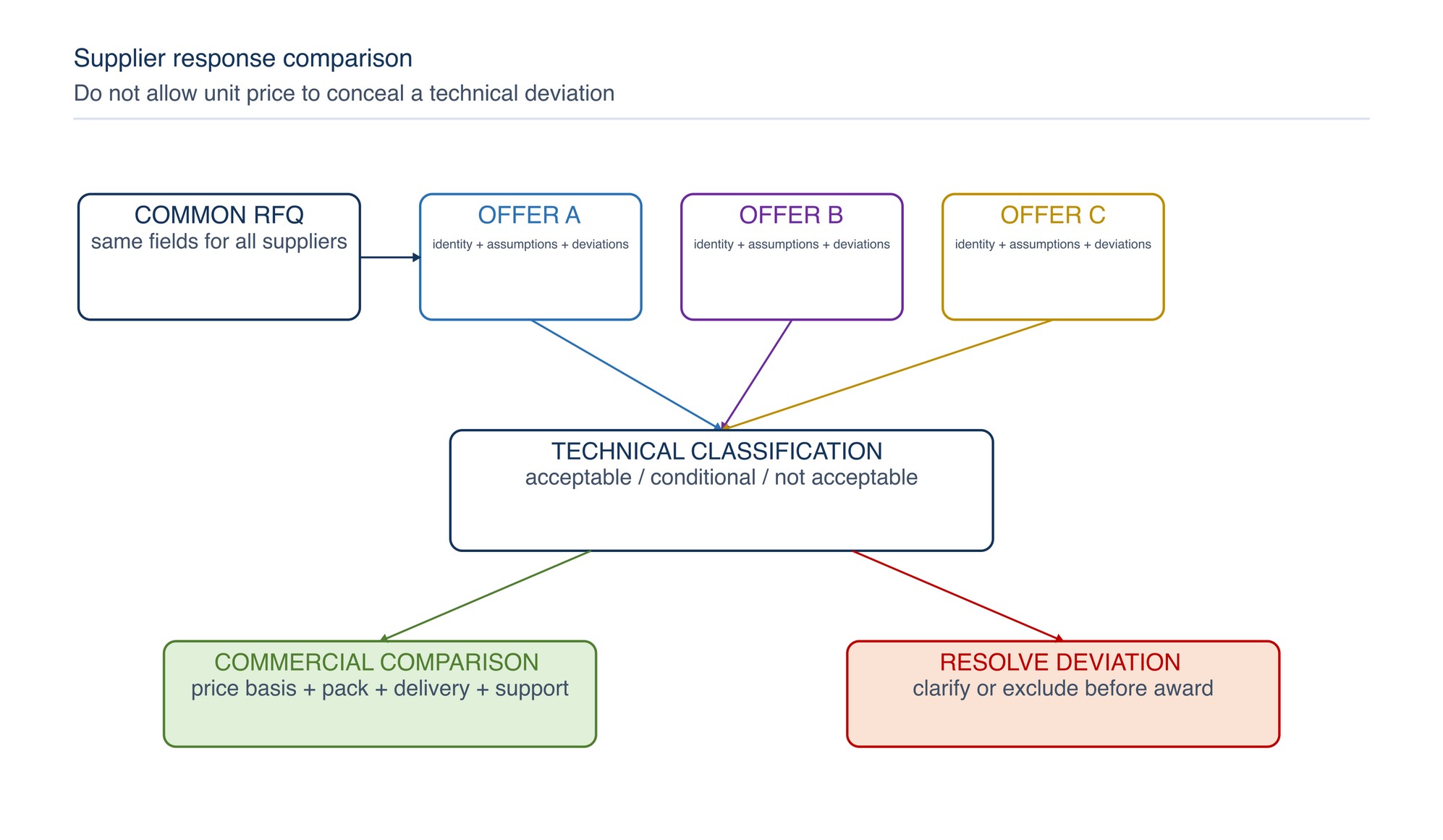
Use two linked evaluations rather than one blended score that allows a low price to conceal a technical deviation.
| Stage | Compare | Decision |
|---|---|---|
| 1. Technical classification | Mandatory compliance, machine/interface fit, intended use, outcome basis, safety information, deviations | Technically acceptable, conditionally acceptable or not acceptable |
| 2. Commercial comparison | Price basis, pack quantity, usable quantity, lead time, delivery, support and payment terms | Best evaluated commercial value among technically acceptable offers |
| 3. Approval | Product identity, conditions, accepted deviations and purchase description | Controlled award and release |
Where cost-per-component or abrasive life matters, define the evaluation method before comparing claims. Do not treat an unsupported catalogue statement as a guaranteed production result.
Control clarifications and RFQ revisions
Issue supplier clarifications through one controlled route. If an answer changes the technical basis, update the RFQ revision and provide the same information to every active bidder. Do not allow private assumptions to become an undeclared advantage.
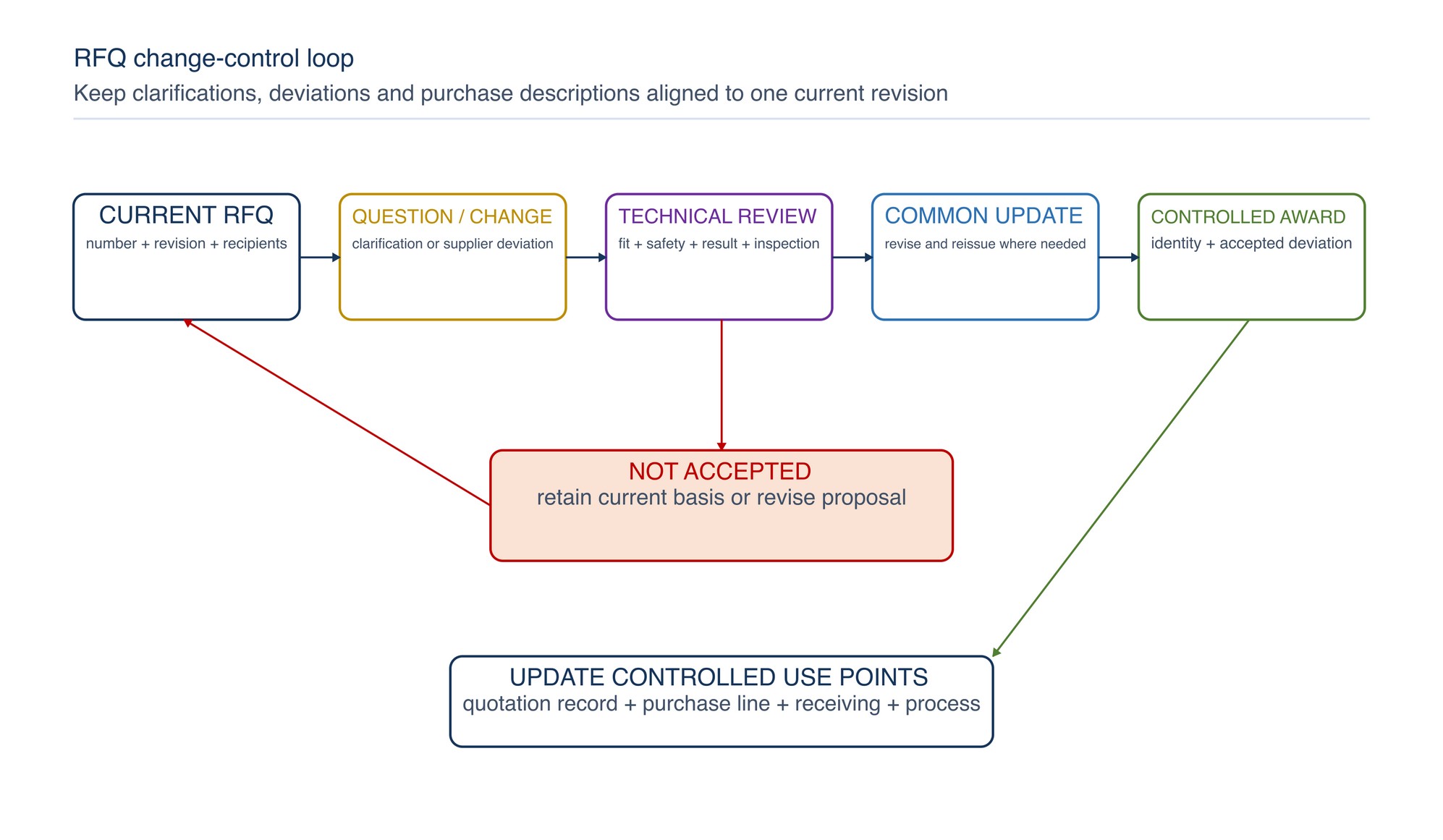
ISO 10005:2018 supports the establishment, review, acceptance, application and revision of quality plans, while ISO 10007:2017 provides configuration-management guidance for controlled identity and change status. These principles support clear RFQ revision and award records without implying product approval by the standards. [S354; S355]
Record:
- RFQ number, revision and issue date;
- recipients of each revision;
- clarification question and common answer;
- changed requirement and reason;
- technical reviewer and authoriser;
- accepted supplier deviation;
- awarded product identity and quotation reference; and
- resulting purchase-description revision.
Troubleshooting the RFQ
| Problem | Likely cause | Improvement |
|---|---|---|
| Quotations describe different products | Application and response format are too open | Issue one common summary and supplier-response table |
| Supplier cannot recommend a product | Workpiece, operation, machine or required result is unclear | Complete the application and equipment fields |
| Offered product fits the diameter but not the tool | Interface, accessory or guard information is incomplete | Record the full mounting system and machine identity |
| Prices cannot be compared | Unit, pack quantity, currency or delivery basis differs | Require one commercial response format |
| “Same grit” products give different results | Grading system and construction are not declared | State the system and compare through the application outcome |
| Receiving cannot identify the awarded item | Award record and purchase line omit controlled identity and revision | Carry manufacturer, product, form, dimensions into the order |
| Alternative is introduced after award | Substitution and change-notification rules are unclear | Require declared change and technical review before release |
| Sample result cannot be repeated | Starting condition, machine, sequence or inspection method changed | Control the application and verification conditions |
| Certification is treated as product approval | Supplier-system and product/application decisions are mixed | Evaluate supplier capability and product suitability separately |
RFQ issue checklist
Before release, confirm that the RFQ:
- has a unique title, number, revision, owner and response date;
- describes the operation, workpiece, geometry and starting condition;
- states the required result and inspection basis;
- identifies the machine, interface, guard and wet/dry condition;
- names the abrasive form, dimensions and grading system where prescribed;
- separates mandatory, preferred and supplier-proposed attributes;
- describes safety, environmental and contamination conditions;
- states quantity, packaging, identification, storage and delivery needs;
- defines sample, receiving and acceptance arrangements where applicable;
- requests relevant product, safety, marking and traceability information;
- requires assumptions, deviations and alternatives to be declared;
- separates technical classification from commercial comparison;
- controls clarifications, revisions and substitutions; and
- contains no unverified product value, approval, result or guarantee.
Concise safety reminders
- Confirm product, machine, mounting, guard and intended-use compatibility before purchase and use.
- Never infer a permitted speed or use condition from product appearance, nominal size or a competitor's product.
- Do not request altered wheels, removed safety markings or unapproved mounting combinations.
- Identify dust, sparks, noise, vibration, coolant, workholding and contamination controls for the actual task.
- Segregate damaged, wet, distorted, contaminated or illegibly marked products through the site's controlled process.
- Follow the product label, Technical Data Sheet, machine instructions and workplace risk controls.
Alternative Product Approval
Alternative Product Approval appears on the following page of the printed handbook (page 531), outside this chapter extract.