
Production engineers, process engineers, supervisors, technical buyers, QA/QC personnel, safety teams, maintenance teams, storekeepers, contractors and abrasive users
Alternative-product definition; approval ownership; baseline and proposed-product identity; workpiece and outcome comparison; machine, guard and interface compatibility; safety and environmental review; controlled comparison; acceptance; authorisation; implementation; monitoring; reversion; supplier change notification and troubleshooting.
An alternative abrasive is approved for a defined application and operating envelope—not because it looks similar, carries a similar grit description or costs less per unit.
Alternative products can improve availability, process capability, ergonomics or total cost. They can also change fit, aggressiveness, heat generation, finish, contamination risk, dust, vibration, product life, operator technique or downstream quality. A disciplined approval method separates useful innovation from uncontrolled substitution.
This chapter provides a customer-facing method for comparing an alternative against the current approved basis. It does not assign MKTECH-specific product specifications, operating values, performance results or guarantees. Exact product limits and identification remain controlled by the applicable product information.
Chapter objectives
After this chapter, the reader should be able to:
- recognise when a proposed product is an alternative requiring technical review;
- define the current approved application and product baseline;
- compare product identity, construction, dimensions and grading systems correctly;
- confirm machine, mounting, guard and accessory compatibility;
- review safety, contamination and downstream-process implications;
- prepare a controlled comparison with defined acceptance criteria;
- classify approval decisions and authorised conditions;
- update purchasing, stores, work and inspection controls after approval; and
- monitor early production and control later supplier or process changes.
Define an alternative product broadly
Treat a product as an alternative when any characteristic relevant to fit, safe use, process behaviour, quality or identification differs from the approved basis. Examples include:
- a different manufacturer or product code;
- a different abrasive family or physical form;
- a change in diameter, thickness, bore, thread, shank, belt size or hole pattern;
- a different grain or grading system;
- a change in backing, bond, density, flexibility, structure or coating pattern;
- a different mounting accessory, backing pad, flange or contact wheel;
- a change in wet/dry use, coolant or process sequence;
- revised safety, storage, marking or shelf-life information; or
- a supplier change that affects product identity or construction.
A packaging change may be purely commercial, but it still needs review if it affects traceability, moisture protection, product condition or store identification. The significance of a change is determined by its practical effect, not by the supplier’s label of “equivalent”, “replacement” or “new generation”.
Separate alternative approval from routine buying
Routine replenishment purchases an already approved identity under established conditions. Alternative approval determines whether a different identity can enter that controlled route.
| Activity | Routine replenishment | Alternative approval |
|---|---|---|
| Product identity | Matches the current controlled description | Differs in one or more relevant fields |
| Technical review | Confirm identity and condition | Compare fit, use, risk and result |
| Supplier response | Availability and commercial terms | Full identity, technical information, deviations and assumptions |
| Evaluation | Receiving checks | Controlled application comparison |
| Decision | Release approved stock | Approve, approve with conditions, reject or hold for further review |
| Records | Purchase and receiving record | Comparison, decision, authorised conditions and revision updates |
Do not permit a buyer, storekeeper or operator to substitute an unreviewed product solely to avoid a stockout. Urgency changes scheduling; it does not remove compatibility and safety questions.
Assign approval ownership
Alternative approval is cross-functional when the change can affect production, safety, quality or stock control.
| Role | Approval responsibility |
|---|---|
| Application owner | Defines the actual work, operating envelope and production need |
| Engineering or technical owner | Reviews product form, construction, machine/interface fit and process implications |
| QA/QC | Defines outcome criteria, measurement and acceptance |
| Safety or EHS | Reviews hazards, controls, product information and worker considerations |
| Purchasing | Obtains a complete supplier proposal and prevents premature substitution |
| Stores | Segregates evaluation stock and protects identity/traceability |
| Operator or worker representative | Provides practical feedback on access, control, loading, vibration and usability |
| Authorised approver | Records the decision, scope and conditions of release |
ISO 45001:2018 provides an occupational health and safety management framework that includes worker participation, hazard identification, risk assessment and operational control. Use the organisation’s current safety-management process for the actual workplace. [S359]
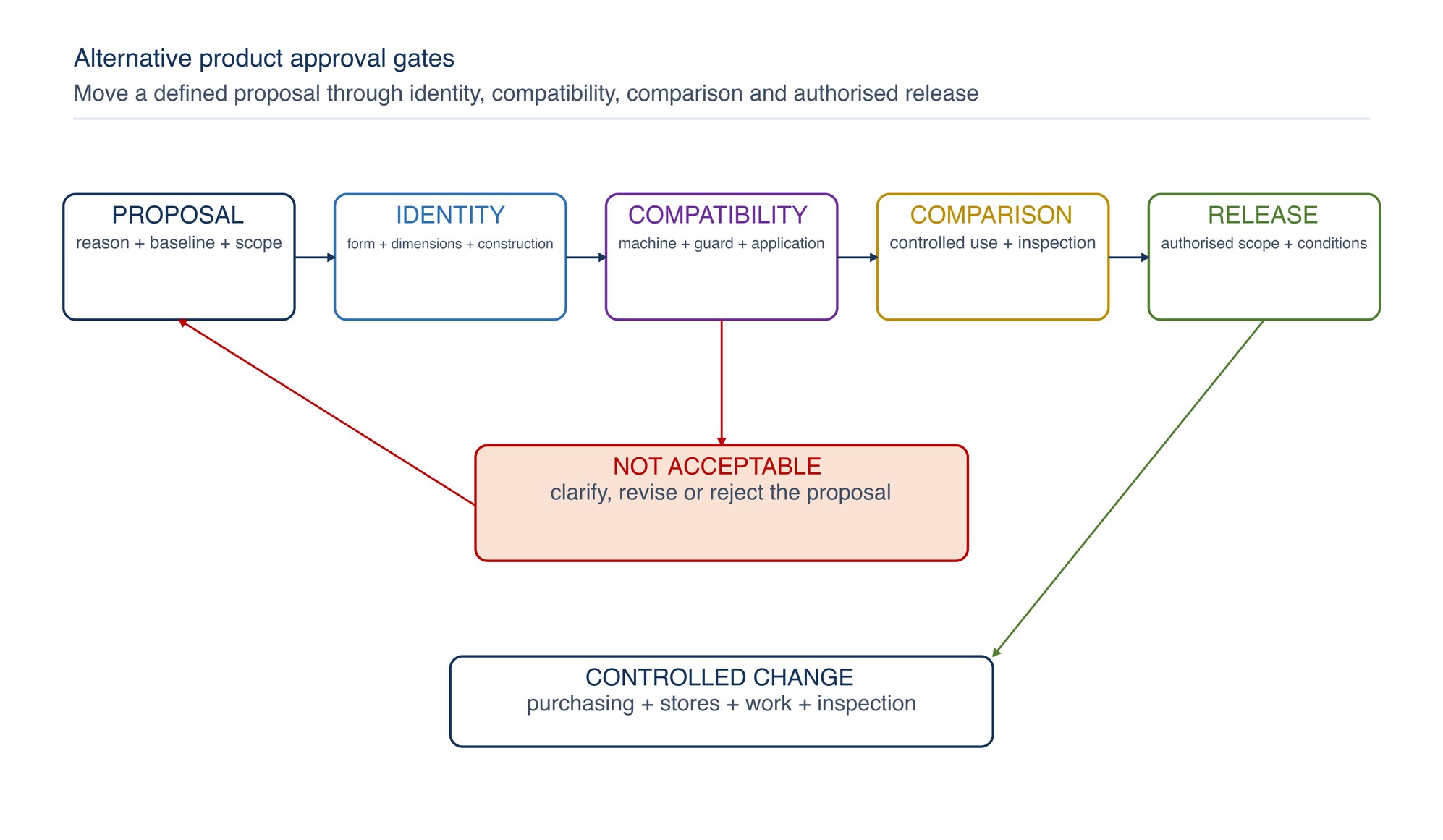
Start with a controlled change proposal
State why the alternative is being considered. Common reasons include availability, discontinuation, lead time, process improvement, reduced rework, ergonomics, technical support, standardisation or total cost.
The proposal should identify:
- current product and approved application;
- proposed product and supplier;
- reason for the change;
- expected benefit stated as an objective, not a guaranteed outcome;
- known technical differences;
- affected machines, parts, work areas and documents;
- proposed comparison and acceptance method; and
- owner and required decision date.
Do not write “same as current” unless each relevant field has been compared. A clearly stated difference is easier to manage than an assumed equivalence.
Establish the approved baseline
The baseline is the product, application, machine arrangement, process condition and result against which the alternative will be judged. It should be representative of normal acceptable production rather than an unusually favourable run.
| Baseline element | What to define |
|---|---|
| Product identity | Manufacturer, product name/code, form, dimensions, grade/system and revision |
| Workpiece | Material, condition, geometry, starting surface and sensitive features |
| Operation | Cutting, stock removal, deburring, blending, preparation, finishing or polishing |
| Machine system | Machine, guard, spindle/interface, pad/flange/contact wheel and extraction/coolant |
| Operating envelope | Wet/dry use, contact geometry, sequence and established controlled conditions |
| Required result | Drawing, texture, appearance, defect, cleanliness and dimensional criteria |
| Production context | Batch pattern, access, operator method and downstream process |
| Current controls | Purchase description, receiving check, work instruction and inspection method |
If several approved applications use the current product, do not assume one comparison covers them all. Define the scope of approval by material, machine, operation and outcome.
Capture the proposed product identity
Obtain the complete supplier-controlled identity before comparison:
- manufacturer and product name/code;
- abrasive family and intended operation;
- physical form and dimensions;
- bore, thread, shank, attachment or hole pattern;
- grain and grading-system designation;
- backing, bond, density, flexibility or structural description where relevant;
- required accessory or mounting component;
- product and packaging marking;
- Technical Data Sheet and applicable safety information;
- storage and shelf-life/use-by information where relevant; and
- change-notification and traceability information.
When an exact product speed, dimension, construction, compatibility limit, storage condition or ordering code is required, Refer to the product label, Technical Data Sheet, or MKTECH representative.
Compare baseline and alternative field by field
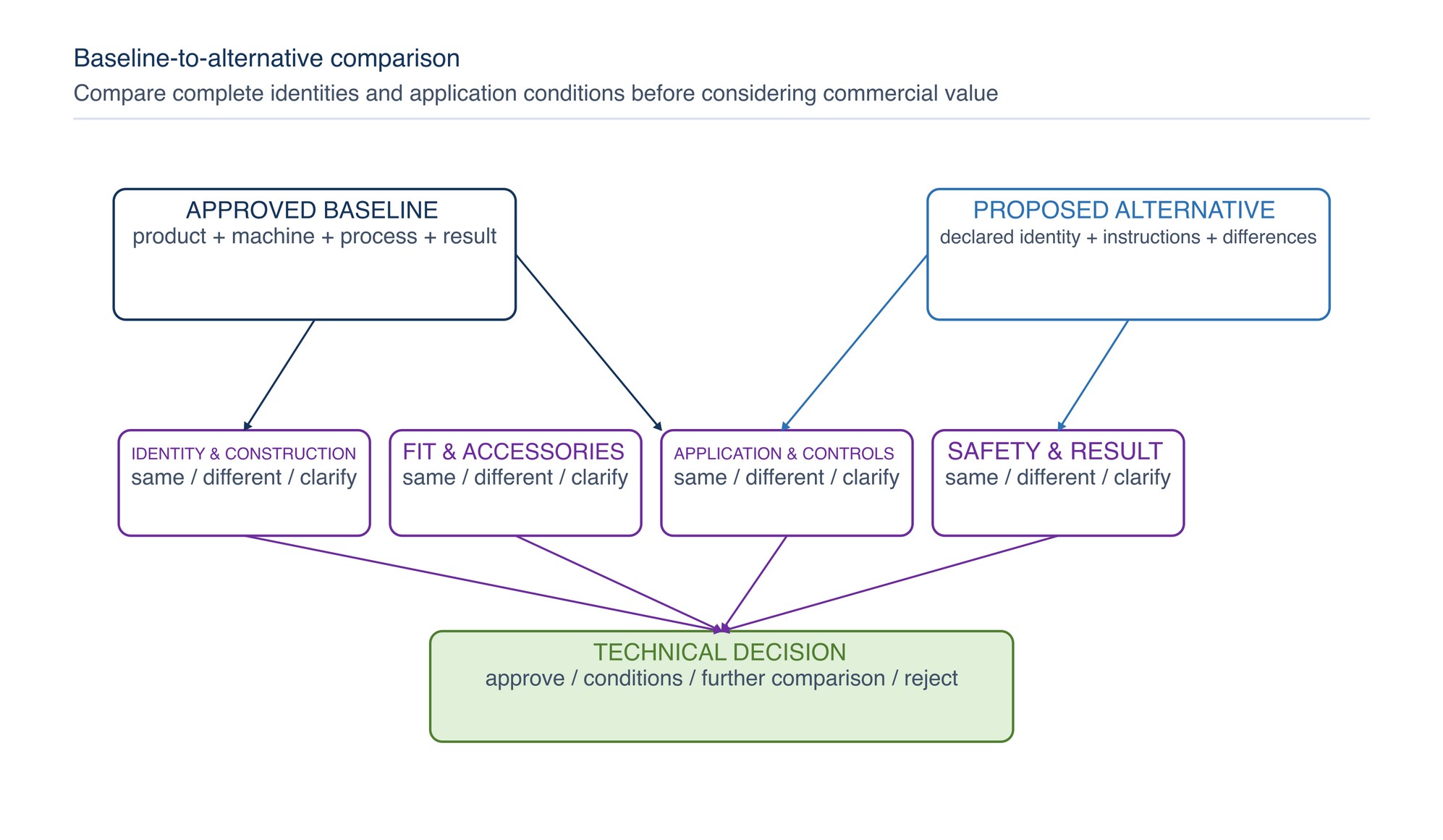
| Comparison field | Baseline | Proposed alternative | Decision question |
|---|---|---|---|
| Product family/form | Approved form | Offered form | Is the intended operation the same? |
| Dimensions/interface | Approved values | Offered values | Does it fit the machine and guard correctly? |
| Grain/grade system | Controlled designation | Declared designation | Are systems being kept separate? |
| Construction | Declared differences | Could behaviour, flexibility or heat change? | |
| Intended materials/use | Approved application | Supplier-stated use | Does the proposed use cover the actual workpiece and duty? |
| Accessories | Approved pad/flange/contact system | Required components | Is the complete combination permitted? |
| Safety information | Current instructions | Proposed instructions | Do hazards or controls change? |
| Storage/marking | Current arrangement | Proposed arrangement | Can condition and identity remain controlled? |
| Required result | Approved criteria | Same comparison criteria | Can the alternative be judged on the same basis? |
Record “same”, “different”, “not applicable” or “supplier clarification” for each field. Do not leave a blank field to be interpreted as compliance.
Keep grading systems separate
P grades for coated abrasives, F grades for bonded abrasives, superabrasive designations and proprietary grades are separate systems. ISO 6344, ISO 8486 and ISO 6106 provide distinct designation contexts. [S346; S347; S348; S349]
Do not approve an alternative because its number resembles the baseline grit. Compare the complete product construction and the result on the defined application. Grain type, backing, bond, structure, flexibility, coating pattern, contact system and process conditions can all change the outcome.
Confirm machine, guard and interface compatibility
The proposed abrasive must be checked against the actual machine system, not only against a catalogue diameter.
Confirm:
- machine/tool type, model and operating range;
- product form and intended operation;
- outside diameter, thickness/width and bore or attachment;
- spindle, arbor, thread, shank or quick-change system;
- guard type, position and permitted product geometry;
- flange, blotter, nut, pad, contact wheel or accessory arrangement as applicable;
- available power and contact condition;
- wet/dry use and extraction/coolant arrangement; and
- product and machine speed compatibility using their controlled information.
ISO 12100:2010 provides a general machinery risk-assessment and risk-reduction method covering hazard identification, risk estimation, evaluation, documentation and verification. It remains the current published edition while a replacement is under development. [S358]
OSHA 29 CFR 1910.215 illustrates that abrasive-wheel guarding, mounting and flange provisions depend on wheel type and machinery arrangement. It is a United States regulation and is not presented as Malaysian law; use applicable Malaysian requirements, machine instructions and product information for the actual workplace. [S360]
Review workpiece and process risks
An alternative may fit the machine yet behave differently on the workpiece. Review:
- material grade, hardness and coating;
- thin sections, edges, radii, datums and seal faces;
- starting scale, weld, burr, corrosion or prior finish;
- stock-removal allowance and dimensional sensitivity;
- heat, burn, heat-tint or distortion risk;
- loading, glazing, chatter, gouging or pull-out;
- contamination restrictions for stainless steel, non-ferrous materials or coating preparation;
- finish direction, texture and appearance;
- cleaning requirements and residue; and
- effects on welding, coating, sealing, fatigue-sensitive features or later inspection.
If the alternative changes the required process sequence or accessory, treat that as part of the proposal. Do not approve only the consumable while leaving the necessary process change uncontrolled.
Review safety and environmental changes
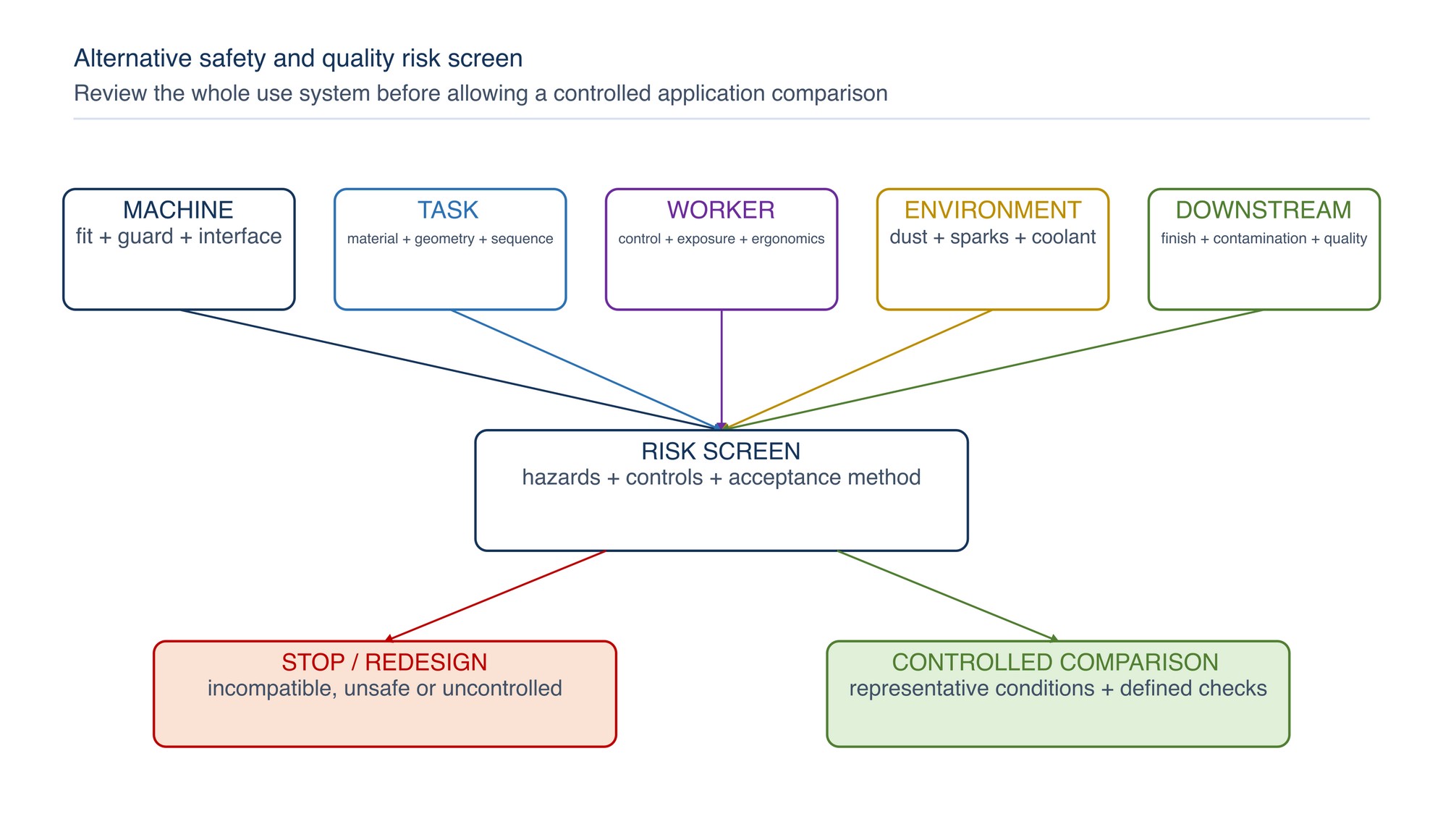
Compare the baseline and alternative for:
| Area | Review questions |
|---|---|
| Mechanical | Does form, mounting, guard coverage, accessory or failure mode change? |
| Dust and fumes | Could dust quantity, particle behaviour, workpiece coating or extraction need change? |
| Sparks and ignition | Could spark direction, intensity or combustible exposure change? |
| Noise and vibration | Could operator exposure, tool control or use duration change? |
| Ergonomics | Does weight, cutting action, pressure sensitivity, access or handling change? |
| Coolant/chemical | Is the product intended for the stated wet/dry condition and process fluid? |
| Contamination | Could transferred material or residue affect stainless, non-ferrous, coating or clean-area work? |
| Storage and disposal | Do packaging, shelf-life, moisture, damage or waste controls change? |
FEPA provides separate safety guidance for bonded, coated and superabrasive product families. Use the instructions applicable to the offered product family. [S352]
Classify the change before comparison
Use a risk-based classification to set the depth of review without weakening essential checks.
| Change class | Typical characteristics | Review approach |
|---|---|---|
| Limited | Same approved identity with packaging or administrative change that does not affect condition, traceability or use | Verify identity and document update |
| Moderate | Different product identity with matching form/interface and no identified change to guarding or process sequence | Full technical comparison and controlled application check |
| Significant | Different form, dimensions, accessory, construction, machine condition, hazard profile or downstream effect | Cross-functional risk review, controlled comparison and explicit authorisation |
| Unacceptable without redesign | Product cannot be shown compatible with machine, guard, intended use or required result | Reject or redesign the complete system before reconsideration |
Classification is not approval. It determines the review path; the final decision still depends on compatibility and the defined result.
Plan a controlled comparison
Compare the baseline and alternative under conditions that represent the application and allow a fair decision.
Define:
- sample identity and traceability;
- workpiece material, geometry and starting condition;
- machine, guard, interface and accessory;
- operator method and sequence;
- wet/dry condition, coolant and extraction;
- required outcome and inspection method;
- observation points such as cut control, loading, heat, finish and product condition;
- stop conditions for unsafe, damaging or clearly unacceptable behaviour;
- sample quantity or comparison duration from the approved quality/risk method; and
- responsibility for observation, measurement and decision.
Do not alter several variables at once unless the proposal is intentionally a complete process-system change and the comparison is designed accordingly.
Use defined acceptance criteria
Acceptance criteria should reflect the functional and production risks of the application.
| Criterion | Possible comparison basis |
|---|---|
| Fit and mounting | Correct installation with permitted accessories and guard arrangement |
| Process control | Stable cutting/grinding action without unacceptable loading, chatter or loss of control |
| Dimensions | Drawing tolerance or stock-removal allowance maintained |
| Surface result | Defined texture, direction, appearance and defect limits achieved |
| Thermal effect | No unacceptable burn, heat tint, distortion or substrate damage |
| Cleanliness | Contamination and residue controls satisfied |
| Safety/ergonomics | No unacceptable change in hazards, vibration, handling or exposure controls |
| Productivity | Measured using an agreed method where material to the decision |
| Product consumption | Compared on a controlled basis where material to total cost |
| Repeatability | Acceptable results across the approved comparison scope |
ISO 2859-1:2026 and ISO 28590:2017 provide frameworks for attribute sampling and selection of sampling systems. Do not assign an AQL, inspection level, sample size or acceptance number without the organisation’s approved sampling method and risk basis. Sampling does not prove every unit conforms. [S356; S357]
Record observations, not impressions
Replace “better”, “faster” or “feels good” with defined observations and measurements. Useful records can include:
- component or cut identity;
- baseline and alternative product identity;
- machine and accessory;
- start and finish condition;
- inspection results and defect observations;
- product changes or interruptions;
- operator feedback linked to a defined question;
- rework, rejection or downstream effects; and
- deviations from the planned comparison.
Operator feedback is important, especially for control, access, loading and vibration. Combine it with objective inspection where the decision affects quality or safety.
Use clear decision categories
| Decision | Meaning | Consequence |
|---|---|---|
| Approved | Meets the defined technical, safety and quality criteria | Release only for the recorded scope and conditions |
| Approved with conditions | Acceptable when stated restrictions, accessories or controls are applied | Carry every condition into purchasing, work and inspection controls |
| Further comparison | Information is insufficient for a reliable decision | Extend or refine the controlled comparison |
| Rejected | Does not meet compatibility, safety, quality or process criteria | Segregate evaluation stock and retain the current approved basis |
Price, lead time or availability may influence the business decision after technical classification. They do not convert a technically unacceptable product into an approved alternative.
Define the approval scope precisely
Record the exact boundary of approval:
- proposed product identity and revision;
- approved workpiece material and condition;
- operation and process stage;
- machine/tool and accessory combination;
- product form, dimensions and mounting;
- wet/dry condition and coolant/extraction arrangement;
- required sequence and operating envelope;
- inspection and acceptance method;
- limitations and prohibited uses;
- effective date, owner and authoriser; and
- relationship to the previous product—additional option, preferred option or replacement.
An approval for weld blending on one machine does not automatically cover cutting-off, another machine, another alloy or another product size.
Release the change through every use point
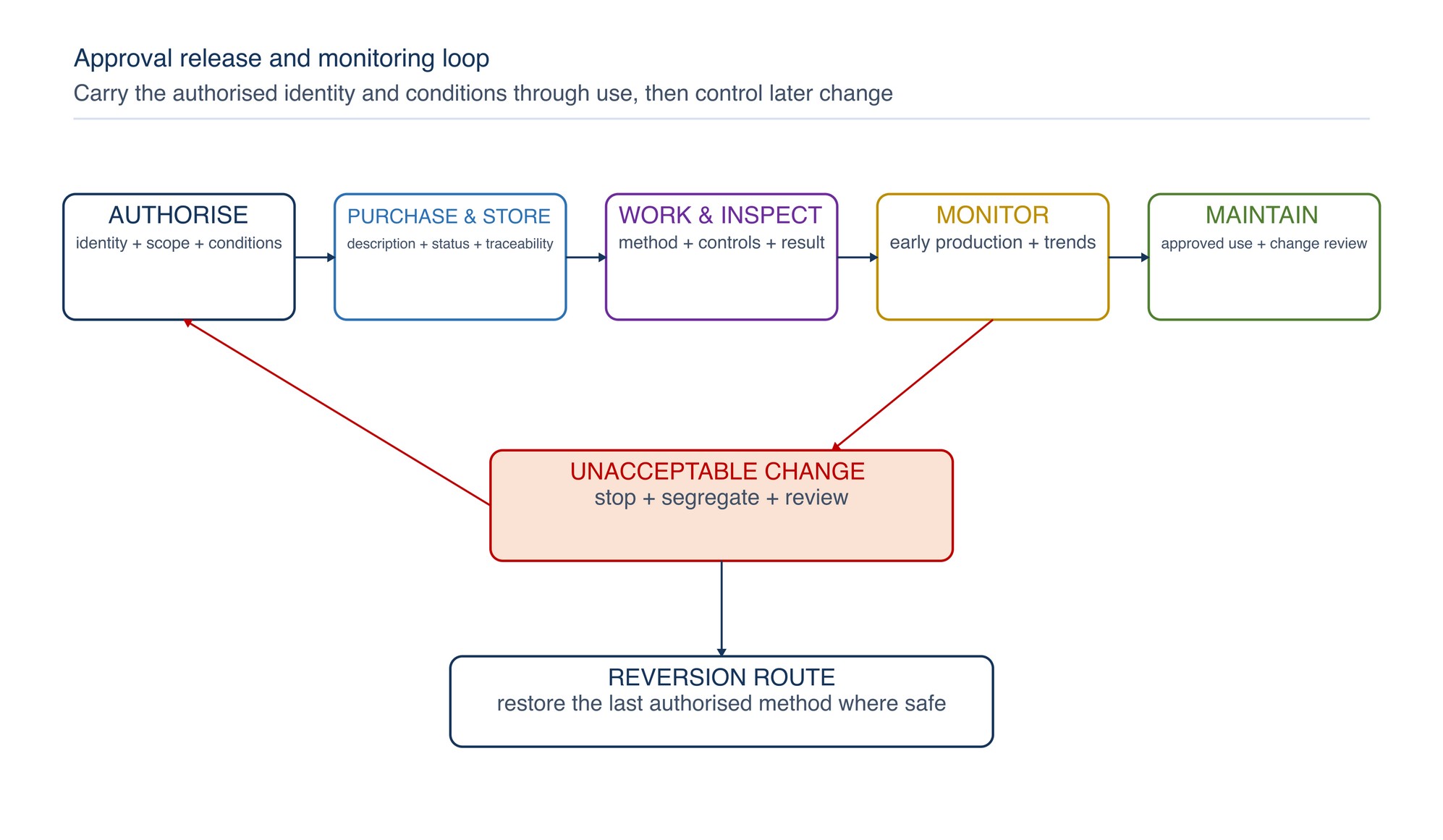
Update, as applicable:
- approved-product or specification record;
- purchase description and supplier reference;
- receiving inspection and traceability fields;
- store location, label and segregation status;
- issue and return controls;
- machine, accessory and setup information;
- work instruction and operator communication;
- inspection plan and reference samples; and
- superseded descriptions and emergency-buying lists.
ISO 10005:2018 supports the establishment, review, acceptance, application and revision of quality plans. ISO 10007:2017 supports controlled identity, configuration status and change management. These principles help keep the approved alternative aligned across its lifecycle. [S354; S355]
Monitor early production and control later change
Use an appropriate early-production monitoring period for the application risk and usage pattern. Confirm that the released product continues to produce the approved result under normal production variation.
Monitor, where relevant:
- receiving identity and condition;
- fit and mounting consistency;
- process stability and operator control;
- finish, dimensions and defect trends;
- contamination and downstream effects;
- product consumption, rework and interruption;
- safety observations and exposure controls; and
- supplier, packaging, marking or construction changes.
Define a reversion route before release. If the alternative produces an unsafe condition, machine incompatibility, damage or unacceptable quality, stop use, segregate stock and restore the last authorised method where safe and available.
For exact marking, speed, storage, use or compatibility information, Refer to the product label, Technical Data Sheet, or MKTECH representative.
Troubleshooting alternative approval
| Problem | Likely weakness | Improvement |
|---|---|---|
| Alternative is treated as automatically equivalent | Only size or grit was compared | Compare identity, construction, fit, use, safety information and result |
| Product fits but cannot be guarded correctly | Guard and accessory arrangement was omitted | Review the complete machine-product system |
| Finish changes unexpectedly | Grading system, backing, bond or process condition differs | Keep designation systems separate and compare the full construction |
| Comparison result cannot be repeated | Starting condition, operator method or inspection changed | Control the application and verification method |
| Useful alternative is rejected on unit price confusion | Technical and commercial decisions are mixed | Classify technical acceptance before total-cost comparison |
| Receiving mixes evaluation and approved stock | Identity and status are unclear | Segregate, label and trace evaluation material |
| Conditions are lost after approval | Purchase and work documents were not updated | Release the change through every controlled use point |
| Supplier changes the product later | Change-notification route is unclear | Require declared change and repeat the applicable review |
| One approval is applied to unrelated jobs | Approval scope is too broad | State material, machine, operation, size and conditions precisely |
Alternative approval checklist
Before authorisation, confirm that:
- the reason for change and approval owner are clear;
- the current baseline and proposed product identities are complete;
- product family, dimensions, mounting and grading system are compared;
- machine, guard, accessory and speed compatibility are confirmed from controlled information;
- workpiece, finish, contamination and downstream risks are reviewed;
- safety, environmental and operator considerations are addressed;
- the controlled comparison uses representative conditions;
- acceptance criteria and inspection methods are defined;
- observations and deviations are recorded;
- the decision category and scope are explicit;
- purchasing, stores, work and inspection controls are updated;
- early-production monitoring and reversion routes are defined; and
- later supplier or process changes return through change control.
Concise safety reminders
- Never use similarity in colour, size or grit as proof of safe interchangeability.
- Confirm the complete product, machine, guard, mounting and accessory combination.
- Do not exceed the lower permitted speed of the machine/product combination.
- Stop comparison immediately for unsafe behaviour, damaged product, loss of control or incompatible mounting.
- Segregate unapproved and rejected evaluation stock from released production stock.
- Follow the product label, Technical Data Sheet, machine instructions and workplace risk controls.
Inventory and Reorder Planning
Chapter 060 begins on the following page of the printed handbook (page 543), outside this chapter extract.