
Production managers, engineers, supervisors, operators, maintenance personnel, stores teams, buyers, QA/QC personnel and continuous-improvement teams
Accepted-output measurement; loss classification; product selection; machine and accessory condition; workholding; contact; force; working-area use; change-out; loading; glazing; damage; storage; issue and return; standard work; trials; monitoring and troubleshooting.
Reducing consumption never justifies use beyond a marked limit, damaged condition, safe discard point or designed working surface. Confirm product condition, machine and accessory compatibility, speed relationship, guard, mounting, workholding, extraction and PPE. Stop for abnormal vibration, damage, separation, loss of secure mounting or loss of work control.
Reduce abrasive consumption by removing avoidable loss while preserving safe use, cutting efficiency and accepted quality. A disc or wheel that lasts longer but increases labour, rework or risk is not an improvement.
Abrasive consumption is influenced by much more than product durability. Incorrect selection, excessive or insufficient force, a worn support pad, unstable workholding, poor storage, premature change-out, product damage and unrecorded issue can all increase use. The best control measure links abrasive use to accepted output and makes each loss mechanism visible.
When an exact product value is required, Refer to the product label, Technical Data Sheet, or MKTECH representative.
Chapter objectives
After this chapter, the reader should be able to:
- calculate abrasive consumption per accepted output;
- classify normal use and avoidable loss;
- identify selection, equipment, method and stock-control causes;
- define safe, observable change-out rules;
- use the designed working area without unsafe overuse;
- distinguish loading, glazing, shedding and mechanical damage;
- control issue, return and partial-product status;
- standardise work without inventing universal operating settings;
- verify a reduction through a controlled comparison; and
- sustain the improvement with practical indicators and review triggers.
Measure the right result
Use a denominator that represents useful production:
Abrasive consumption per accepted unit = abrasive units consumed ÷ final accepted units
For continuous or mixed work, a suitable denominator may be accepted weld length, accepted cut length, accepted area or another defined production unit. Use the same boundary and acceptance rule over time.
Also monitor first-pass acceptance, rework, scrap, processing time and cost per accepted component. A lower disc count with more labour or defects can increase total cost.
Establish a reconciled baseline
Before changing the process, record:
- product form and complete identity;
- operation and workpiece family;
- material and incoming condition;
- machine and accessory;
- operator or team basis;
- abrasives issued, returned, damaged and discarded;
- partial products retained for safe reuse;
- accepted output, rework and scrap;
- productive time, interruptions and product changes; and
- reasons recorded at change-out.
Observe enough representative production to include normal variation. Do not build a baseline from one unusually easy or difficult job.
Classify the consumption loss
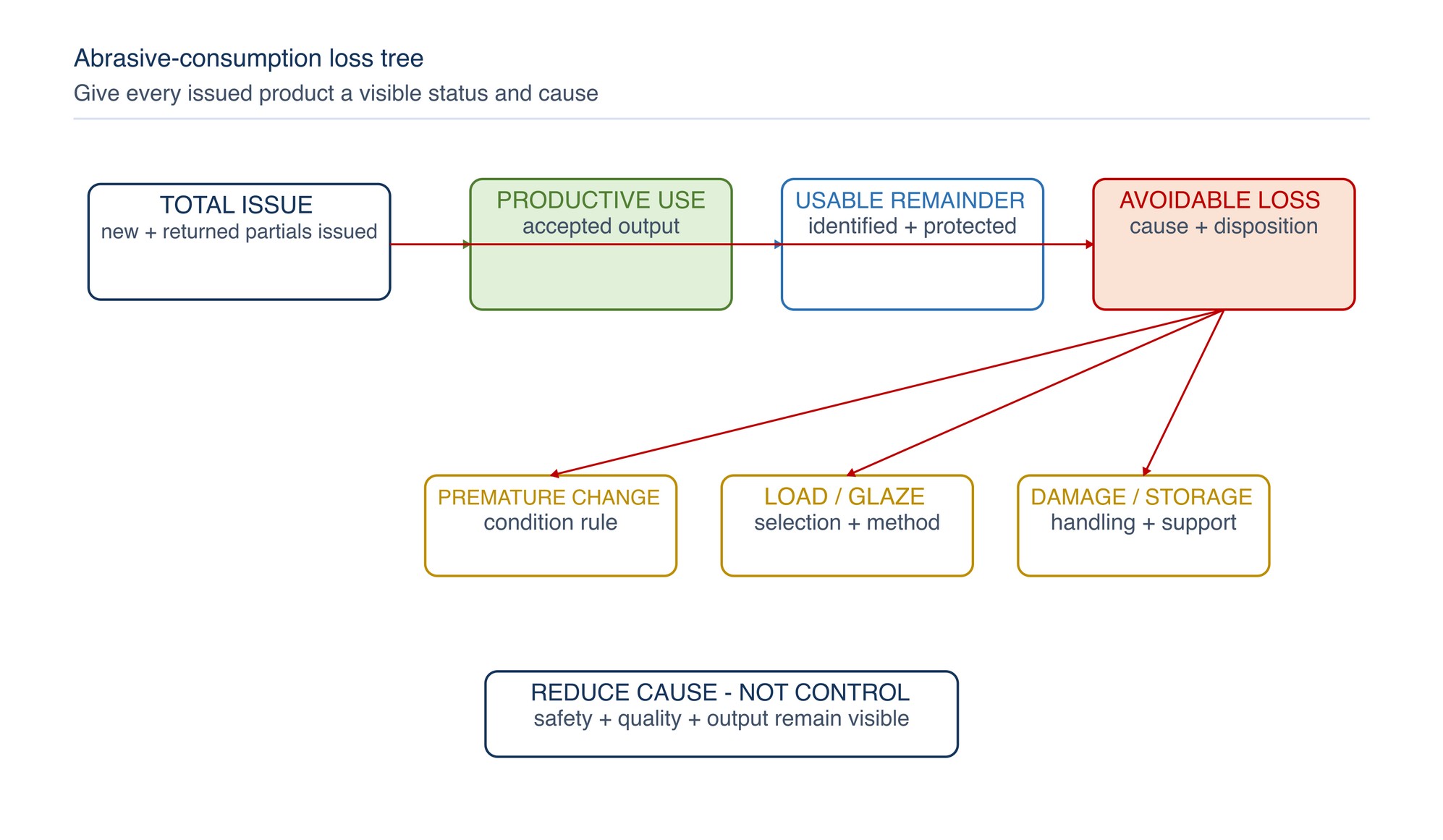
| Status | Meaning | Control response |
|---|---|---|
| Productive wear | Abrasive consumed while producing accepted output | Optimise only through controlled comparison |
| Safe usable remainder | Product can be identified, protected and safely reused | Return to controlled status |
| Premature change-out | Product removed before the common condition rule | Improve change-out standard and supervision |
| Loading or glazing | Cut falls because the surface is obstructed or dull | Diagnose material, product, force, contact and extraction |
| Mechanical damage | Tear, edge loss, crack, deformation or mounting damage | Stop use, segregate and correct the cause |
| Storage/handling loss | Product deteriorated or damaged before use | Improve receiving, storage and transport |
| Untraceable loss | Issue cannot be linked to use, return or disposal | Strengthen point-of-use control |
Do not call all discarded abrasive “normal wear.” The cause classification directs the improvement.
Protect the safety and quality gates
Consumption reduction must not rely on:
- exceeding a marked product or machine limit;
- using a damaged, contaminated or incorrectly stored abrasive;
- defeating a guard or changing an approved mounting arrangement;
- using a prohibited face, side, edge, hub or core;
- reducing extraction, inspection or PPE;
- accepting a poorer surface, geometry or cut; or
- extending use after safe discard condition.
FEPA safety guidance emphasises correct selection, inspection, marking, speed compatibility and intended use. [S032; S352]
Select for the complete task
Match the abrasive to:
- material and hardness;
- stock-removal requirement;
- contact area and geometry;
- required finish and permitted dimensional change;
- machine type, power and speed control;
- accessory or contact element;
- wet or dry process where applicable;
- loading or contamination tendency;
- access, visibility and operator control; and
- downstream operation.
Grit designation alone does not determine product life, finish or suitability. Coated-abrasive P grades, bonded-abrasive F grades and superabrasive designations have different standards contexts. [S346; S347; S348; S349]
Avoid false economy from maximum nominal life
The longest-lasting wheel is not automatically the most economical. A product that becomes dull may require greater force and longer contact, increasing vibration exposure, heat and labour.
HSE foundry guidance specifically warns against selecting grinding wheels only for maximum life and instead focuses on cutting efficiency. It notes that an overly hard, poorly cutting wheel can encourage greater force and increase time and vibration. [S378]
Compare accepted output, task time, quality loss and total cost—not nominal life in isolation.
Control the machine condition
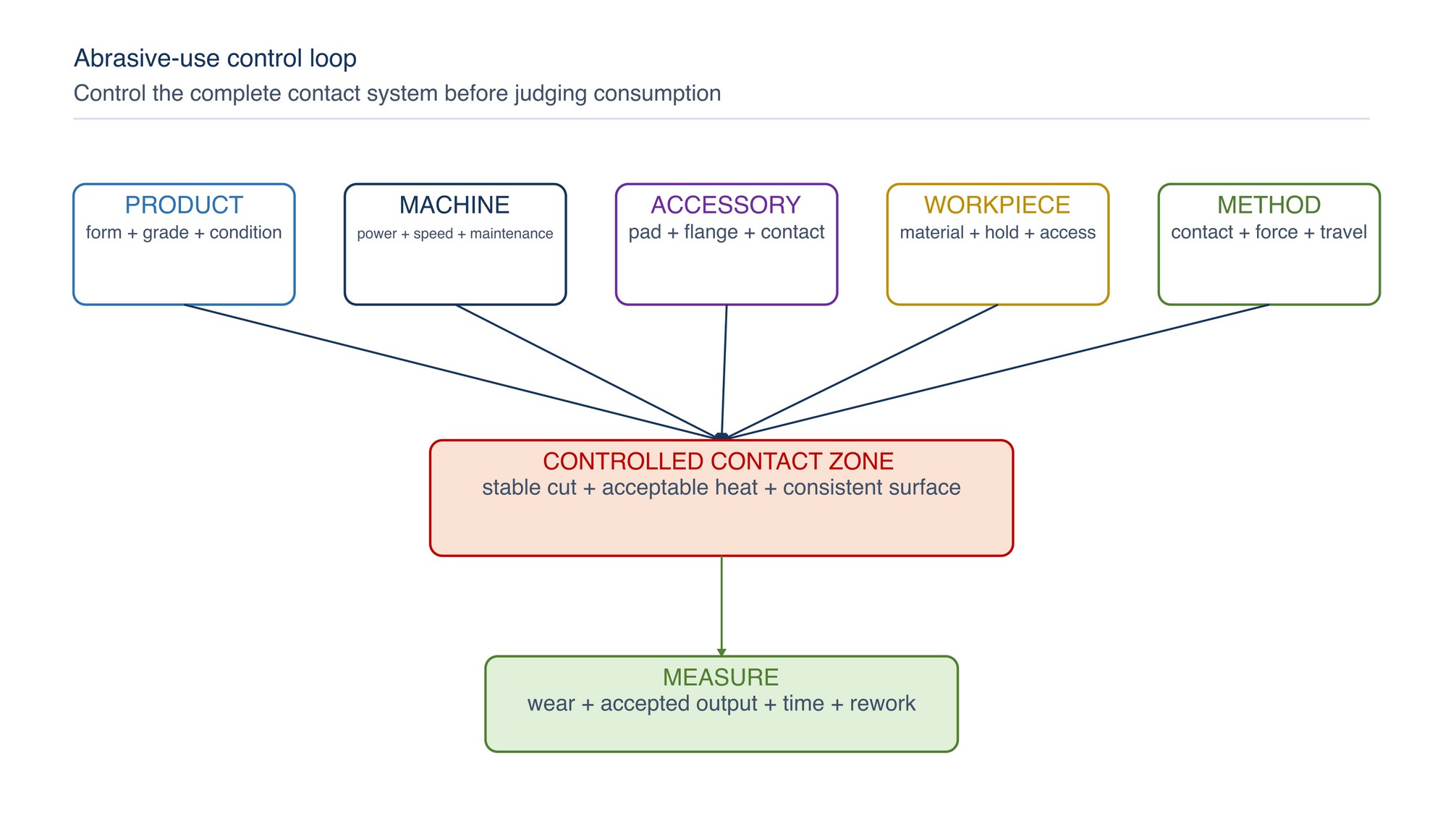
Check conditions that can waste abrasive:
- spindle, bearings and drive condition;
- air supply, electrical supply or battery condition as applicable;
- free-running speed and speed-control function under the approved maintenance method;
- vibration, runout and abnormal noise;
- guard, flange, mounting and fastener condition;
- ventilation slots, cooling and dust ingress;
- extraction effectiveness; and
- maintenance status.
Abrasive change cannot compensate for a defective or underperforming machine. Remove abnormal equipment from service under workplace procedure.
Maintain the support system
Backing pads, contact wheels, flanges, adaptors, mandrels and compounds influence support, contact and wear. A worn or mismatched support can cause edge damage, poor tracking, uneven use, heat or loss of control.
Record accessory identity with the abrasive. Inspect before use and at defined triggers. Replace only under its controlled condition rule. Do not assume that a reusable accessory has unlimited life.
Secure and present the workpiece
Unstable work increases abrasive loss through chatter, edge impact, pinching and repeated passes. Confirm:
- secure workholding;
- support that prevents movement or harmful deflection;
- clear access to the intended contact zone;
- safe body and tool position;
- a cut path that does not close on a cutting wheel;
- removal of obstructing scale, contamination or weld projections only by the approved method; and
- consistent presentation for repeated components.
A suitable fixture can improve both consistency and abrasive utilisation, but it must not obstruct guarding or create a trapping hazard.
Control contact, travel and dwell
Use the product on its designed working surface and maintain a stable contact pattern. Avoid:
- edge striking or dropping onto the work;
- dwelling in one location;
- rocking that alternately overloads edges;
- repeated contact with sharp projections;
- twisting a cutting wheel in the kerf;
- using only one narrow strip of a wider belt; and
- travel that traps swarf under the product.
Where the product and machine permit, distribute work across the usable abrasive area. Follow the approved method for direction, presentation and access.
Apply controlled force
Excessive force can accelerate shedding, damage a coated-abrasive structure, deform a wheel or overheat the work. Too little effective engagement can allow rubbing, glazing and slow processing. The correct condition depends on the product, machine, material and task.
Train operators to recognise a stable cutting sound, controllable spark or swarf pattern, normal tool response and acceptable surface result. Investigate a need for rising force; do not simply press harder. HSE guidance links efficient equipment and consumables with shorter task duration and reduced unnecessary exposure. [S379]
Use the safe working area fully
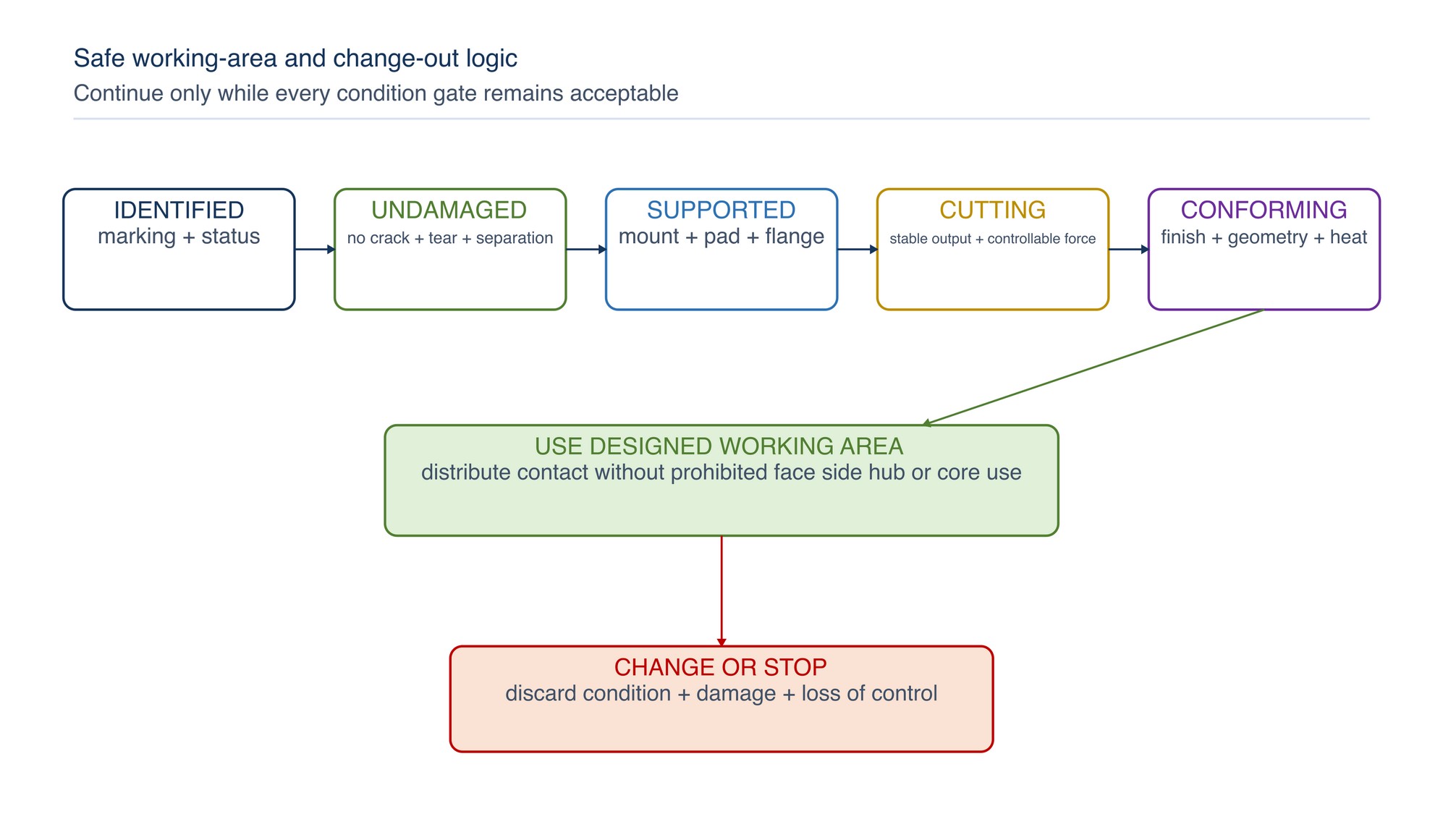
For suitable product forms, improve utilisation by:
- rotating work position or approach to distribute contact;
- using the supported usable face consistently;
- tracking belts so the width is used evenly;
- avoiding local contamination;
- protecting unused portions during pauses; and
- returning identifiable partial products to a protected holder.
Never use a hub, backing, flange-contact zone or other non-working area as abrasive. Safe discard condition depends on wheel construction, guard, flange, spindle and intended grinding surface. [S382]
Define a safe change-out rule
Use observable conditions rather than operator preference alone:
| Change-out trigger | Required interpretation |
|---|---|
| Marked or manufacturer-defined discard condition | Mandatory removal |
| Damage, crack, tear, distortion or separation | Stop, isolate and investigate |
| Loss of secure mounting or support | Stop and correct configuration |
| Loading or glazing | Diagnose before replacement; do not force the product |
| Accepted output or task time deteriorates materially | Confirm cause using the process record |
| Required finish or geometry is no longer stable | Change under the approved quality rule |
| Product is contaminated for the next material/process | Segregate; prevent cross-contamination |
Apply one rule consistently to baseline and candidate during a controlled trial.
Diagnose loading and glazing
Loading is the accumulation of removed material or residue in the abrasive surface. Glazing is a dull, poorly cutting condition in which the abrasive surface does not renew effectively. They can feel similar to the operator but require diagnosis.
Check:
- material and coating tendency;
- abrasive construction, openness and grade family;
- grit choice;
- contact area and support;
- force and dwell;
- machine output and speed control;
- extraction or chip clearance;
- coolant, lubricant or grinding-aid condition where approved; and
- contamination from previous materials.
Do not dress, clean or condition a product unless that action is permitted for the exact product and machine arrangement.
Diagnose rapid wear and shedding
Rapid wear may result from unsuitable product construction, excessive force, edge impact, too aggressive a contact element, misalignment, excessive flex, heavy infeed, heat or workpiece movement. Normal self-sharpening must be distinguished from uncontrolled grain or bond loss.
Inspect the discarded product and the workpiece together. Record where wear occurred—centre, edge, one side, one belt track or around a mounting area. A consistent pattern often points to contact or equipment condition rather than product durability alone.
Protect products before use
Receiving and storage controls can prevent consumption without changing the process:
- inspect packaging and product condition on receipt;
- retain identification and manufacturer information;
- store dry, protected and in the intended orientation;
- avoid heat sources, damp surfaces, chemical contamination and distortion;
- use suitable racks, bins or flat support for the product form;
- rotate stock by a controlled date or batch rule;
- segregate damaged, suspect or expired stock; and
- transport products in protective containers.
Manufacturer guidance supports original packaging, controlled environment, careful handling and stock rotation, while exact conditions remain product-specific. [S338; S339; S340]
Control issue, return and partial products
At point of use:
- issue the correct product against the job or workstation;
- avoid uncontrolled handful issue;
- provide a labelled holder for usable partial products;
- separate new, in-use, returnable and rejected status;
- prevent mixing of visually similar grades or materials;
- record damage and reason for disposal;
- reconcile pack quantity with issue, return and remaining balance; and
- retain lot or batch traceability where applicable.
GS1 traceability principles support identification of traceable objects, batch/lot precision and inventory status, without requiring a particular coding system. [S363]
Standardise the method and train operators
Create a concise visual method covering:
- product and accessory identity;
- inspection and mounting;
- approved operating envelope;
- workholding and sequence;
- contact and travel technique;
- quality check point;
- change-out and partial-product status;
- abnormal-condition response; and
- issue/return record.
Involve experienced operators in defining observable cues. Train with representative work, then verify competence.
Standard work should preserve a safe method while allowing a clearly controlled response to normal workpiece variation.
Verify each improvement
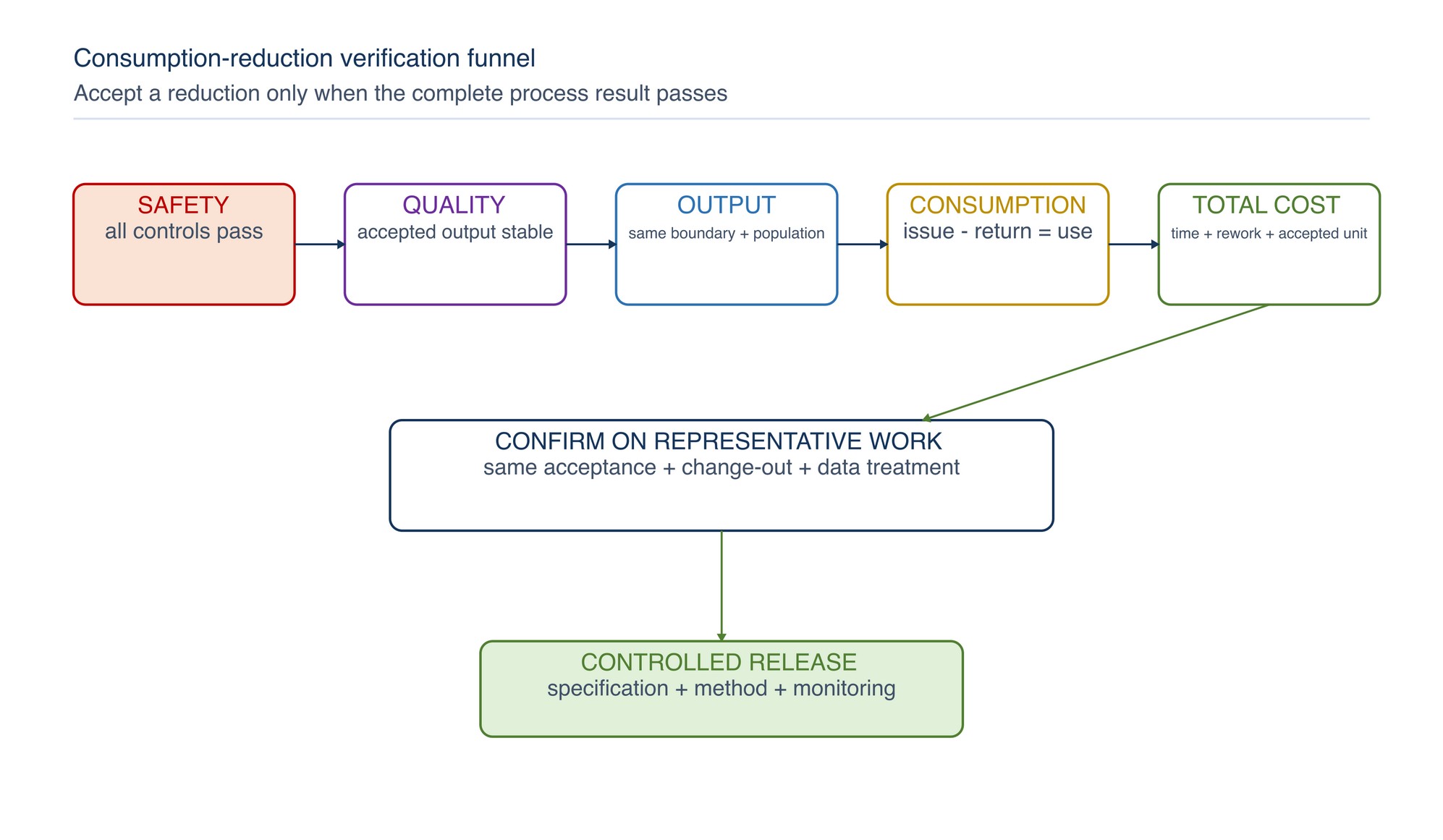
Use Chapter 063’s controlled product-trial method. Compare the baseline and proposed change with the same:
- workpiece population;
- acceptance method;
- machine/accessory configuration;
- process boundary;
- issue and change-out rule; and
- data treatment.
Calculate consumption per accepted unit and cost per accepted component. Confirm the result on representative production before changing the approved specification or work instruction.
Sustain and review
Use a small indicator set:
| Indicator | What it reveals | Review trigger |
|---|---|---|
| Abrasives per accepted unit | Overall use efficiency | Sustained shift from controlled baseline |
| Premature change-out proportion | Method or behaviour loss | Concentration by operator, shift or job |
| Damage before/use during mounting | Handling or configuration loss | Repeat event or common product form |
| Loading/glazing occurrence | Selection or process mismatch | Increase by material or operation |
| Rework and first-pass acceptance | Hidden quality trade-off | Deterioration after use reduction |
| Task time and cost per accepted component | False economy | Labour or total cost rises |
| Unreconciled issue | Stock-control weakness | Material unexplained balance |
Review after changes to product, material, machine, accessory, method, operator mix, storage condition or acceptance requirement.
Practical consumption-reduction checklist
Confirm:
- consumption is normalised to accepted output;
- every issued abrasive has a use, return, damage or disposal status;
- safety and quality gates remain mandatory;
- product and accessory match the complete task;
- machine, workholding and support condition are stable;
- force, contact, travel and dwell are controlled;
- the safe working area is used without prohibited contact;
- the change-out rule is observable and consistent;
- loading, glazing, shedding and damage are diagnosed separately;
- stock is identified, protected and rotated;
- partial products have a controlled status; and
- improvement is verified through representative comparison.
Troubleshooting
| Problem | Likely cause | Improvement |
|---|---|---|
| Disc count falls but task time rises | Product used beyond efficient condition | Review change-out against accepted output and time |
| Operators change at very different conditions | Rule is subjective | Define visible and process-based triggers |
| Wear is concentrated on one edge | Contact, access or support is uneven | Review presentation, pad and workholding |
| Product loads rapidly | Material/residue, pressure, dwell or construction mismatch | Diagnose the complete contact system |
| Product glazes and requires more force | Poor self-renewal or inadequate engagement | Review selection and approved method |
| Belt wears in one narrow track | Work is not distributed across the usable width | Correct tracking and contact pattern |
| Edges tear or chip | Impact, projection or unsupported contact | Stabilise entry, support and workpiece condition |
| New products are discarded as damaged | Receiving, storage or transport is unsuitable | Protect, inspect and segregate stock |
| Store issue exceeds recorded use | Returns and partials are uncontrolled | Introduce status holders and reconciliation |
| Consumption improves but rework increases | Finish or geometry gate was weakened | Restore acceptance control and revalidate |
Safety reminder
Reducing consumption never justifies use beyond a marked limit, damaged condition, safe discard point or designed working surface. Confirm product condition, machine and accessory compatibility, speed relationship, guard, mounting, workholding, extraction and PPE. Stop for abnormal vibration, damage, separation, loss of secure mounting or loss of work control.
Key takeaways
- Measure abrasive use per accepted output.
- Classify loss instead of treating every discard as normal wear.
- Select for cutting efficiency, quality and total cost—not nominal life alone.
- Stabilise the machine, support system, workholding and operator method.
- Use the safe working area fully and apply a common change-out rule.
- Protect inventory and reconcile issue, return, partial and disposal status.
- Verify every reduction through a controlled representative comparison.
Reducing Labour and Rework
Chapter 065 — Reducing Labour and Rework begins on the following page of the printed handbook (page 592), outside this chapter extract.