
Production operators, supervisors, maintenance personnel, process engineers, EHS teams, QA/QC personnel and technical buyers
Industrial cleaners; degreasers; descalers; pickling and passivation products; process baths; rinsing; drying; staining; corrosion; surface attack; contamination; storage; spills; waste and verification.
Never correct a chemical problem by guessing, mixing or adding more product. Confirm identity, hazard, material compatibility and the controlled process condition before changing anything.
The same symptom can have several causes. Poor cleaning may result from the wrong chemistry, exhausted or contaminated solution, inadequate mechanical action, trapped soil, short contact or poor rinsing. Staining may result from residue, water quality, corrosion, incompatible contact or chemical over-attack. Troubleshoot the complete system.
When an exact product value is required, Refer to the product label, Technical Data Sheet, or MKTECH representative.
Chapter objectives
After this chapter, the reader should be able to:
- recognise chemical conditions requiring immediate stop and escalation;
- confirm product identity and current information before use;
- separate soil-removal failure, residue and surface attack;
- diagnose wetting, cleaning, descaling, staining, corrosion and rinse problems;
- prevent incompatible mixing, contamination and trapped chemistry;
- control bath condition only through an approved method; and
- verify the treated surface and downstream readiness.
Immediate stop conditions
Stop the task, isolate the area as directed and activate the site response when there is:
- unknown, unlabelled or incorrectly labelled chemical;
- unexpected heat, gas, pressure, vigorous reaction or colour change;
- fire, smoke, strong unexpected odour or ventilation failure;
- splash, inhalation, skin contact or other suspected exposure;
- leaking, swollen, corroded or unstable container;
- incompatible products mixed or likely to meet;
- chemical entering an unauthorised drain, soil or water pathway;
- rapid metal attack, pitting, embrittlement concern or component damage; or
- loss of process control, monitoring or emergency equipment.
Do not smell, touch or mix an unknown material to identify it. Follow the current Safety Data Sheet and workplace emergency procedure.
Confirm identity before diagnosis
Check:
- full product name and manufacturer;
- batch or lot where applicable;
- current container label;
- Safety Data Sheet and Technical Data Sheet revision;
- intended operation and compatible materials;
- received, opened and expiry information;
- transfer-container identification;
- storage condition and evidence of contamination; and
- approved work method and chemical assessment.
Malaysia’s USECHH framework places chemical identification, assessment and exposure control within the workplace management system. [S009; S017; S160; S198; S288; S303]
Classify the chemical problem
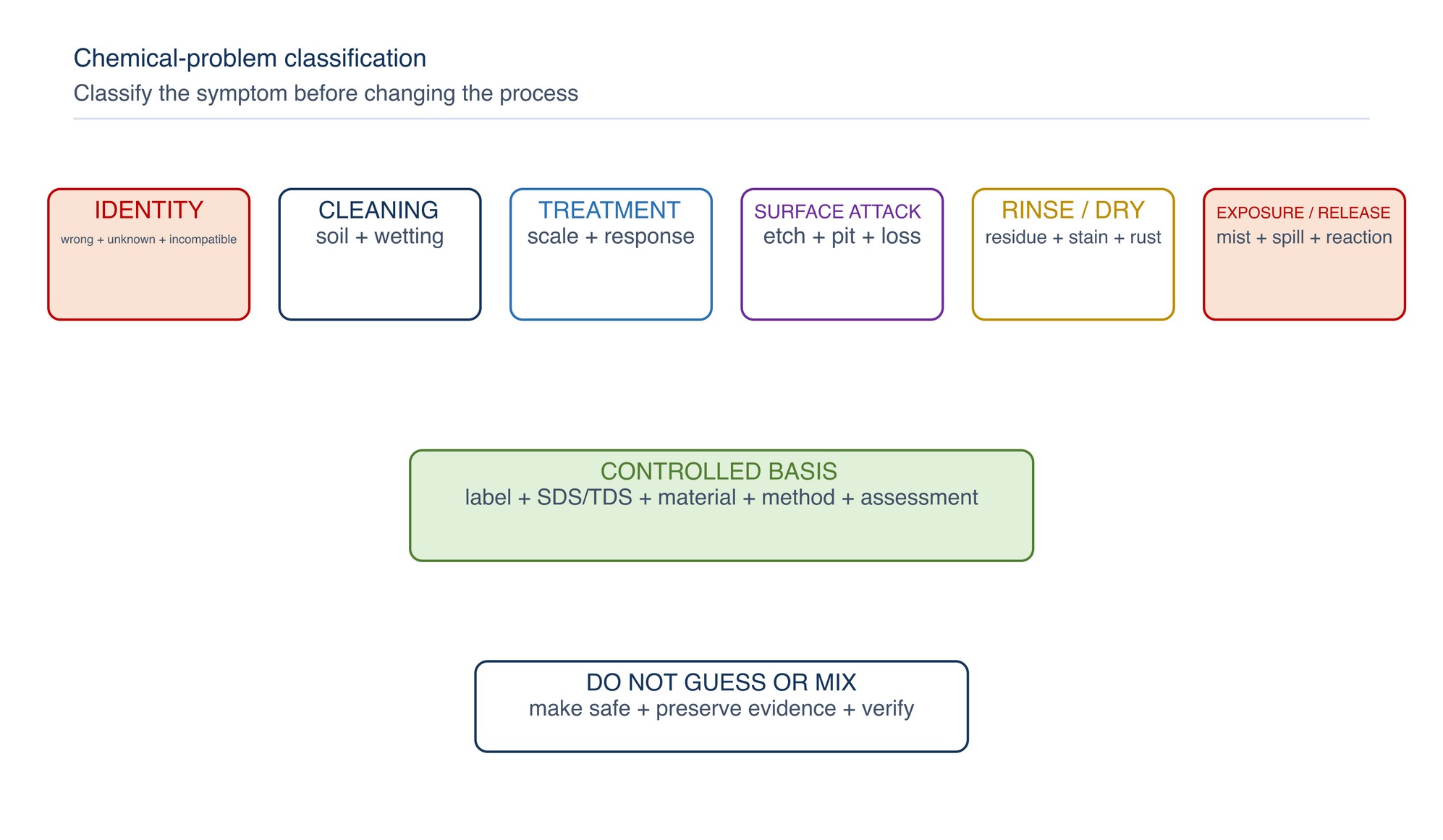
| Problem family | Typical symptom | First checks |
|---|---|---|
| Identity or compatibility | unexpected reaction, coating damage, wrong odour | label, SDS/TDS, material and prior product |
| Cleaning failure | oil remains, water breaks, patchy wetting | soil type, precleaning, solution condition, access |
| Surface-treatment failure | scale remains, uneven colour, poor response | incoming oxide, compatibility, bath control, contact |
| Surface attack | etch, pit, darkening, dimensional change | material, time, temperature, concentration, contamination |
| Rinse or drying | streak, residue, watermark, flash rust | rinse condition, carry-over, drainage, drying delay |
| Exposure or release | mist, splash, leak, drain entry | containment, ventilation, handling, emergency controls |
Use a controlled diagnostic sequence
Proceed in order:
- make the condition safe;
- preserve labels, samples and process records;
- identify the exact symptom and first affected stage;
- confirm material, soil, coating and geometry;
- check product and bath condition;
- check application, equipment, rinse and drying;
- change one controlled factor; and
- verify surface, safety and waste outcomes.
Do not add concentrate, solvent, acid, alkali, oxidiser or neutraliser merely because a result appears weak.
Poor wetting and water-break behaviour
Beading or discontinuous wetting can indicate retained oil, grease, polishing compound, silicone, temporary protection, incompatible residue or a hydrophobic surface condition. It may also reflect contaminated rinse water or handling after cleaning.
Review soil type, precleaning, access to recesses, solution condition, agitation or mechanical action where approved, and clean handling. AMPP solvent-cleaning context distinguishes removal of visible oil and grease from later surface-preparation operations. [S140; S211]
Do not interpret one informal water test as universal proof of cleanliness.
Oil, grease or compound remains
Possible causes include:
- cleaner unsuitable for the actual soil;
- product used outside its controlled condition;
- bath overloaded with removed soil;
- poor access beneath laps, fixtures or heavy deposits;
- insufficient solution movement or contact;
- redeposition during withdrawal;
- contaminated wiping material; and
- soil introduced again during handling.
Remove bulk contamination by an approved method before expecting a fine-cleaning bath to carry excessive soil. Confirm that the cleaner does not damage coatings, seals, plastics or adjacent materials.
Scale, oxide or rust remains
Degreasing and oxide removal are different functions. Oil can shield scale from chemical contact, while a degreaser may leave adherent oxide unchanged. Cleaning, descaling, pickling and passivation have distinct purposes in stainless-steel standards and recognised industry guidance. [S212–S213; S217; S221–S223]
Check incoming oxide thickness and type, precleaning, alloy compatibility, solution condition, access and process control. Do not extend treatment indefinitely; persistent oxide may require a different approved preparation route.
Uneven cleaning or patchy reaction
Patchiness can follow uneven soil, trapped air, poor immersion, contact with fixtures, local heat, bath stratification, inadequate circulation, mixed materials, previous repair, weld heat tint or inconsistent rinsing.
Map the pattern against component orientation and flow. A line at the liquid level suggests a different cause from a patch under a clamp. Repositioning or agitation must follow the controlled method and must not create splash or exposure.
Staining, darkening and unexpected colour
Possible causes include:
- reaction products not rinsed away;
- excessive chemical exposure;
- contaminated bath or rinse;
- incompatible alloy or mixed-metal contact;
- drying marks or mineral residue;
- flash corrosion;
- heat tint that was not fully removed; and
- residue from a prior process.
Do not polish or chemically treat away the evidence before determining whether the colour is residue, corrosion, oxide or base-metal attack.
Over-etching, pitting and dimensional loss
Rapid dulling, roughness, grain-boundary appearance, pitting or measurable stock loss indicates that the chemistry may be attacking the base material. Stop treatment and rinse or contain only according to the approved emergency or process method.
Review material identity, bath condition, contact duration, temperature, contamination and mixed-metal effects. ASTM cleaning and passivation standards provide material-specific frameworks rather than one universal treatment. [S212–S213]
Do not release a visibly restored component until geometry and surface integrity are assessed.
Hydrogen and material-integrity concerns
Some acidic cleaning or pickling conditions can introduce hydrogen-related risk in susceptible high-strength materials, coatings or components. The actual risk depends on material, strength, stress, chemistry and process history.
Stop and refer the component for competent materials review when the approved process controls were exceeded, the material is uncertain or cracking is suspected. This handbook does not assign a safe material strength, exposure time or post-treatment condition.
Foam, carry-over and solution drag-out
Unexpected foam may arise from soil loading, contamination, agitation, incompatible additions, temperature change or product degradation. Carry-over increases chemical loss, contaminates rinse stages and can create residue on parts and floors.
Check bath level, workpiece drainage, basket geometry, withdrawal practice, solution condition and contamination source. Do not add an unapproved defoamer because it may affect cleaning, coating or waste treatment.
Bath strength or condition appears unstable
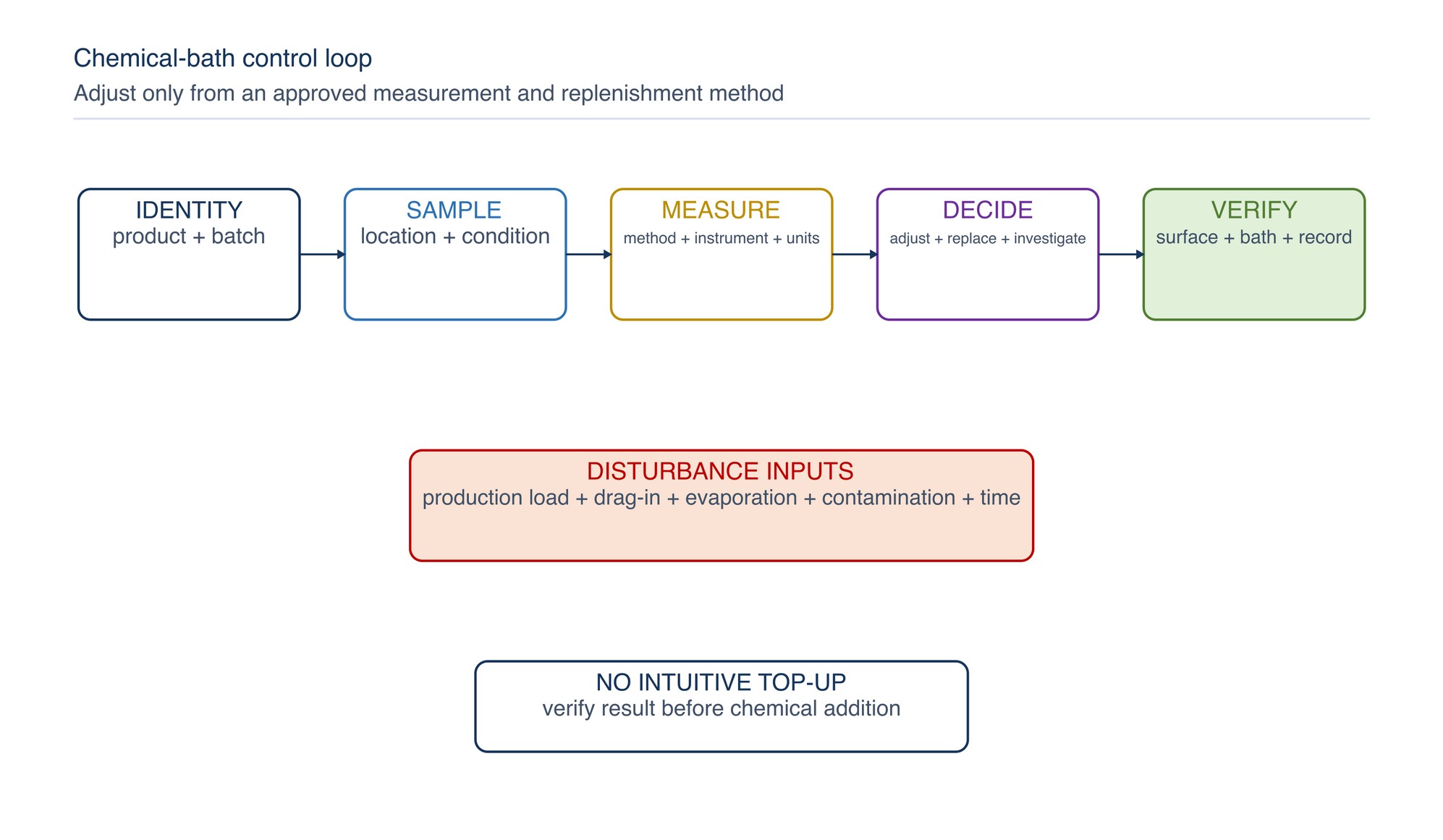
Use only the specified sampling and analysis method. Verify instrument condition, sample location, temperature compensation where required, calculation, units and record traceability. A reading that differs suddenly may reflect sampling or measurement error rather than actual bath change.
Never top up by intuition. Confirm whether the result calls for adjustment, partial replacement, full replacement, filtration or investigation under the approved process.
Contamination and incompatible mixing
Cross-contamination can come from shared pumps, hoses, funnels, tanks, baskets, wipes, recycled containers or drag-in from the previous stage. Even small additions can change pH, reaction, foam, precipitation or material attack.
Dedicate and identify transfer equipment where required. Keep container closures clean and closed. Never return unused chemical to the original container unless the product instructions explicitly permit it.
If incompatible mixing is suspected, stop and use the site chemical-emergency system. Do not attempt improvised neutralisation.
Rinse failure and residue
Rinsing removes process chemistry and dissolved contamination from the surface. Problems include exhausted rinse, insufficient stages, poor flow into recesses, trapped solution, contaminated spray nozzles, mixed carry-over, inadequate drainage and recontamination.
Inspect crevices, threads, tubes, blind holes and horizontal pockets. Verify rinse quality only by the approved method. Do not assign one universal conductivity, pH or rinse-water specification.
Flash rust and corrosion after cleaning
Freshly cleaned metal may corrode rapidly if water, chloride, acidic residue, high humidity or drying delay remains. Possible causes include inadequate rinse, contaminated water, trapped solution, unsuitable drying air, bare reactive metal or contact with contaminated tools.
Identify whether the stain is flash rust, ferrous transfer, process residue or underlying corrosion. Correct rinse, drainage, handling and environmental cause before repeating treatment.
Drying marks and trapped chemistry
Watermarks and streaks can form when droplets dry unevenly or dissolved material remains. Trapped chemistry in seams, hollow sections, threads or porous deposits can leak later and attack the surface or downstream coating.
Design the handling orientation to drain safely, use the approved drying method and inspect inaccessible features. Do not seal, paint or pack a component while retained chemistry is suspected.
Ventilation, splash and PPE problems
Mist, vapour and splash controls depend on chemical hazard, task, temperature, application and quantity. Check enclosure, local exhaust, covers, transfer method, splash shields, emergency washing facilities and work posture.
Chemical glove and clothing selection requires documented compatibility; one material does not protect against every chemical. Malaysian guidance places PPE after higher-level controls and requires suitable selection, use and maintenance. [S288–S289] ISO 374-1 provides current chemical-glove performance terminology. [S297]
Storage, transfer and container problems
Inspect for:
- incompatible chemicals sharing containment;
- damaged, corroded or swollen containers;
- missing labels or open transfer vessels;
- unsuitable pumps, hoses or seals;
- heat, sunlight or moisture exposure;
- stock beyond controlled shelf condition;
- blocked access to spill equipment; and
- leakage paths toward drains or occupied areas.
Malaysian and international guidance emphasises hazard-led segregation, containment, inspection, stock control and emergency readiness. [S224–S228]
Spill, exposure or abnormal-reaction response
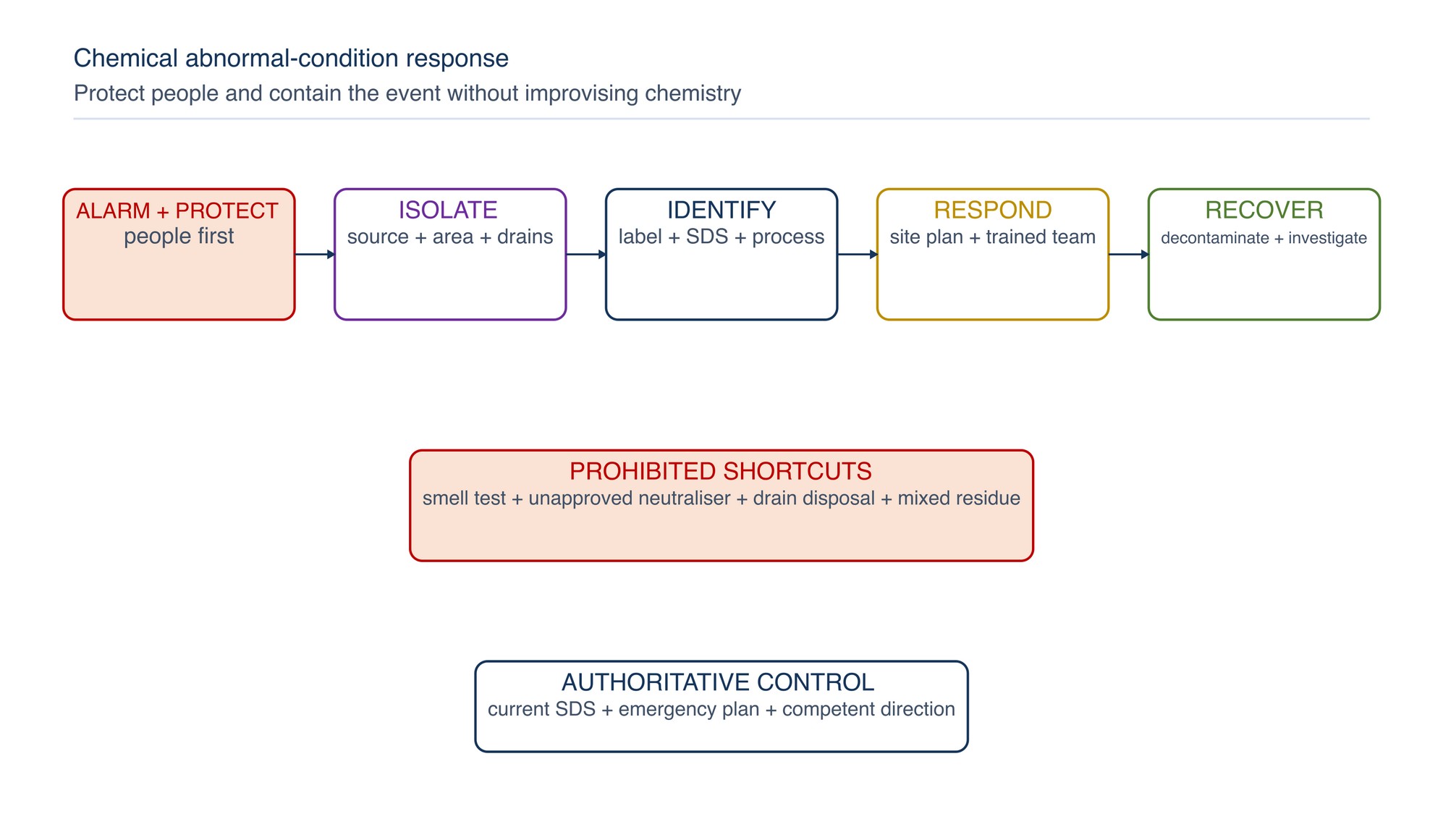
The first priorities are people, alarm, isolation and prevention of spread. Use the current SDS and site plan for first aid, evacuation, compatible spill materials, ventilation, reporting and cleanup. Keep untrained personnel away.
Do not hose chemicals to a drain, combine spill residues or use a neutraliser without an approved procedure.
Manage spent chemistry and contaminated waste
Spent baths, rinse residue, sludge, absorbent, wipes, PPE and containers may require different classification. Determine waste status from the actual chemical, contamination and generating process.
Department of Environment Malaysia guidance controls scheduled-waste classification, packaging, labelling and storage. [S216] Do not assign a waste code solely from the trade name or this handbook.
Verify correction and release
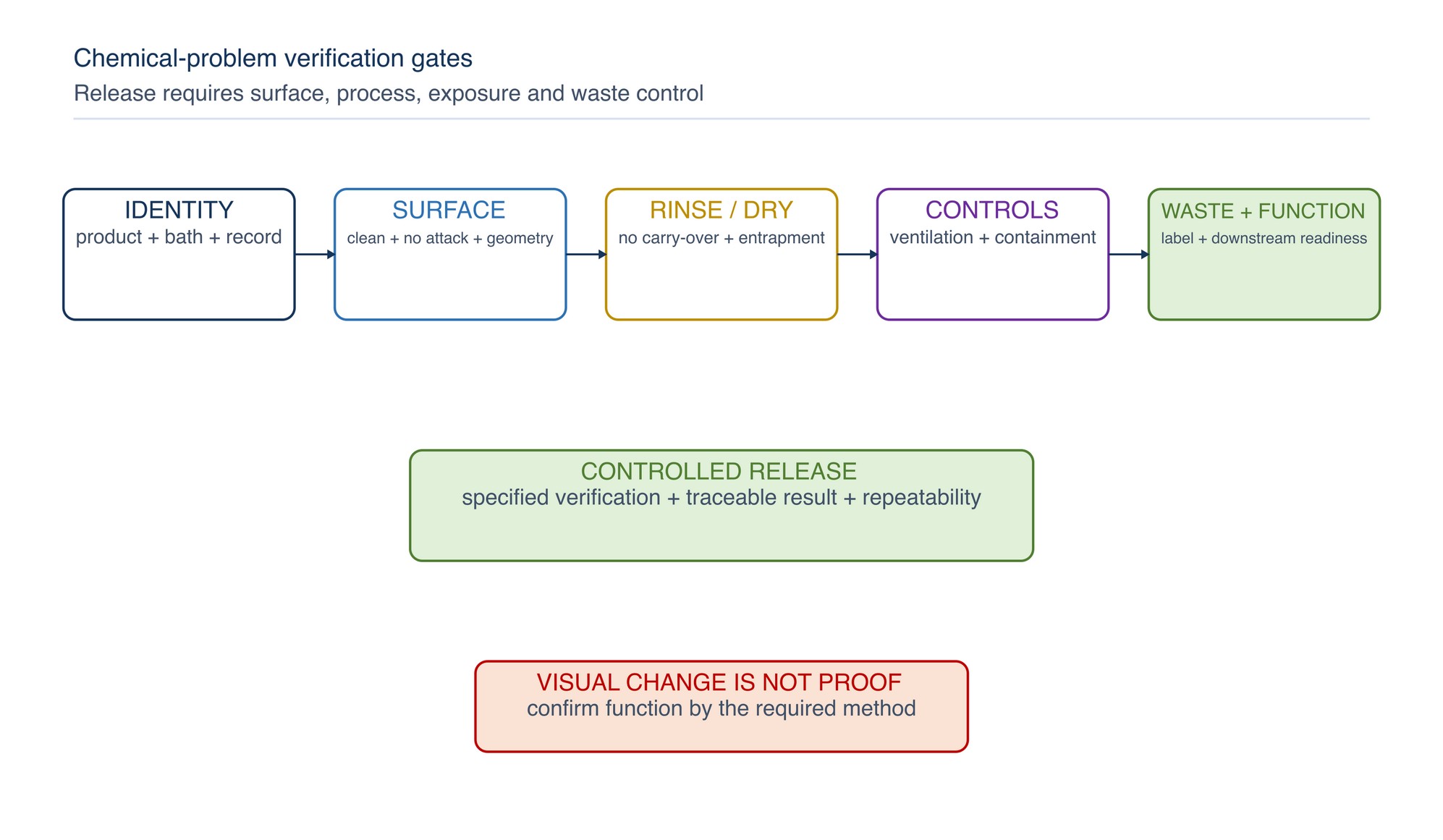
Verify as applicable:
- correct chemical identity and controlled bath condition;
- required soil, oxide or contamination removal;
- no unacceptable etch, pit, stain, residue or dimensional change;
- specified cleanliness or passivation verification;
- complete rinse, drainage and drying;
- coating, bonding, sealing or service compatibility;
- restored ventilation, containment and emergency controls; and
- labelled waste containment and traceable records.
Visual improvement alone does not prove passivation, corrosion resistance or absence of chemical damage.
Rapid troubleshooting table
| Symptom | Likely cause families | Controlled response |
|---|---|---|
| Oil remains | wrong cleaner, overload, access, redeposition | confirm soil and process; restore controlled cleaning condition |
| Scale remains | incomplete degreasing, wrong function, depleted bath | separate soil and oxide removal; verify approved treatment |
| Patchy reaction | air trap, fixture, flow, mixed surface, contamination | map pattern and correct contact or bath cause |
| Dark stain | residue, overexposure, rinse, corrosion | preserve evidence and distinguish deposit from attack |
| Pitting or roughening | incompatibility, excessive condition, contamination | stop, rinse/contain as directed and assess material integrity |
| Excessive foam | soil, contamination, agitation, incompatible addition | stop unapproved additions and investigate bath condition |
| Residue after rinse | carry-over, trapped chemistry, exhausted rinse | restore rinse and drainage control before drying |
| Flash rust | retained water, chloride, acidic residue, drying delay | correct rinse, handling and environmental cause |
| Strong unexpected odour | reaction, ventilation failure, wrong product | stop, isolate and activate chemical response |
| Bath reading changes suddenly | sampling, instrument, unit or actual bath change | verify measurement system before adjustment |
Concise safety reminders
- Read the current label, SDS, TDS and workplace method before use.
- Never mix products or improvise dilution, neutralisation or top-up.
- Add and transfer chemicals only by the specified method and equipment.
- Keep incompatible groups segregated with compatible containment.
- Maintain ventilation, splash control and emergency washing facilities.
- Use documented chemical-compatible PPE and change it when damaged or contaminated.
- Keep food, drink, smoking and ignition sources out of controlled chemical areas.
- Report exposure, spill, unexpected reaction and loss of containment immediately.
Key takeaways
- Confirm chemical identity before diagnosing performance.
- Separate cleaning failure, surface attack, residue and corrosion.
- Never adjust a bath from appearance or intuition alone.
- Control cross-contamination at every transfer and process stage.
- Rinsing, drainage and drying are part of the chemical process.
- Stop for unexpected reaction, exposure or material attack.
- Verify surface, safety, downstream function and waste control before release.