
Production engineers, supervisors, operators, QA/QC personnel, maintenance teams, safety personnel, procurement staff and technical sales personnel
Aluminium oxide, zirconia alumina, ceramic alumina, silicon carbide, diamond, cubic boron nitride and abrasive-grain blends. This chapter explains selection logic but does not approve an MKTECH SKU, universal pressure range, speed, removal rate, service life or cost-per-part claim.
Verify the complete abrasive product, work material, operation, machine, mounting, guard, dimensions, maximum operating speed and current manufacturer instructions before use. Grain name alone never authorises an application. Stop for an unknown product, damaged abrasive, missing marking, incompatible machine or unverified material. [S032; S033]
Chapter objectives
After this chapter, the reader should be able to:
- distinguish hardness, toughness, friability and controlled edge renewal;
- compare the principal conventional and superabrasive grain families;
- explain why a grain that performs well at one load may rub or break down at another;
- separate grain behaviour from bond, backing, coating and product geometry;
- use material family, removal duty, finish and heat sensitivity to shortlist a grain system;
- interpret relative purchase cost without confusing it with total process cost; and
- define a controlled trial before releasing a product recommendation.
Grain name is a starting point, not a specification
Abrasive grains are hard cutting particles, but a working abrasive is a system. In a bonded wheel, grain is retained by a bond and separated by pores. In a coated product, grains are fixed to a backing by adhesive layers; a grinding aid or top coating may modify heat, loading or chip behaviour. Superabrasive grains can be held in resin, vitrified or metal bonds, or plated to a metal body. [S029; S033; S037]
The same nominal grain family can therefore produce different results when crystal size, grain shape, grit size, concentration, orientation, bond, spacing, backing, coating or product geometry changes. Machine power, surface speed, contact area, work material and motion then determine how the system is loaded.
Do not convert a grain description into a production instruction. “Ceramic,” for example, does not define one construction or one pressure. “Diamond” does not mean suitable for every hard material. A product code and current technical data are required.
Four behaviours to compare
Hardness
Hardness is resistance to indentation or scratching. A grain must be hard enough to penetrate the work, but hardness alone does not predict useful life. A very hard grain can still fracture in an unsuitable way, be pulled from its support, load with work material or react chemically at the grinding interface.
Toughness
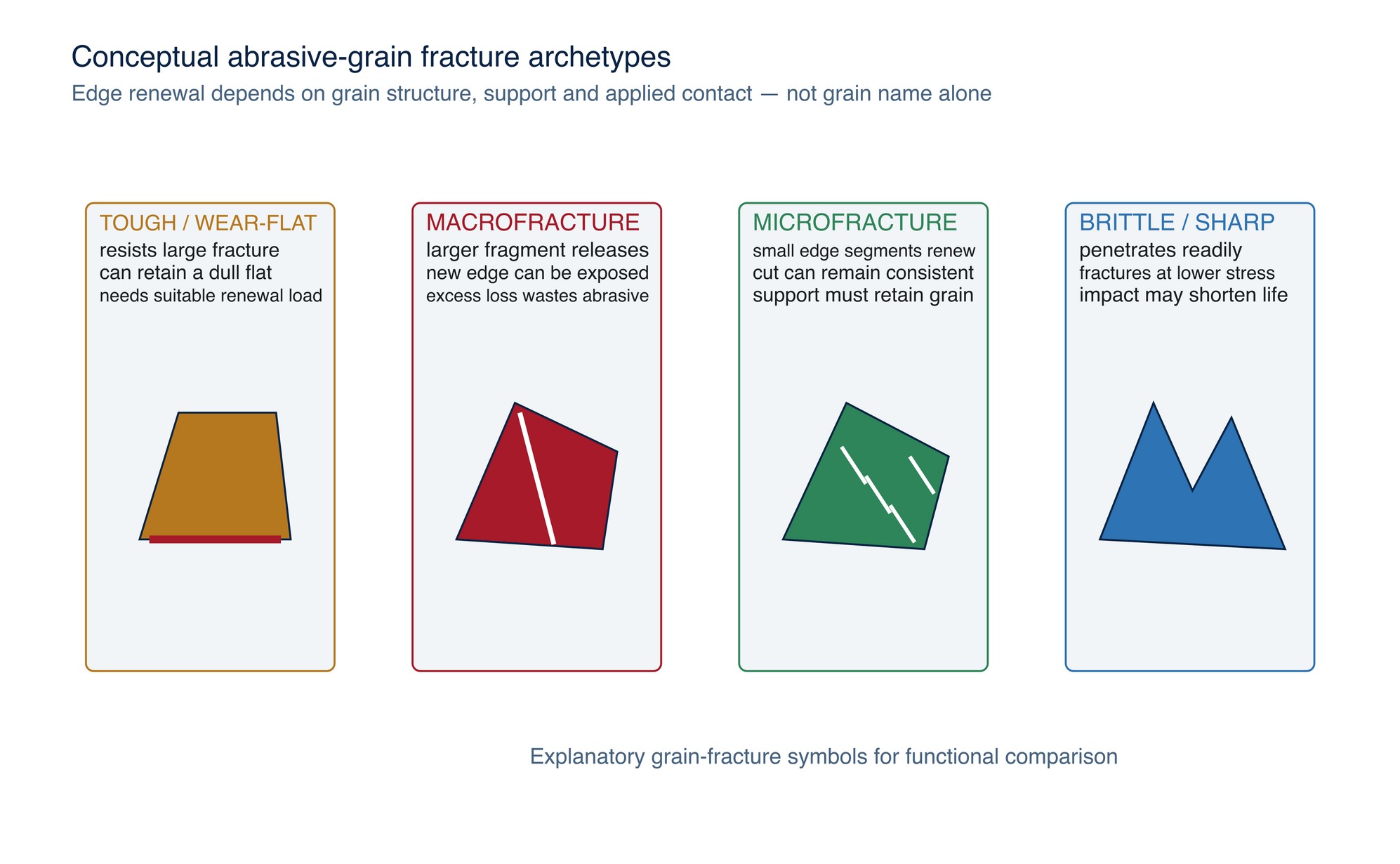
Toughness is resistance to fracture. Tough grains tolerate impact and severe contact, which can benefit heavy stock removal. If the load is too light to renew their edges, however, they can wear flat and rub. Toughness is therefore useful only when matched to the product construction and load.
Friability and fracture scale
Friability describes how readily a grain fractures. A friable grain can expose new edges at lower stress, helping on hard or heat-sensitive work. Excessive or large-scale fracture wastes abrasive and can destabilise the finish. Controlled microfracture renews smaller edges; macrofracture removes larger parts of a grain. Real grains do not occupy one fixed point on this spectrum.
Heat behaviour
“Cool cutting” is a system result, not an intrinsic temperature guarantee. Sharp grains can reduce rubbing, but heat also depends on contact, speed, chip clearance, loading, grinding aid, dwell, material and removal demand. Temperature must be verified on the real process.
Aluminium oxide
Grain structure and fracture behaviour. Fused aluminium oxide is manufactured in multiple purities and variants. Conventional forms are generally tough enough for broad metalworking use, while more friable alumina variants are available for harder steels and different contact conditions. The name “aluminium oxide” therefore covers a family, not one fracture response. [S029; S034]
Cut and heat behaviour. It provides a balanced general-purpose cut. When the selected construction renews properly, it can support predictable grinding and finishing. When dull grains remain in contact or the product loads, rubbing and heat rise.
Suitable materials and qualitative load demand. Common starting applications include carbon and alloy steels, stainless steel, tool steel and other relatively high-tensile materials. Product forms span lower-load finishing to moderate or heavy removal; the grain name alone does not fix the load range.
Applications, limitations, cost and expected performance. Typical uses include general fabrication, weld blending, deburring, dimensioning and surface finishing. Its principal strengths are availability, versatility and relatively low purchase cost. Limitations include lower potential cut persistence than some engineered zirconia or ceramic systems in severe or high-productivity duty. Expected performance is dependable when the product is matched and kept cutting, not premium performance in every application.
Zirconia alumina
Grain structure and fracture behaviour. Zirconia alumina is a fused alumina–zirconia abrasive with a fine internal structure. Manufacturer evidence describes a tough grain able to enter the cut and renew by controlled microfracture when stress becomes sufficient. [S035]
Cut and heat behaviour. Its toughness and edge renewal suit aggressive removal. A suitable zirconia system can maintain a strong cut and resist premature grain loss. At insufficient load, a tough grain may not renew efficiently; added force is not an automatic correction because contact and product construction may be wrong.
Suitable materials and qualitative load demand. Common starting points include carbon steel, alloy steel and stainless steel, with some products formulated for nonferrous, titanium or nickel-alloy work. It is generally associated with moderate-to-higher load and stock-removal duty, although manufacturer-specific products can be designed for lower-load work. [S034 –S036]
Applications, limitations, cost and expected performance. Weld grinding, edge preparation, heavy blending and robust belt or disc work are common. Relative purchase cost is normally above conventional aluminium oxide and below many premium ceramic or superabrasive systems. Expected benefits are good stock removal, toughness and usable life in demanding contact. Limitations are weak renewal under the wrong load, possible loading on unsuitable materials and the need for a backing and bond strong enough to exploit the grain.
Ceramic alumina
Grain structure and fracture behaviour. Ceramic alumina is a microcrystalline form of aluminium oxide engineered for controlled small-scale fracture. Manufacturer guidance describes a hard, sharp grain whose microcrystalline structure renews cutting edges. [S034]
Cut and heat behaviour. Sustained sharpness can reduce rubbing and support a cooler cutting response than a dull conventional system. This is conditional: a ceramic product can still overheat a workpiece if it is loaded, misapplied, dwelled, over-forced or used outside its intended speed and contact.
Suitable materials and qualitative load demand. Common applications include hardened steels, stainless steels, tool steels, nickel-based alloys and other difficult-to-grind metals. Ceramic products may be engineered for moderate or high load; some shaped-grain and blend constructions are designed to cut at lower force. Only the specific product data can establish the intended range.
Applications, limitations, cost and expected performance. Typical uses include high-productivity weld removal, precision grinding and difficult-alloy work. Relative purchase cost is high among conventional abrasives, but productive life and cycle time may change total cost. Expected performance is a persistent cut and controlled renewal when the system is correctly loaded. Limitations include higher initial price, potential premature breakdown or finish change if mismatched, and wide variation among “ceramic” products.
Silicon carbide
Grain structure and fracture behaviour. Silicon carbide is harder and generally sharper but more brittle than conventional aluminium oxide. It fractures readily, exposing edges but potentially consuming grain quickly under impact or severe steel-grinding duty. [S029; S034]
Cut and heat behaviour. Its sharp penetration can suit materials that resist cutting by conventional alumina or that tend to smear. The same brittleness that assists renewal can shorten life in heavy, interrupted or high-impact contact.
Suitable materials and qualitative load demand. Common starting applications include aluminium and other nonferrous metals, cast iron, glass, stone, ceramics, some composites and cemented carbide. The required load is often lower-to-moderate for brittle or heat-sensitive work, but bonded products for carbide and mineral processing follow their own manufacturer-defined conditions.
Applications, limitations, cost and expected performance. Deburring nonferrous castings, grinding cast iron, finishing mineral or ceramic materials and working cemented carbide are typical examples. Relative purchase cost is generally low-to-moderate. Expected performance is a sharp, free-cutting action on compatible material. Limitations include brittle breakdown in severe duty, possible loading without suitable product structure and poor general suitability for heavy steel removal compared with tougher alumina systems.
Diamond
Grain structure and fracture behaviour. Diamond is the hardest common abrasive grain. Synthetic diamond is produced in grades with different crystal shape, strength and friability. Its hardness and wear resistance can provide long life on compatible hard, brittle or abrasive materials.
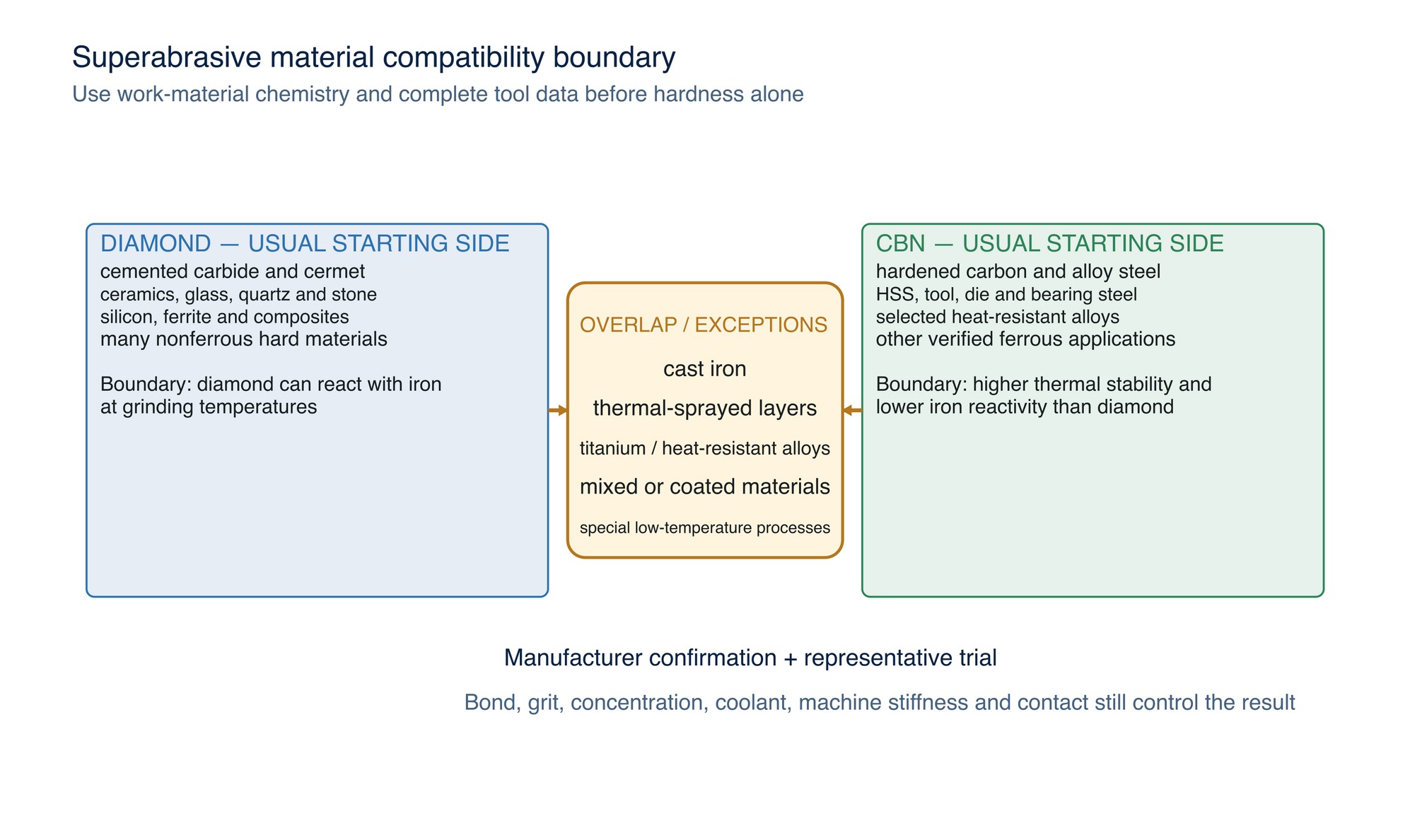
Cut and heat behaviour. Diamond conducts heat well, but the complete wheel or tool governs heat removal. At grinding temperatures diamond can react with iron; specialist manufacturer guidance therefore treats it as generally unsuitable for iron-based materials and uses CBN for many ferrous applications. [S037]
Suitable materials and qualitative load demand. Typical material families include cemented carbide, ceramics, glass, quartz, stone, ferrite, silicon, composites and other nonferrous or nonmetallic hard materials. Load may range from controlled precision contact to robust cutting, entirely dependent on bond, grain concentration, grit and tool design.
Applications, limitations, cost and expected performance. Carbide-tool grinding, ceramic and glass processing, composite trimming and precision nonferrous work are common. Purchase cost is very high relative to conventional grain, but long life, accuracy or reduced dressing may justify it. Limitations include iron reactivity, bond-specific dressing and cooling needs, sensitivity to impact in some constructions and the need for specialist machine capability.
Cubic boron nitride
Grain structure and fracture behaviour. Cubic boron nitride, or CBN, is a synthetic superabrasive with hardness second to diamond. Available grain grades and bond systems vary in toughness, friability, heat transfer, retention and dressability. [S037]
Cut and heat behaviour. CBN has higher thermal stability than diamond and is less reactive with iron. Those characteristics support sustained precision grinding of many hardened ferrous materials. The work can still burn if wheel specification, coolant, dressing, contact or process energy is wrong.
Suitable materials and qualitative load demand. Common starting applications include hardened carbon and alloy steels, high-speed steel, tool and die steel, bearing steel and selected heat-resistant alloys. ASSAB specifically identifies CBN for hardened high-carbide tool steel and high-speed steel. [S038] Load varies greatly by resin, vitrified, metal or plated construction.
Applications, limitations, cost and expected performance. Precision external, internal, surface and form grinding of hardened ferrous components are common. Purchase cost is very high, often above diamond according to specialist guidance, while wear resistance and shape retention can improve process economics. [S037] Limitations include high capital and dressing requirements, dependence on machine stiffness and coolant strategy, and poor justification where a conventional abrasive already meets cost and quality requirements.
Abrasive-grain blends
A blend combines grain families or grain variants to balance cutting, edge renewal, toughness, finish and cost. Examples include ceramic alumina with zirconia alumina, or zirconia alumina with conventional aluminium oxide. Manufacturer selection guides show that blend composition is tailored to product form, work material and operation; it is not a generic recipe. [S036]
One grain may provide durable stock removal while another renews at lower stress or moderates cost. Yet the blend percentage alone cannot predict the result. Grain placement, grit mix, bond, backing and grinding aid can matter as much as the names on the label.
Treat a blend as its own product specification. Do not infer that a 50/50 verbal description exists, that both grains act independently, or that a blend will outperform either constituent in every test.
Controlled comparison
| Grain family | General behaviour | Common starting material families | Qualitative load demand | Relative purchase cost | Main limitation |
|---|---|---|---|---|---|
| Aluminium oxide | Balanced toughness and cut; many variants | Steels, stainless, tool steel; selected alloys | Low to high, product-dependent | Low | Broad name hides major construction differences |
| Zirconia alumina | Tough, stress-assisted microfracture | Steels, stainless; selected alloys | Usually moderate to high | Medium | Can rub if the product is under-loaded |
| Ceramic alumina | Microcrystalline controlled renewal | Hardened steels, stainless, difficult alloys | Moderate to high; some low-force designs | High | Premium grain still depends on full product design |
| Silicon carbide | Very hard, sharp and relatively brittle | Nonferrous metals, cast iron, glass, stone, carbide | Usually low to moderate | Low–medium | Rapid breakdown in severe or impact-heavy steel duty |
| Diamond | Extreme hardness and wear resistance | Carbide, ceramics, glass, stone, composites, nonferrous | Product-dependent | Very high | Generally unsuitable for iron-based grinding at heat |
| CBN | Superhard, thermally stable, iron-compatible | Hardened ferrous steels and selected heat-resistant alloys | Product-dependent | Very high | Specialist machine, bond, dressing and economics |
| Blend | Tuned compromise among renewal, toughness and cost | Defined by the complete product | Product-dependent | Medium–high | Blend name or percentage does not prove performance |
“Low,” “moderate” and “high” are comparison words, not force values. Actual force depends on product construction, machine, contact patch, material, condition and manufacturer data.
Grain-selection workflow
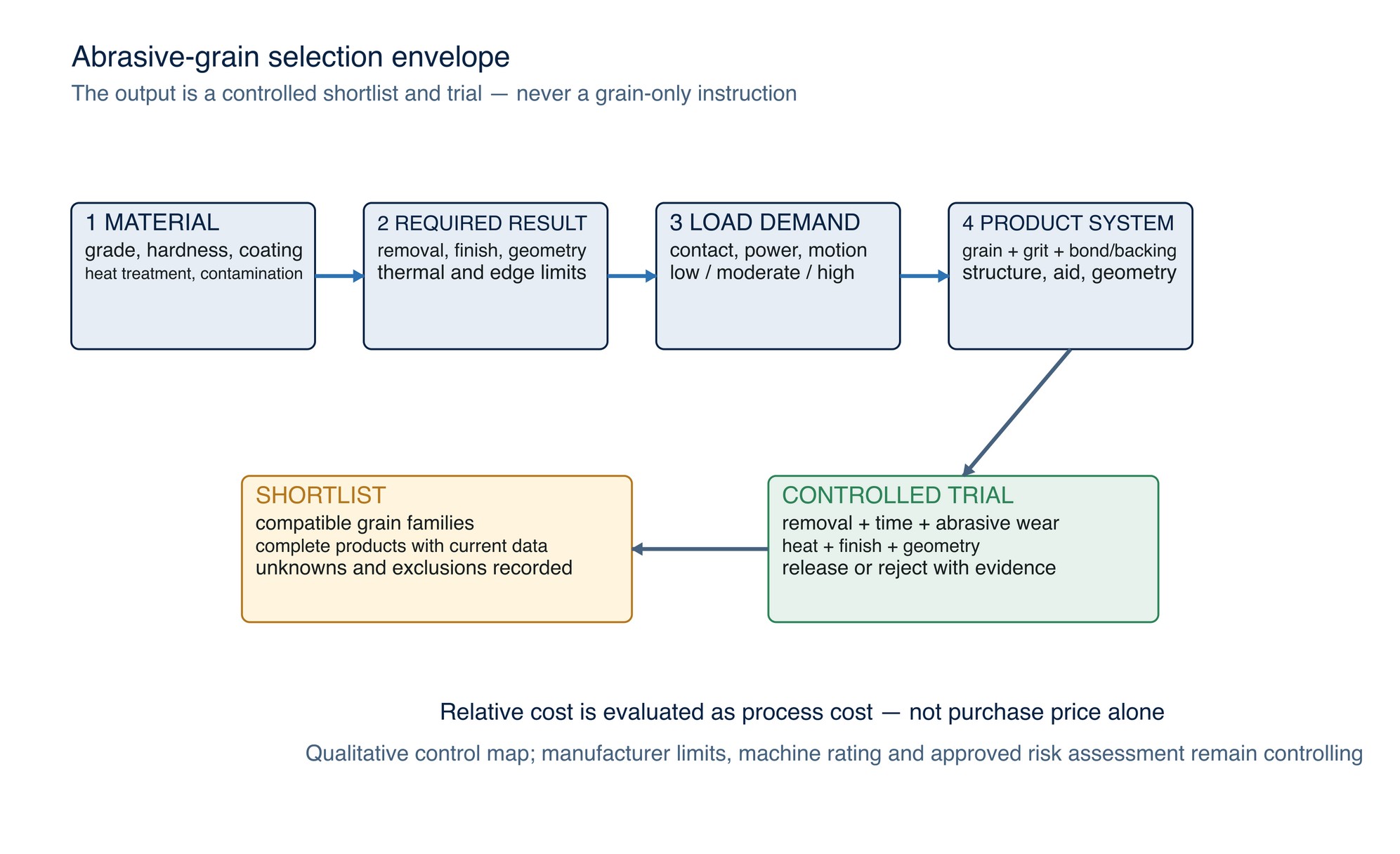
- Verify work-material grade, hardness, coating, heat treatment, geometry and contamination constraints.
- Define the operation: removal, blending, dimensioning, scratch refinement or precision generation.
- Define the required surface, dimensional tolerance, thermal limit and allowable edge change.
- Identify machine type, power, speed range, guarding, mounting, contact area, wet/dry duty and extraction.
- Shortlist grain families using material compatibility and the expected fracture/load behaviour.
- Obtain the complete product specification and current manufacturer application data.
- Reject any product whose identity, rating, mounting or intended operation cannot be verified.
- Trial on representative material, recording removal, time, force method, temperature, wear, surface and geometry.
- Compare total process cost, including abrasive use, labour, dressing, rework, downtime and disposal—not purchase price alone.
- Release only after technical, safety, quality and MKTECH approval, with stop and replacement criteria.
Applying grain selection in practice
Use grain family as one part of the selection. The backing or wheel structure, bond, coating, grit distribution, product shape and machine interface can change how the same grain family behaves. Confirm that the exact product is declared for the work material and operation.
For difficult-to-grind alloys, hardened materials or heat-sensitive components, compare cutting stability, loading, heat, edge retention and finish on representative work. Do not assume that products with the same grain name are interchangeable.
Refer to the product label, Technical Data Sheet, or MKTECH representative.
Grit Size and Scratch Depth
The grit-size and scratch-depth content appears on the following page of the printed handbook (page 52), outside this chapter extract.